Why it is written this way
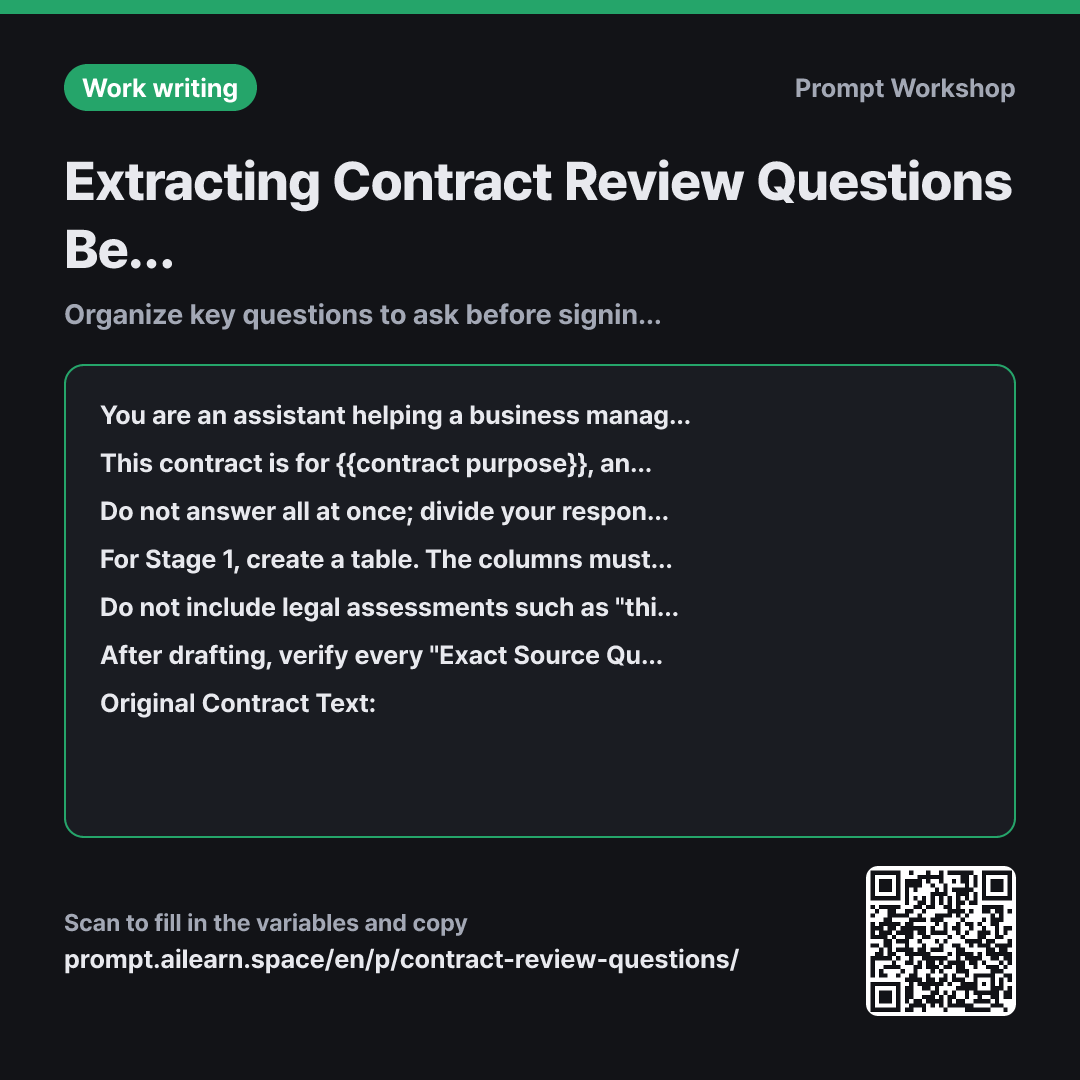
When you paste a contract into an AI and ask "Is this okay?", two problems occur immediately: first, the answer sounds like formal legal advice, and second, you cannot verify the basis for its claims. That is why this contract review prompt sets explicit boundaries in the first paragraph's role: do not make legal judgments; simply organize the clauses and generate questions.
Splitting the workflow into two stages in the third paragraph is structured intentionally because execution order determines the quality of output. Extracting the clauses into a table first grounds the subsequent questions in the actual text. In contrast, asking for questions first leads to generic legal platitudes. When preparing review notes, laying out the source text first is always the safer approach.
The fifth paragraph instructs the model to turn judgments into questions. Instead of "60-day payment terms are unfavorable," it produces "Payment is net 60; check if this aligns with our cash flow schedule or if we can negotiate net 30." The former is an unreliable conclusion; the latter is an immediate, actionable task. The "Missing from Document" section exists because the biggest risks in agreements often stem from omitted protections rather than written ones.
The cross-check in the sixth paragraph acts as a self-verification safeguard. Because legal agreements contain numerous clause numbers, AIs frequently hallucinate non-existent sections. Forcing the model to discard rows lacking direct quotes mitigates this significantly. Wrapping the contract in """ prevents contractual language (e.g., "Party A shall notify Party B") from being misinterpreted as instructions to the AI.
Unfamiliar terms? See Aha AI: prompt-injection, hallucination
Compared with a bad example
Review this contract and let me know if there are any problematic clauses.
(Pastes contract)
This prompt returns generic claims such as "Clause 9 is one-sidedly favorable to Party A and needs revision." While plausible-sounding, you cannot tell which specific sentences informed that conclusion, and it may cite non-existent section numbers. Walking into a negotiation armed with this response leaves you unable to cite exact wording, while critical missing protections remain completely overlooked.
Variations
Checking for missing standard clauses
Below is an agreement for {{contract purpose}}. Our position is {{our position stance}}. Based on standard terms typically included in this type of agreement (Payment Terms, Term & Duration, Inspection/Acceptance, Intellectual Property, Confidentiality, Termination, Indemnification, Dispute Resolution), create a table showing whether each term is present or absent in this document. If present, list the Clause Number and a one-sentence Source Quote; if absent, mark it as "Missing from Document" and provide one question to ask the counterparty regarding its omission. Do not include legal judgments on fairness.
""" {{original contract text}} """
Specialized for detecting omitted provisions. By providing a predefined checklist of standard clauses, the AI stays strictly focused on matching against the provided text.
Preparing a one-page meeting question sheet
Review the contract below and create a question sheet for our upcoming meeting with the counterparty. Limit the list to at most 8 questions, ranked in order of priority. Under each question, add "Relevant Clause: (Number and one-sentence quote)" and "Escalate to Internal Review if Counterparty Responds: (One sentence)". Do not generate questions for clauses that do not exist in the text; compile those separately under "Unverified Items".
""" {{original contract text}} """
Replaces the table with an actionable checklist ready for use in negotiations. Pre-defining trigger criteria for internal escalation prevents on-the-spot guesswork during meetings.
Model notes
Attach or paste your contract text directly. This prompt only organizes clauses and prepares clarification questions. Final legal risk assessments and decisions must be validated by in-house legal counsel or qualified legal counsel.
For lengthy agreements, language models may map the initial clauses into the table and prematurely summarize or skip the latter half. For maximum accuracy, split the request by clause ranges (e.g., "Process Sections 1 through 10 only") across multiple turns, then merge the tables at the end.
Related prompts
Last updated 2026-09-02 · Found a mistake? Let us know