Why it is written this way
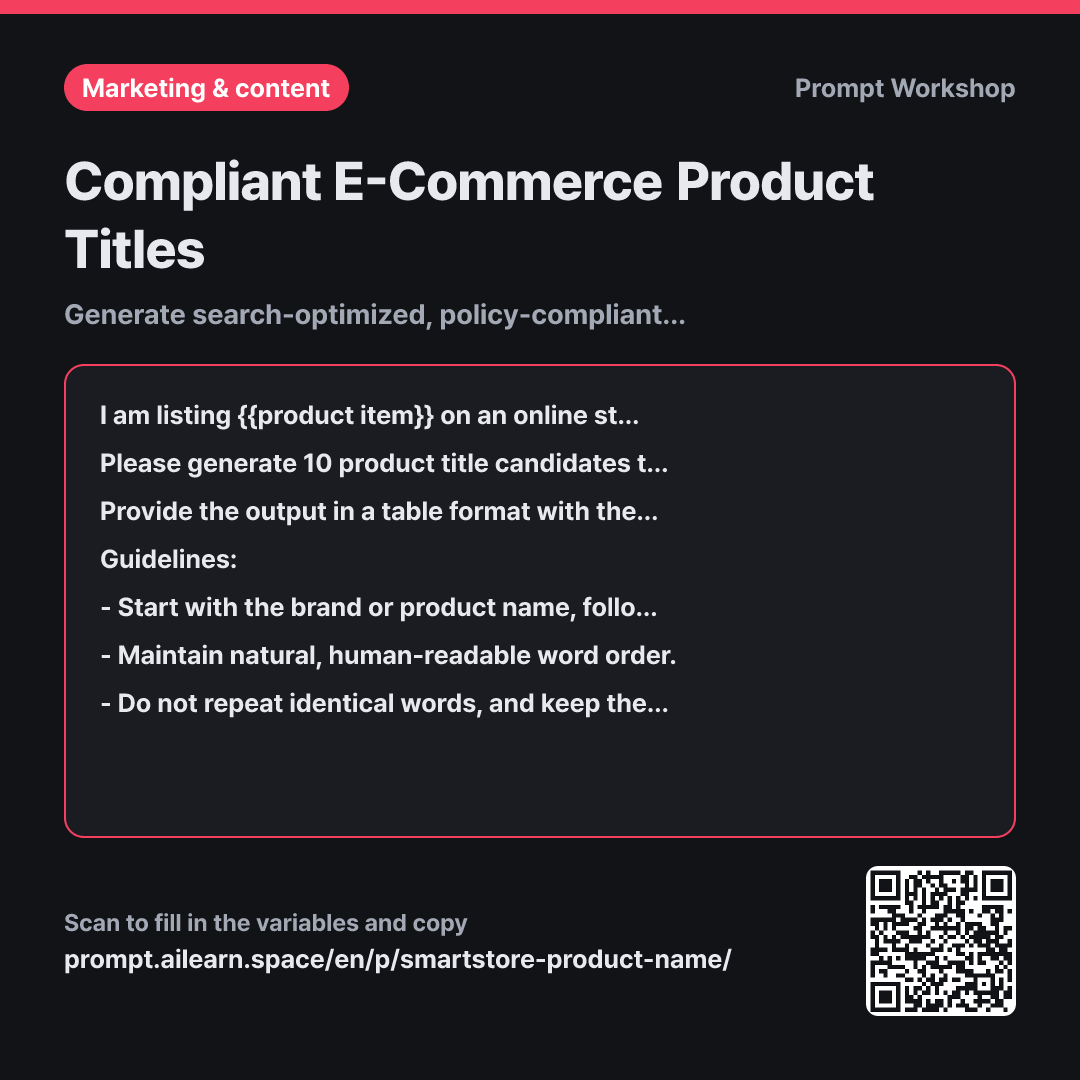
When asking AI to generate e-commerce product titles, the most common pitfall is keyword spamming. Prompts like "give me lots of keywords" result in repetitive, cluttered strings of synonyms that confuse shoppers and trigger marketplace spam penalties.
The Task explicitly requests ten distinct options and forbids merely shuffling word order. Without this constraint, AI typically shuffles identical terms across ten rows. Mandating distinct search scenarios produces genuinely diverse angles—such as gift-oriented, volume-focused, or origin-focused titles.
The Constraints form the core of this prompt: natural readability, zero word repetition, and a strict 50-character limit clearly separate clean listing titles from keyword stuffing. Negative keywords are also defined to filter out unverified promotional claims.
The Format uses a structured table with character counts so you can review metrics at a glance. The "Target Search Intent" column provides clear decision criteria for selecting the best variation. Finally, the concrete Example guides the AI on phrasing structure far more effectively than abstract rules alone.
Unfamiliar terms? See Aha AI: few-shot, output-format
Compared with a bad example
Make an online store product title for 200g whole bean coffee. Put in lots of keywords so it ranks well in search.
Asking for "lots of keywords" inevitably produces keyword-stuffed strings filled with redundant synonyms. Character counts vary wildly, often exceeding display limits, and without structured rationale for each variation, you are left picking an option by pure guesswork.
Variations
Bundled Title, Option Names, and Hero Copy
I am listing {{product item}}.
Please provide: 1. 5 product title options (under 50 characters, natural word order) 2. A clean list of option/variant names for the dropdown menu 3. 3 concise headline copy options for the top of the product detail page, emphasizing benefits not covered in the title.
Avoid exaggerated claims.
Generates all three essential listing elements in a single step, shifting secondary selling points from the title into product page headlines.
Optimizing an Existing Product Title
Below is an existing product title currently in use. Please point out structural issues and provide 3 revised options. Highlight repeated words, awkward syntax, or unsupported claims, while retaining high-performing keywords from the current title.
Current Title: {{product item}} Target Keywords to Include: {{primary key phrase}}
Ideal for refining established listings where preserving existing search indexing is safer than a total overhaul.
Model notes
Marketplace listing guidelines vary by platform and update frequently. Always cross-check the generated titles against your target sales channel's official title policy before publishing.
LLMs can occasionally miscount exact character lengths. If a character count seems inconsistent, ask: "Identify only the candidates exceeding 50 characters and regenerate them shorter." Double-check character limits directly in your marketplace dashboard before publishing.
Related prompts
Last updated 2026-09-02 · Found a mistake? Let us know