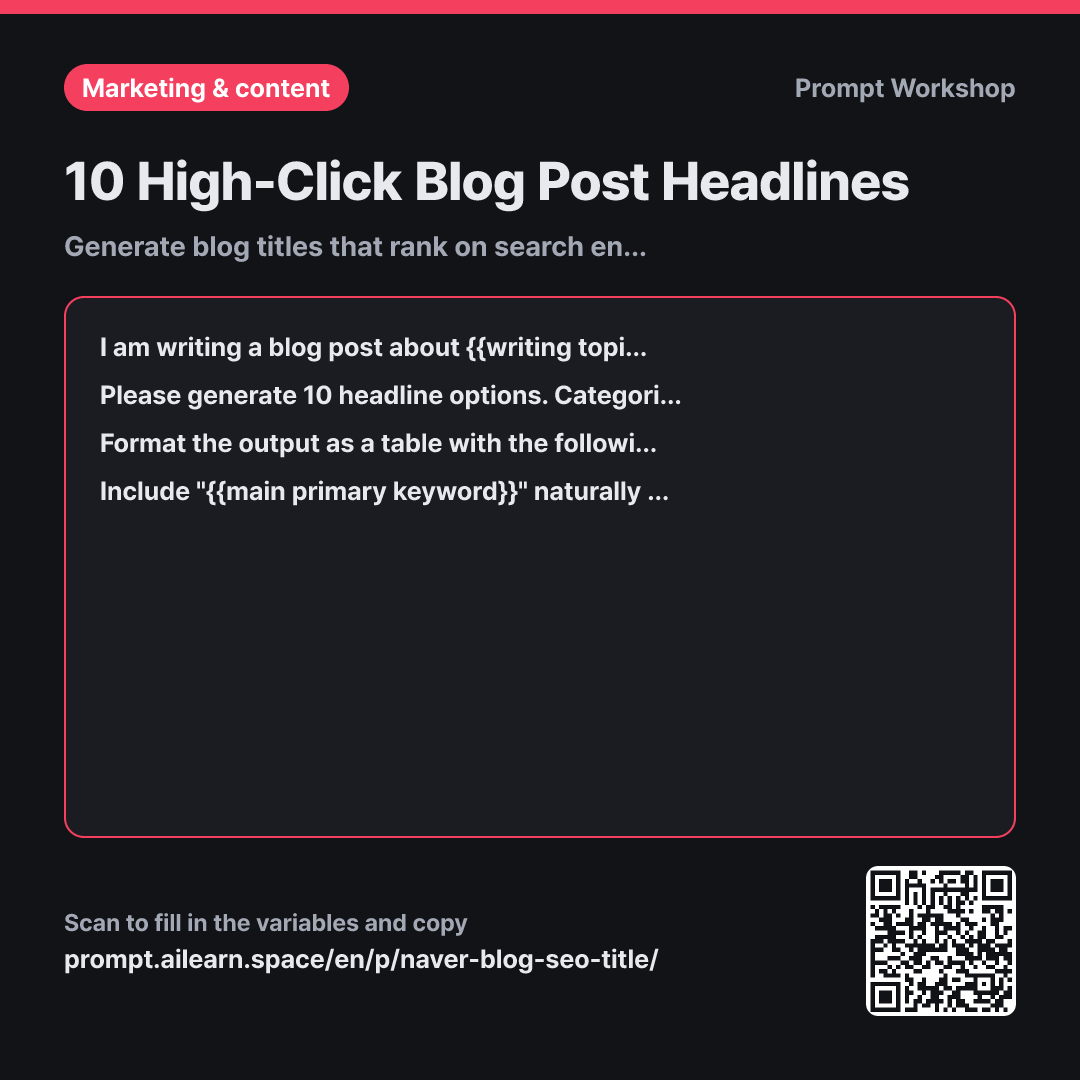
Why it is written this way
The most common mistake with blog headline prompts is simply asking to "include the keyword." This often results in keyword-stuffed strings like "Apartment Condensation Mold Removal Guide Review Tips." While it might technically match search queries, real people will scroll past it. A headline must provide both a reason to rank and a reason to click.
The first paragraph establishes both objectives. Balancing the target keyword with the instruction to make readers click prompts the AI to satisfy both search visibility and human curiosity.
The 5 specific angles in the Task paragraph ensure diversity. Without explicit angle constraints, AI models tend to produce 10 variations that only differ in minor word choices. Showing a practical guide alongside a personal story helps you immediately see which angle fits your content best.
In the Format instructions, requesting character counts and the "Why a Reader Would Click" explanation provides the exact data needed to make a final choice. Search engines truncate long headlines on result pages, so character length matters, and forcing the AI to justify the click-worthiness weeds out generic suggestions. The Constraints section prevents keyword repetition and unsubstantiated hype words.
This prompt works best as an iterative starting point. After reviewing the table, pick your favorite two or three angles and ask for 5 more refinements based on those winners rather than expecting a single final headline on the first try.
Unfamiliar terms? See Aha AI: output-format, prompt
Compared with a bad example
Give me 10 blog post titles for apartment window condensation mold. Make them good for SEO.
Asking the AI to make titles "good for SEO" usually prompts it to stuff keywords repeatedly. You end up with overly long headlines that get cut off in search snippets, look repetitive, and give you no real basis for choosing the best option.
Variations
Refining Selected Headlines
I like options #3 and #7 from the previous list. Please generate 5 more headlines that follow the style and tone of these two. Keep "{{main primary keyword}}" included naturally once, and this time ensure every headline is under 50 characters. Add a one-line note for each new option explaining how it differs from #3 and #7.
Great headlines often require iteration. Use your preferred initial options as anchors to narrow down the best variations.
Optimizing for Search & Question Queries
Please create 8 headline options for a blog post about {{writing topic}}. I want to capture both broad search intent and conversational queries. Provide 4 headlines containing the exact phrase "{{main primary keyword}}", and 4 headlines framed as natural questions or alternative phrasing that readers frequently ask. Add a brief note under each headline describing the search scenario it targets.
Search behavior varies across platforms and intents. Splitting between exact phrase matching and conversational questions helps you capture both direct searchers and intent-driven queries.
Model notes
AI models often miscount character lengths. Once you narrow down your final two or three candidates, verify the exact character count with a character counter tool or preview them in a search snippet simulator before publishing.
Related prompts
Last updated 2026-09-02 · Found a mistake? Let us know