Why it is written this way
When asking for thumbnail text, AI often just provides shortened versions of the title. If your title is "What I Learned After Testing 3 Dehumidifiers for 2 Months" and the thumbnail says "Testing 3 Dehumidifiers", you are wasting valuable screen real estate by repeating the exact same message twice. It gives viewers zero additional reason to click.
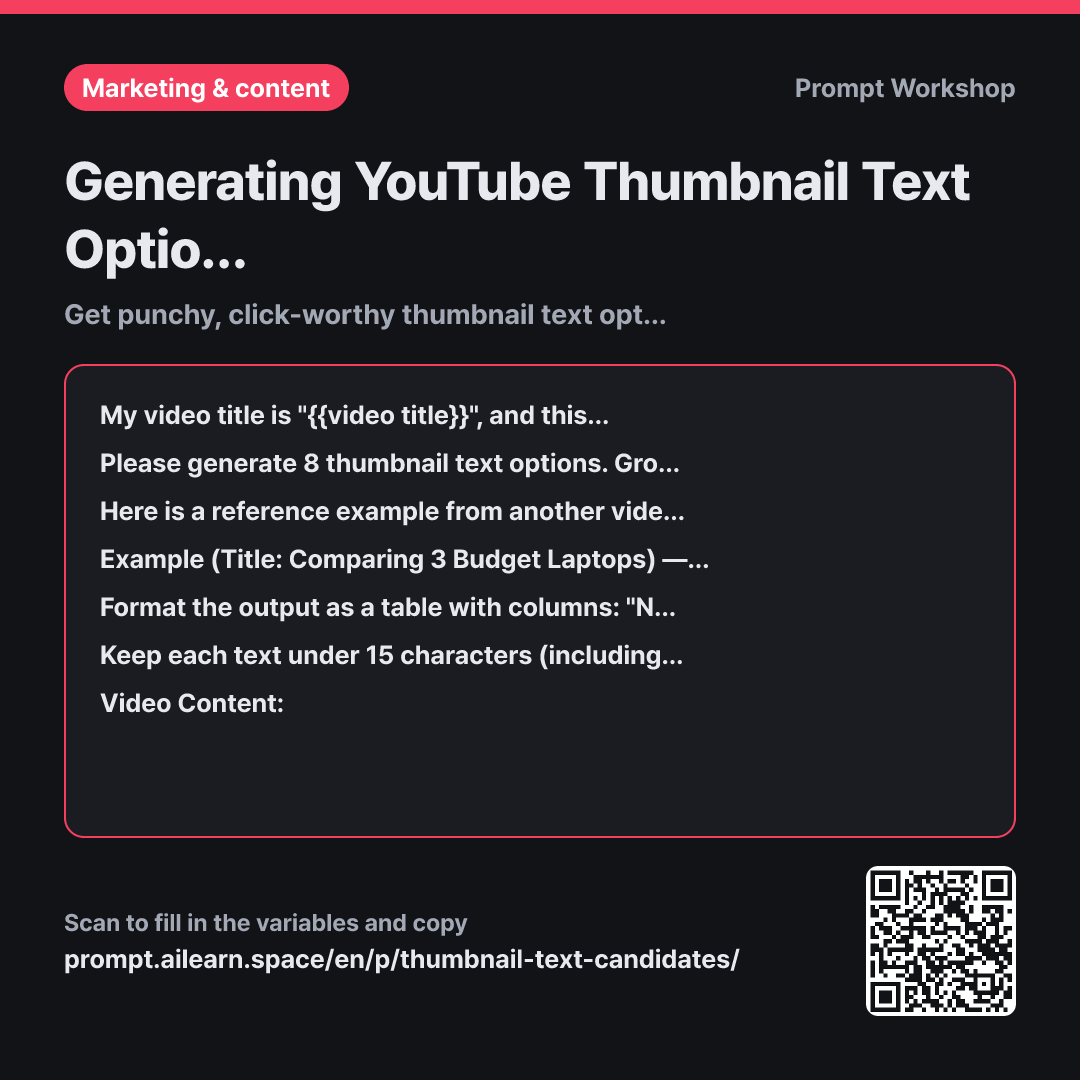
The first paragraph assigns distinct roles. By sharing the title first and stating that "it must convey what the title hasn't already said," the thumbnail text functions as a complementary hook rather than a redundant summary.
The Task paragraph asks for eight ideas split across four angles to ensure variety. Single-word hooks are often overlooked, yet on a thumbnail, a bold word like "Mistake" reads much faster from a distance than a long sentence. The Example in the third paragraph calibrates the desired length and punchiness. Simply specifying a character limit might yield dry, descriptive phrases, but seeing real examples shows the model that punchy 2- to 3-word hooks are the target.
The final column in the Format paragraph acts as a built-in quality check. Forcing the AI to explain what the title and thumbnail say when read together instantly filters out options that look cool in isolation but clash with the title.
The length and punctuation limits in the Constraints section reflect real-world design requirements. Longer text forces smaller fonts, making thumbnails unreadable on mobile devices. Wrapping the video content in """ keeps reference material cleanly separated from instructions.
Unfamiliar terms? See Aha AI: few-shot, output-format
Compared with a bad example
Suggest some YouTube thumbnail text for my dehumidifier comparison video.
Without length limits, the AI generates long phrases like "Complete Guide to Comparing Dehumidifiers". Squeezing that into a thumbnail makes the text too small to read on mobile. Without providing the title, suggestions will likely repeat words in the title and produce repetitive, generic variations.
Variations
When space is limited by a prominent subject or face
Please generate 6 thumbnail text options for the video "{{video title}}". The product photo takes up the right half of the thumbnail, leaving space for only a single line in the top-left corner. Each text must be on one line, under 10 characters (including spaces), focusing strictly on nouns and numbers without filler words. Label the target emotion for each option in one word.
""" {{video content}} """
When thumbnail space is tight, focus on punchy words rather than full phrases. Character limits are tightened to ensure maximum legibility.
For recurring series requiring visual consistency
"{{video title}}" is an episode in an ongoing series with a consistent format. I want a modular thumbnail text template where only the number and keyword change each episode. Please propose 3 distinct templates and provide an example filled out for this episode. Each template must remain under 12 characters.
""" {{video content}} """
For series content, using a consistent template builds instant brand recognition across your channel feed.
Model notes
Models often generate options that slightly exceed the character limit. After getting the table, prompt: "Select only the options that exceed the limit and shorten them." Always test the text by overlaying it on the thumbnail image and zooming out to mobile size to verify readability.
Related prompts
Last updated 2026-09-02 · Found a mistake? Let us know