Why it is written this way
If you ask for a YouTube script with a simple one-line prompt, you will usually receive a generic, wall-of-text 8-minute draft. While that seems convenient at first glance, it often lacks structured pacing, repeats the same point twice, and requires regenerating the entire output just to fix a single section—with no guarantee the second version will be any better.
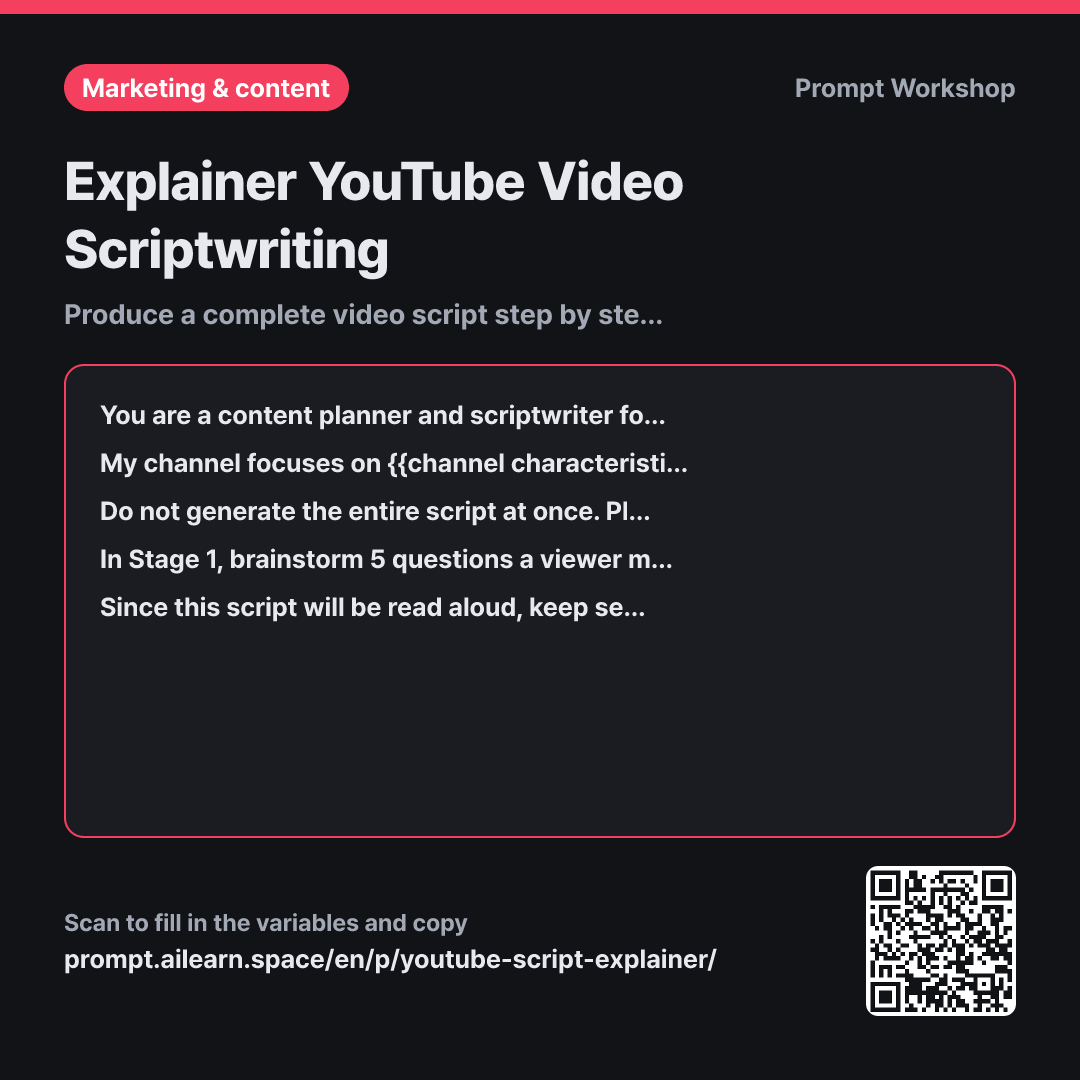
This prompt divides the workflow into three sequential checkpoints: finalize the outline, allocate timing, and only then write the dialogue. Because you review the progress at each gate, you avoid generating 8 minutes of content headed in the wrong direction. This step-by-step approach saves the most time when using AI for scriptwriting.
Combining the Role of planner and scriptwriter in the first paragraph is intentional. A writer alone creates great sentences but weak narrative structure; a planner alone creates a structured outline that reads like a dry textbook. Specifying the target audience in the Context paragraph sets the exact complexity level: first-time renters need basic terms unpacked, whereas seasoned investors would find those definitions tedious.
Defining the exact number and purpose of each phase in the third paragraph prevents the AI from inventing arbitrary steps or jumping straight into the script. The fourth paragraph defines the Process. The command to "Stop after Stage 1 and ask" is crucial; without it, the model will often acknowledge the stages and immediately write everything at once. Finally, the Constraint requiring [Source Check Needed] safeguards explainer channels against hallucinated statistics or nonexistent legal clauses.
Unfamiliar terms? See Aha AI: chain-of-thought, role-prompting
Compared with a bad example
Write an 8-minute YouTube script about how to check a property title registry before signing a rental lease.
This will return an unstructured draft with generic introductory greetings and terminology definitions taking up half the video. Although requested as an 8-minute video, it might actually read in 4 or 15 minutes, with no section timestamps to guide trimming. Furthermore, unverified claims like "According to recent statistics..." may slip in without sources, leading to factual errors and corrections in the comments.
Variations
When the Outline is Already Finalized
You are a scriptwriter for an educational YouTube channel. My channel focuses on {{channel characteristics tone}}, the audience is {{target audience persona}}, the topic is {{main central topic}}, and the target length is {{video length}}. The outline is already finalized and provided below this message. Without altering the structure, write the spoken script for each section. Keep sentences conversational and concise (under 20 words each), and flag unprovided facts with [Source Check Needed]. Stop after writing each section and ask for confirmation before moving to the next.
If your structure is already set, you can skip Stages 1 and 2. Keeping the pause after each section ensures you can review and refine iteratively.
For Interview or Panel Discussion Formats
We are preparing a {{video length}} panel discussion on {{main central topic}} for our channel about {{channel characteristics tone}}. The audience is {{target audience persona}}. Instead of a monologue script, please build an interview question guide. In Stage 1, brainstorm 10 key questions viewers would want answered. In Stage 2, arrange the top 8 questions in a natural conversational flow, including two sample bullet points for expected responses and one follow-up probe for each. Present Stage 1, then stop and ask for confirmation.
Interviews cannot follow a rigid word-for-word script, so the output is adapted into a structured discussion guide while preserving the staged review process.
Model notes
Keep all three stages within a single chat session so the model remembers earlier decisions. If the conversation becomes long and the AI loses context, simply paste the approved outline back into the prompt and continue.
Related prompts
Last updated 2026-09-02 · Found a mistake? Let us know