Why it is written this way
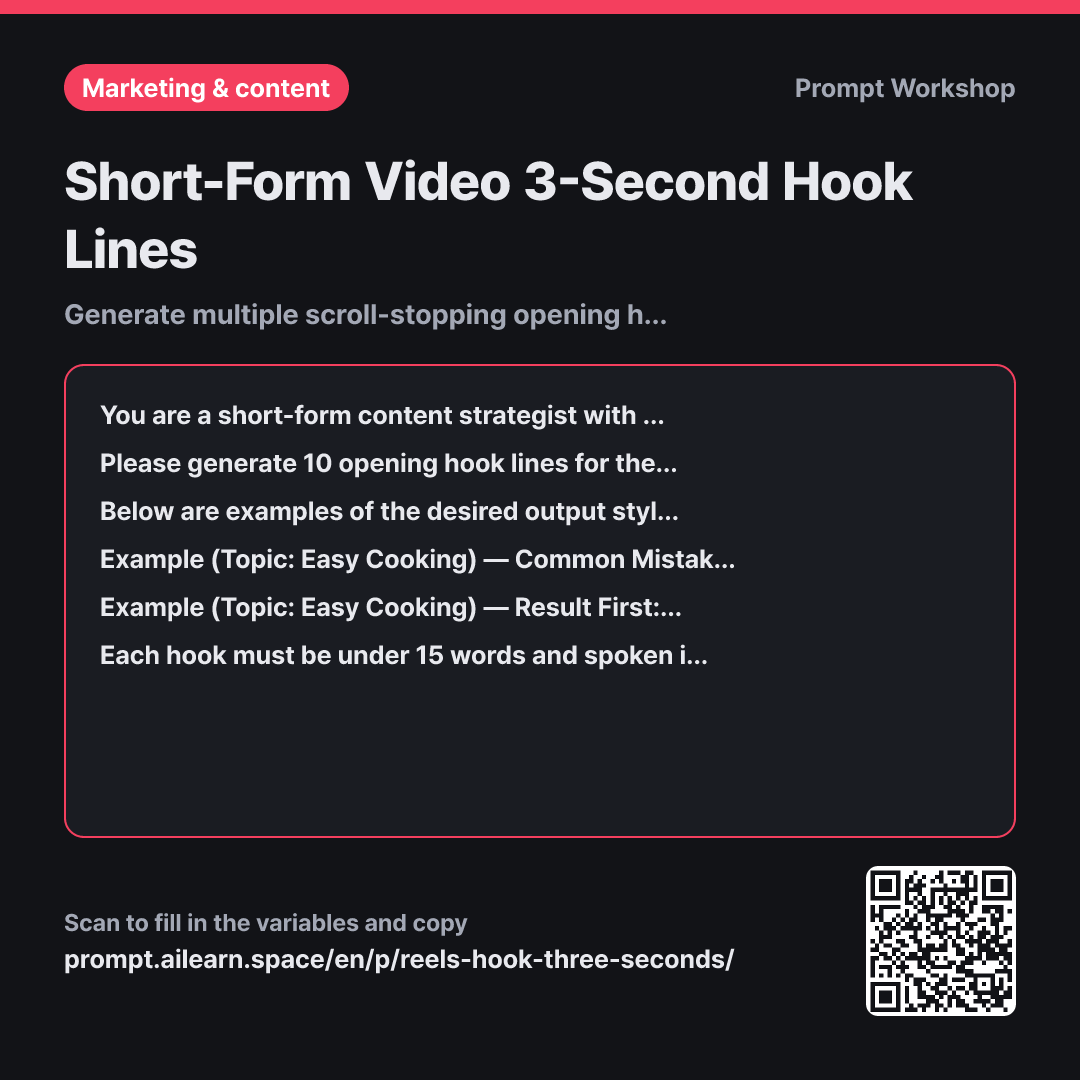
When you ask an AI for short-form video hooks, it usually returns a video summary instead—like "Today, I'm going to show you an easy omelet recipe." It is grammatically correct and accurate, but the moment viewers hear it, they lose the reason to keep watching. You've already revealed everything. A hook is not meant to inform; it is meant to create curiosity.
Setting the role in the first paragraph as a "strategist who can explain why people stop" makes all the difference. If you just ask for a copywriter, the AI tends to write overly poetic or fancy lines, which end up abstract and impossible to digest in 3 seconds.
Dividing the task into five specific categories prevents the AI from just giving you ten variations of the same phrasing. When you simply ask for ten hooks, the tenth looks like a twin of the first. Specifying categories guarantees ten distinct angles you can actually compare. Providing the target audience serves the same purpose—a first-time cook and a seasoned chef won't stop for the same line.
The third paragraph provides few-shot examples. Showing length and tone is far more effective than explaining them. Adding two concrete examples significantly cuts down on the "cheesy ad-copy" feel typical in AI-generated hooks. Finally, the constraints paragraph (under 15 words, 3-second read, no cheap clickbait) ensures high watch time without driving up the bounce rate.
Unfamiliar terms? See Aha AI: few-shot, role-prompting
Compared with a bad example
Give me 10 reels hook lines. The topic is easy cooking.
With just a one-line topic, the AI writes without knowing who is watching. You will end up with ten generic hashtag-style phrases like "Must-try recipe for beginners!" Lengths will vary wildly—some taking 6 seconds to read—and without categorized angles, you'll have no clear criteria to choose the best one.
Variations
When targeting saves and shares
Please create 8 opening lines for a short-form video about {{video topic}}. The audience is {{target audience persona}}, and the primary goal of this video is "saves" rather than mere views. Write lines that trigger a feeling of "I might not need this right this second, but I will definitely search for it later." Next to each line, add a one-sentence note predicting the exact situation when the viewer will pull this video back up.
Hooks that drive saves target future utility rather than instant entertainment. Shifting the objective from views to saves changes the entire direction of the copy.
For educational/review channels requiring strict credibility
Please create 8 opening lines for a video about {{video topic}}. The target audience is {{target audience persona}}. Since this channel relies on credibility and precision, you must stop the scroll using a single compelling fact without exclamations or hyperbole. Include at least one specific number, direct comparison, or qualifying condition in each line. If a figure needs verification, mark it as [Verify Number].
To hook viewers without exaggeration, you need concrete facts. This prompt asks for specific numbers while introducing a verification rule so the AI doesn't hallucinate unverified data.
Model notes
LLMs often struggle with exact character or syllable counts, so some lines may turn out slightly longer than 3 seconds. The best workflow is to pick your top 3–4 favorites, read them aloud, and then follow up with: "Shorten this specific line to under 10 words."
Related prompts
Last updated 2026-09-02 · Found a mistake? Let us know