Why it is written this way
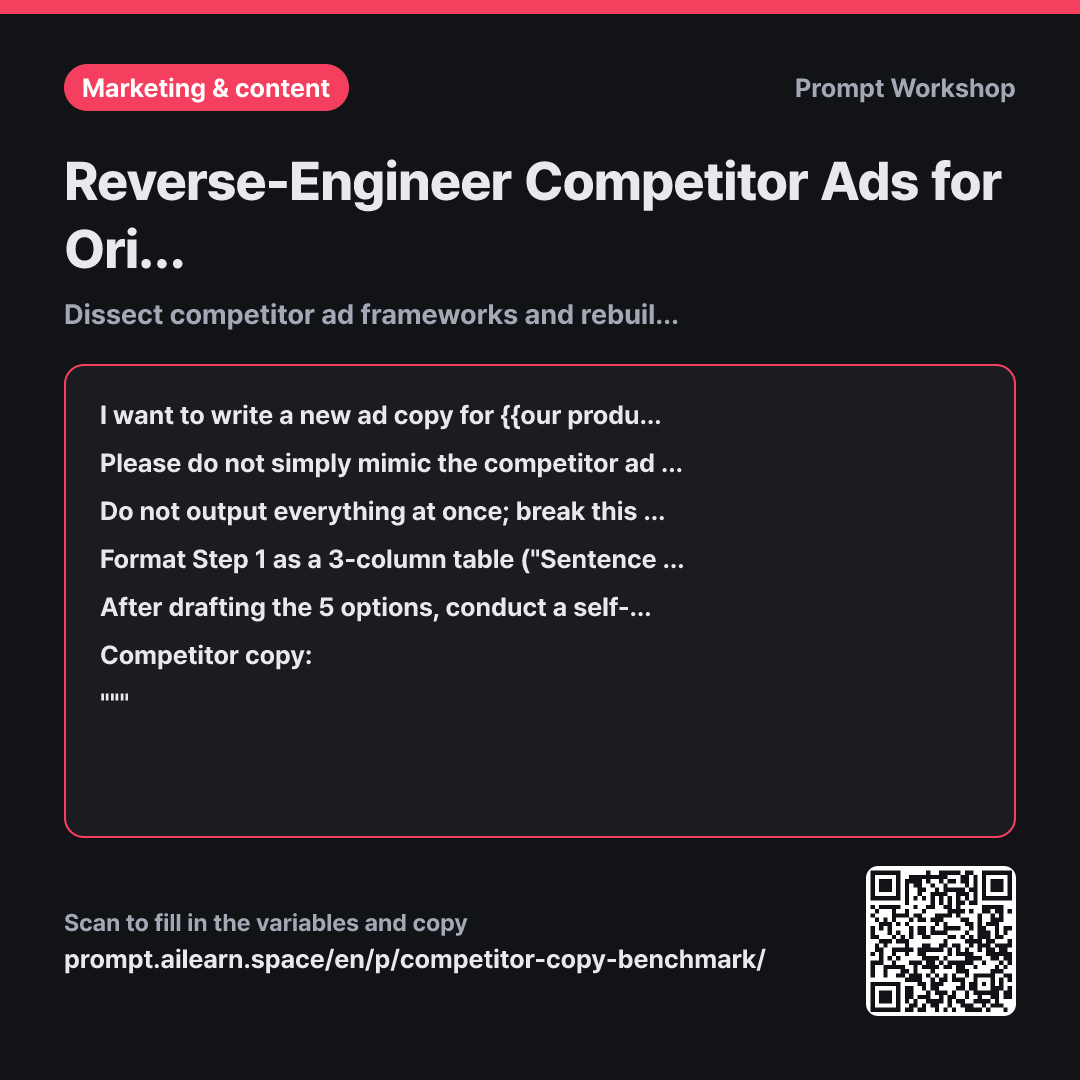
When you see an effective ad, it is tempting to just copy its style. However, swapping a few words easily leads to plagiarism issues, and worse, you end up claiming someone else's strengths under your own brand name. What you should ask AI to do with competitor copy is not copy it, but separate the structural skeleton from the content.
That is why this prompt breaks the task into three distinct steps instead of doing it all at once. If you ask for analysis and drafting in the same breath, AI often skips the deep breakdown and jumps straight to an overly similar draft. Breaking it down by steps lets you first see the skeleton in the Step 1 table—like "this sentence triggers anxiety, that sentence removes price friction"—so you only borrow the structural blueprint.
Step 2 is deliberately isolated because competitor ads often contain claims we cannot make. Superlatives like "#1 in satisfaction" require legal proof. Filtering these out beforehand makes Step 3 significantly safer. This step is the most frequently missed part of benchmarking prompts.
The final self-audit checks two things: overlapping phrasing and unsubstantiated claims. AI often sneaks in phrases like "industry-leading" just to make copy sound slick. Wrapping the competitor copy in """ also prevents the AI from mistaking lines like "50% off tonight" as instructions for your own prompt.
Unfamiliar terms? See Aha AI: chain-of-thought, self-consistency
Compared with a bad example
Here is a competitor's ad copy. Write something similar with this vibe:
(paste competitor copy)
Asking for "this vibe" makes the AI copy the rhythm and vocabulary almost directly. "A new body in 3 months" turns into "a new you in 2 months," resulting in an obvious rip-off. It will also copy unsubstantiated claims like "#1 in satisfaction," leaving you with ad copy you cannot legally or factually prove.
Variations
Quick single-line headline breakdown
Explain why the headline below grabs attention by listing 3 psychological or structural reasons. Then, using the exact same framework but completely different phrasing, write 3 alternative headlines for {{our product item}}. Do not use overlapping vocabulary.
""" {{competitor ad copy}} """
Simplifies the process to focus only on the headline. Useful when you need fast alternatives during a brainstorm.
Checking similarity against competitor copy
Compare the two copies below. Identify overlapping expressions, similar sentence rhythms, and shared persuasion triggers, ordered by highest degree of similarity. Then, rewrite our copy to better highlight {{our core strength}} while removing overlaps. Focus purely on factual similarity rather than subjective judgment.
Competitor copy: """ {{competitor ad copy}} """ Our draft: {{our product item}} ad draft
Used when auditing an already written ad draft. It points out similarities objectively so human editors can make the final call.
Model notes
If the model attempts to generate all three steps at once despite the prompt, simply ask for Step 1 first. Once you review the output, reply with "Proceed to Step 2" to ensure thorough analysis at each stage.
Related prompts
Last updated 2026-09-02 · Found a mistake? Let us know