Why it is written this way
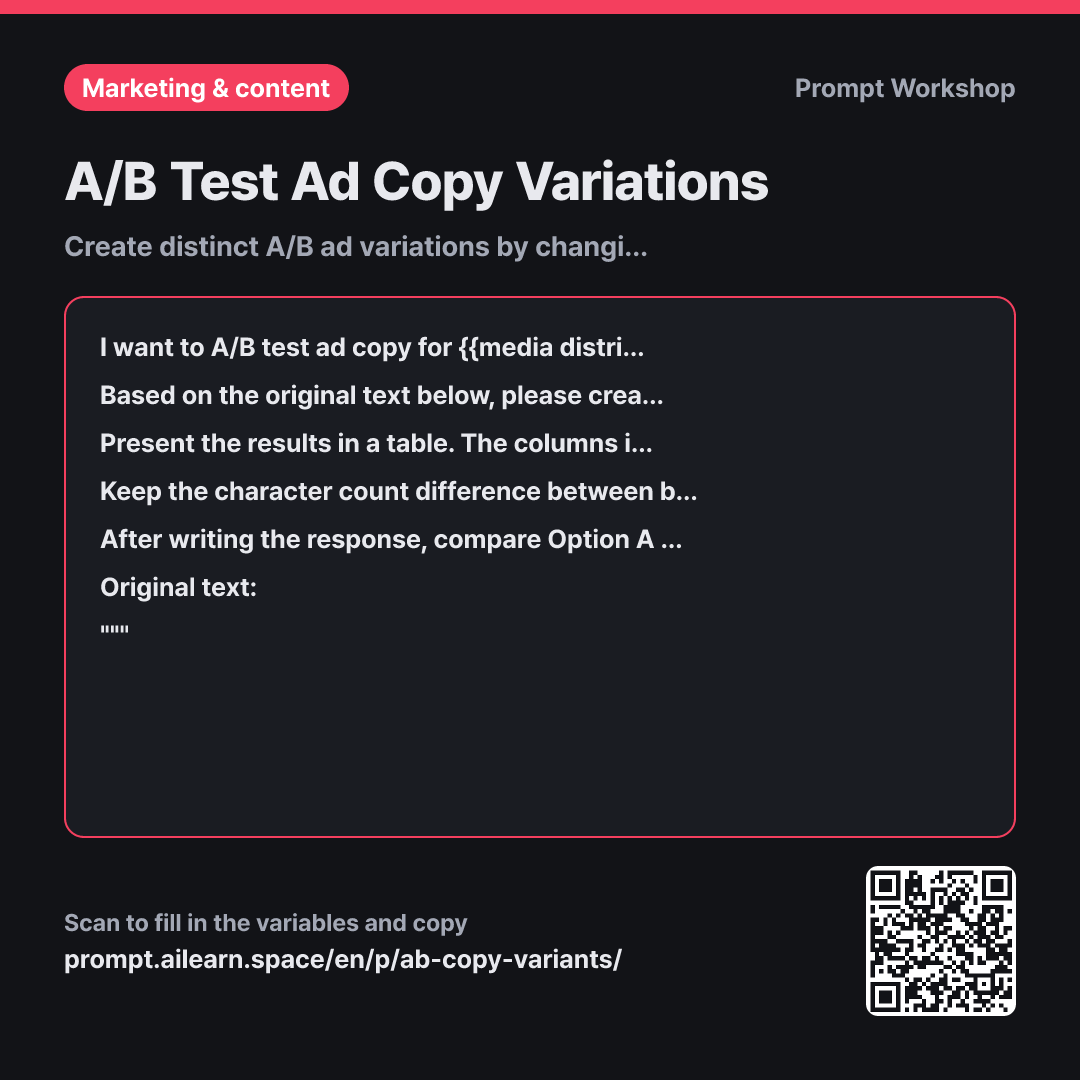
When you ask AI to generate ad copy for A/B testing, it easily provides "two versions." The issue is that both versions often differ simultaneously across headlines, length, emojis, and benefit framing. Even if Variant B wins, you cannot identify what drove the win, leaving no actionable insights for future tests. This prompt focuses entirely on isolating a single variable.
In the Task paragraph, anchoring Option A to the original text is essential. If both options are rewritten from scratch, the baseline disappears. Locking Option A ensures that any change in Option B represents a measurable difference.
In the Format, the "Modified Element" column forces the model to state explicitly what it altered. If it lists multiple items, the violation is immediately obvious in the table. The Constraint regarding character count and emoji parity controls subtle variables that skew click-through rates.
Finally, the last paragraph instructs the model to self-check and refine its output. The most common pitfall in AI-generated split testing is altering multiple elements; demanding a side-by-side comparison filters out most multi-variable errors before output. Restricting the evaluation to a single metric serves the same goal: evaluating CTR, conversion rate, and saves at once leads to ambiguous interpretations. Deciding the success metric beforehand ensures clean testing.
Unfamiliar terms? See Aha AI: output-format, prompt
Compared with a bad example
Write 2 versions of this ad copy for an A/B test.
(Paste original copy)
This produces two completely different ad copies—for instance, one short and emotional, the other long and benefit-driven. If one wins, you cannot tell whether brevity or emotional tone caused the lift, leaving no reusable insight for the next campaign.
Variations
When testing multiple elements sequentially
I want to run a multi-stage test on ad copy for {{media distribution channel}}. The hypothesis is: "{{hypothesis to test}}".
Create 3 options by modifying only one specific part from the original below. Option 1 should change only the opening sentence, Option 2 only the benefit phrasing, and Option 3 only the final call-to-action, keeping everything else identical to the original. Present the results in a table with columns: "Modified Part | Before | After".
""" {{original phrasing}} """
Predefining the test positions allows for phased experimentation. Each of the three options touches only one specific area.
When auditing existing A/B test copies
Below are two A/B test copy drafts I wrote for {{media distribution channel}}. The hypothesis is: "{{hypothesis to test}}".
Do not rewrite them; please audit them instead: ① List all actual differences between the two versions, ② Identify any differences unrelated to the hypothesis, and ③ Explain why interpreting test results might be difficult if run as-is. Finally, provide revised versions that eliminate only the unrelated differences.
""" {{original phrasing}} """
Human-written drafts often contain multiple unintended differences. Use this to audit and isolate variables before launching a test.
Model notes
If multiple elements differ between the two options, prompt again with: "Keep only one modified element in Option B and use the exact same wording from Option A for the rest."
If the model changes multiple elements, follow up with: "Keep only one modified element in Option B and match the rest of the text word-for-word with Option A." Because LLMs struggle with exact character counting, verify the final length manually.
Related prompts
Last updated 2026-09-02 · Found a mistake? Let us know