Why it is written this way
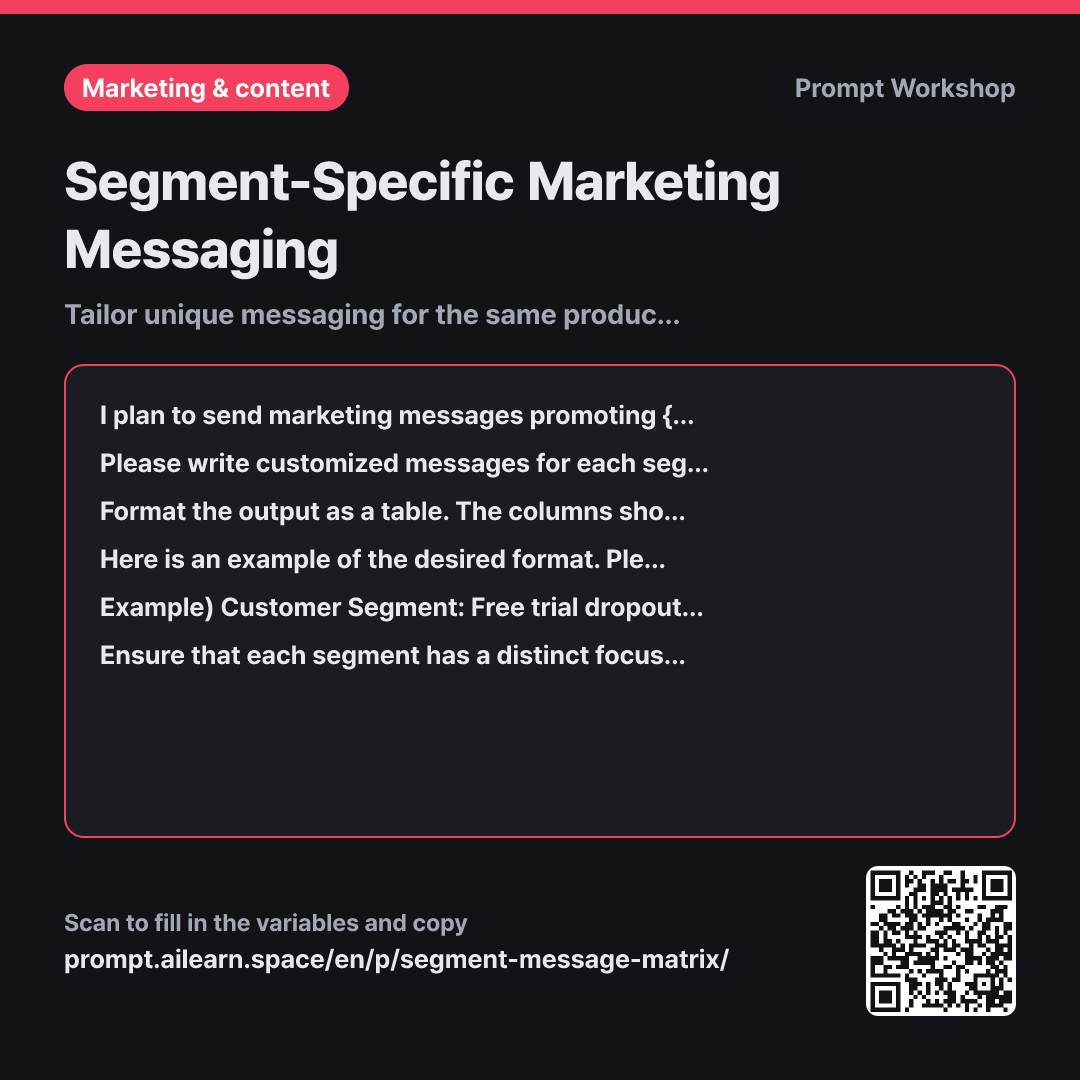
When asking AI to generate customer segment messaging, the most common pitfall is receiving identical messages with only the segment headers swapped. If every segment gets "Sign up now for 10% off," segmentation loses all purpose. A single generic phrase sent to everyone resonates with no one.
The context section explicitly establishes that each segment has a different relationship and awareness history with the product. This guides the AI to view segments through lifecycle stages rather than simple demographics. The task section enforces identifying the "core hesitation" before drafting the copy, ensuring that differing root causes drive genuinely different messages.
The format constraint limiting the hook line to under 40 characters ensures optimization for lock-screen push previews or SMS headers. Regardless of how good the body copy is, a weak first line will never get opened.
The fourth paragraph's example provides a concrete few-shot template for tone and length. AI often struggles with abstract length instructions for targeted copy, but providing a completed sample sets a clear benchmark for all following segments. Swapping this example with your actual product further boosts quality.
Finally, demanding distinct focus areas prevents messages from converging into repetitive discount offers, while the [Needs Verification] flag encourages the AI to point out informational gaps instead of hallucinating details.
Compared with a bad example
Write marketing messages for our customer segments: new users, churned users, and heavy users.
While segment names are included, the AI produces three practically identical blurbs filled with cliches like "Special perks await" and "Get started today." Because there is no underlying logic explaining why a specific user needs this specific message, the copy fails to engage any audience, and the lack of channel parameters requires extensive manual editing.
Variations
When Customer Segments Are Not Yet Defined
I am selling {{product item}}. Please propose 3 different frameworks for segmenting my audience from a messaging perspective. For each framework, include up to 4 segments, identifying why each group hesitates to buy and one hook line for each. Please exclude demographic splits like age or gender.
Use this when starting without defined customer segments. Excluding age and gender forces the AI to create behavioral segments that translate directly into actionable copy.
Adapting Messaging for Different Channels
Please adapt our existing segment messages for {{customer type list}} to fit {{media distribution channel}}.
Keep the core message intact while adjusting only the tone, format, and length to suit the channel. List the channel-specific constraints (character count limits, line breaks, link placement) in one sentence first, then display the revised messages in a table.
Use this when expanding an established message strategy to new channels without altering the underlying value propositions.
Model notes
If you have more than six segments, the later messages tend to resemble the earlier ones. Request them in batches of three across two prompts.
When generating copy for more than six segments, later responses tend to lose distinctiveness and mirror earlier ones. Split your request into batches of three, and include the generated hook lines in your follow-up prompt with the instruction: "Ensure these new segments do not overlap with the previous ones."
Related prompts
Last updated 2026-09-02 · Found a mistake? Let us know