Why it is written this way
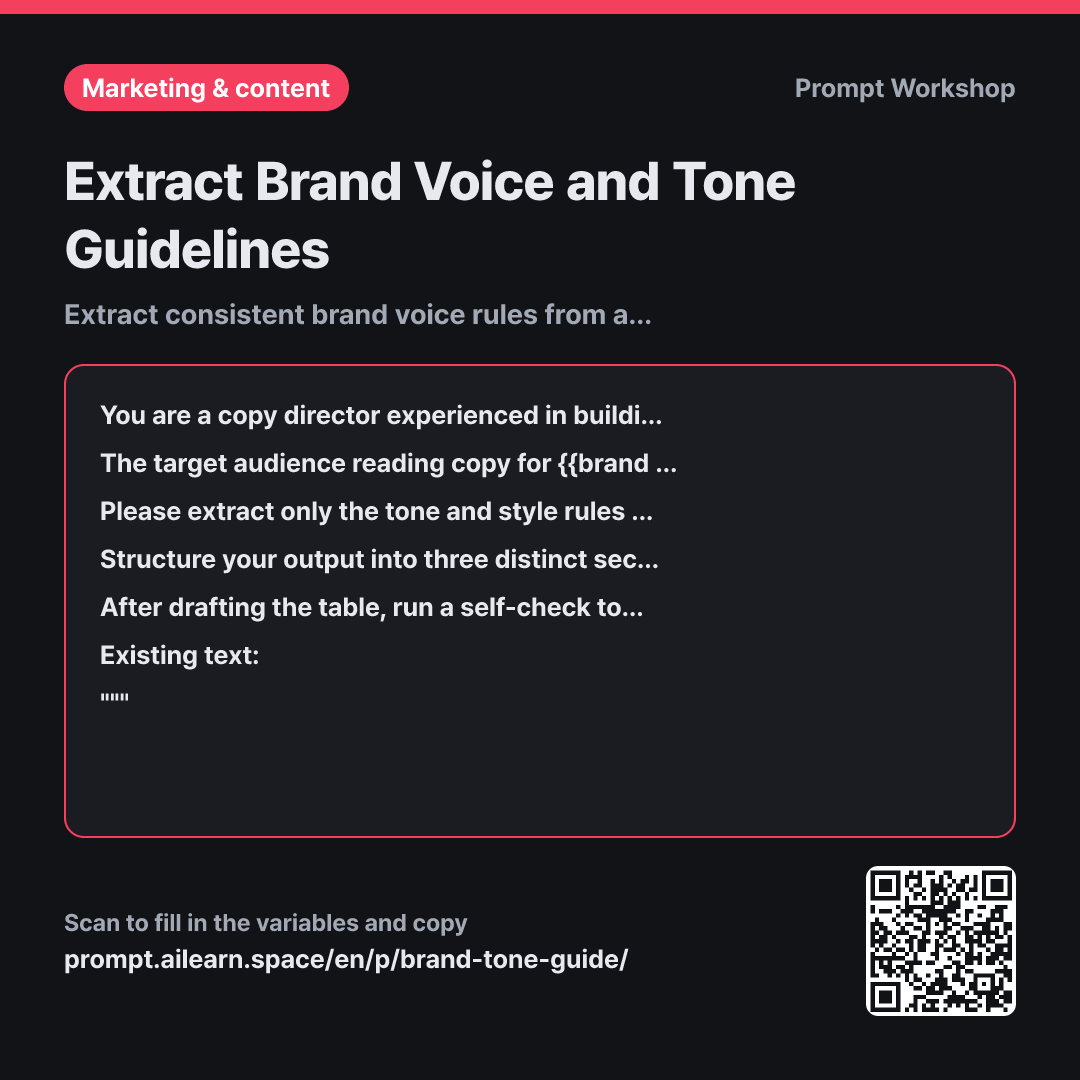
A common mistake when asking an AI for brand tone and manner guidelines is ending up with generic adjectives like "friendly yet professional." Phrases like that decide nothing. One writer might use casual phrasing while another uses rigid corporate language, and emoji usage varies wildly between people. This prompt is designed to extract a definitive list of approved and banned sentence patterns instead of vague adjectives.
This is why the role explicitly anchors the AI as "a copy director who defines voice through concrete sentences rather than adjectives." It is the first mechanism to force rule generation at the sentence level. The third paragraph deliberately separates the tasks, restricting this run to rule extraction only. When asked to draft guidelines and generate new copy simultaneously, the model tends to focus on writing creative copy while glossing over the underlying rules.
The rules table requested in the fourth paragraph contains a dedicated "Supporting example from existing text" column. Requiring a direct textual citation filters out the generic corporate fluff that AI often fabricates, because the model cannot fill this column for rules that do not exist in the source copy.
The final paragraph forces a self-check. Elevating a one-off phrase into an overarching brand rule is the most common pitfall in voice extraction. Requiring the "[Single Observation]" tag leaves ambiguous rules open for human review. The "What NOT to write" column serves a similar purpose: clearly defining boundaries helps onboarding writers understand what to avoid, and the resulting table can be directly pasted into future writing prompts.
Unfamiliar terms? See Aha AI: few-shot, role-prompting
Compared with a bad example
Create a brand tone and manner guide for us.
(Pastes a few Instagram captions)
You will get generic platitudes like "warm yet authoritative, approachable yet professional" that can fit almost any brand. When actually drafting copy, this kind of guide offers zero practical decision-making criteria. Furthermore, rules not present in your actual text will blend in without any supporting evidence to verify them.
Variations
Auditing new copy against extracted voice rules
Please audit the copy below against the brand voice rules established earlier for {{brand name}}. Do not rewrite the entire text. Instead, provide a table highlighting only the non-compliant sentences and the specific rules they violated. Then, provide a revised version of only those flagged sentences rewritten according to the rules.
""" {{existing text}} """
This is step two, separating rule extraction from rule application. Asking the AI to handle both at once weakens rule enforcement.
When no reference copy exists yet
{{brand name}} is a newly launched brand with no existing copy archive. The primary audience is {{target customer segment}}.
Please propose three distinct directions for our brand voice. For each direction, demonstrate the tone by writing 3 sample messages containing identical information across different formats (announcement · product launch · apology/service disruption). Add a one-line explanation for each direction detailing the specific scenarios where it provides a competitive advantage.
If no existing copy exists, there are no rules to extract. Instead, this variant writes the same core message in three different tones to help you choose a direction.
Model notes
If you input more than five samples of existing text, the distinct characteristics of the earlier passages tend to wash out. Group similar content together and run them in two batches.
If you input more than five samples of existing text, the distinct characteristics of the earlier passages tend to wash out. Reduce the number of samples or group similar content together across two separate runs. Once finalized, you can paste the completed rules table at the very top of subsequent prompts to maintain a consistent brand voice.
Related prompts
Last updated 2026-09-02 · Found a mistake? Let us know