Why it is written this way
If you ask an AI to "give me some giveaway ideas," you'll get generic variations of the same plan: follow and comment for a gift card. It won't address whether the plan fits your budget or how to actually run the logistics. This prompt is engineered to produce an operational workflow rather than abstract brainstorming.
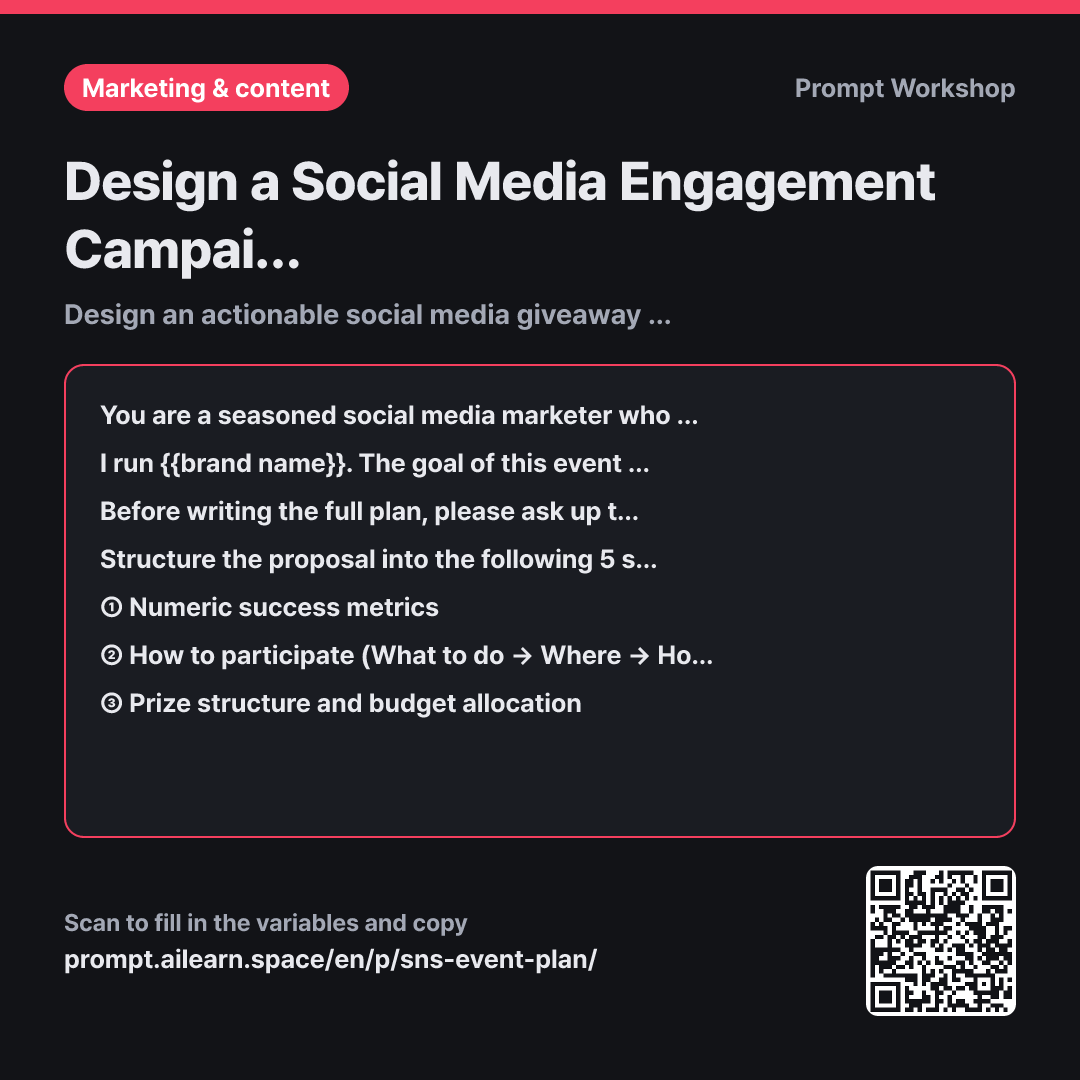
Setting the Role as a "marketer with hands-on experience" grounds the response in real-world feasibility. Agency or creative director personas tend to generate flashy concepts while ignoring post-contest operational steps like winner verification. Specifying the target goal, budget, and timeline in the Context section prevents the AI from defaulting to generic advice.
The third paragraph introduces a Clarification step. Instead of hallucinating arbitrary assumptions about your niche or follower count, the model asks targeted questions first (capped at 3 to prevent endless loops).
The fourth paragraph locks the structure into five sequential Steps. Most contest prompts omit entry requirements and fulfillment logistics; clear numbering makes missing parts obvious. Putting numeric criteria first ensures goals are measurable (e.g., "gain 300 new followers in 2 weeks") so prize value and ad spend scale appropriately. Finally, the Constraint against collecting personal data in comments protects user privacy, while [Verify with Manager] flags compliance items needing human review.
Unfamiliar terms? See Aha AI: role-prompting, context-window
Compared with a bad example
Give me 5 Instagram giveaway ideas. We are a bakery.
Without goals or a budget, the model produces generic "like, follow, and tag a friend" suggestions with prize values that often exceed practical limits. You are forced to follow up repeatedly to extract actual participation rules and fulfillment steps.
Variations
Short weekend comment contest
Design a quick weekend comment giveaway for {{brand name}} running during {{time period}}. The primary goal is {{event target goal}} with a budget of {{budget amount}}.
I only have one day to prepare. Provide ready-to-use copy: 1 social media caption, 3 bullet points of entry rules, and 1 winner announcement template. Skip the strategy overview and output only the copy to post.
Omits the clarification stage and structural breakdown to deliver immediate, copy-pasteable assets for short-turnaround campaigns.
Driving in-store foot traffic
Design a social media campaign for {{brand name}} where the primary goal is {{event target goal}}, structured so that participants must visit the physical store to complete entry. The budget is {{budget amount}} and the duration is {{time period}}.
Exclude purely digital entry mechanics. Detail the exact in-store action required to qualify and provide a brief script for retail staff to guide customers.
Shifts the completion trigger from online engagement to in-store visits to ensure social media activity translates directly into foot traffic and sales.
Model notes
When the clarification prompt is active, some models may stop after asking questions. If you need an immediate full response, append: "Skip the questions, make reasonable assumptions for missing info, and highlight them in the output."
When the clarification prompt is active, some models may stop after asking questions. If you need an immediate full response, append: "Skip the questions, make reasonable assumptions for missing info, and highlight them in the output." Always verify the math in the budget allocation table manually, as LLMs frequently make calculation errors.
Related prompts
Last updated 2026-09-02 · Found a mistake? Let us know