Why it is written this way
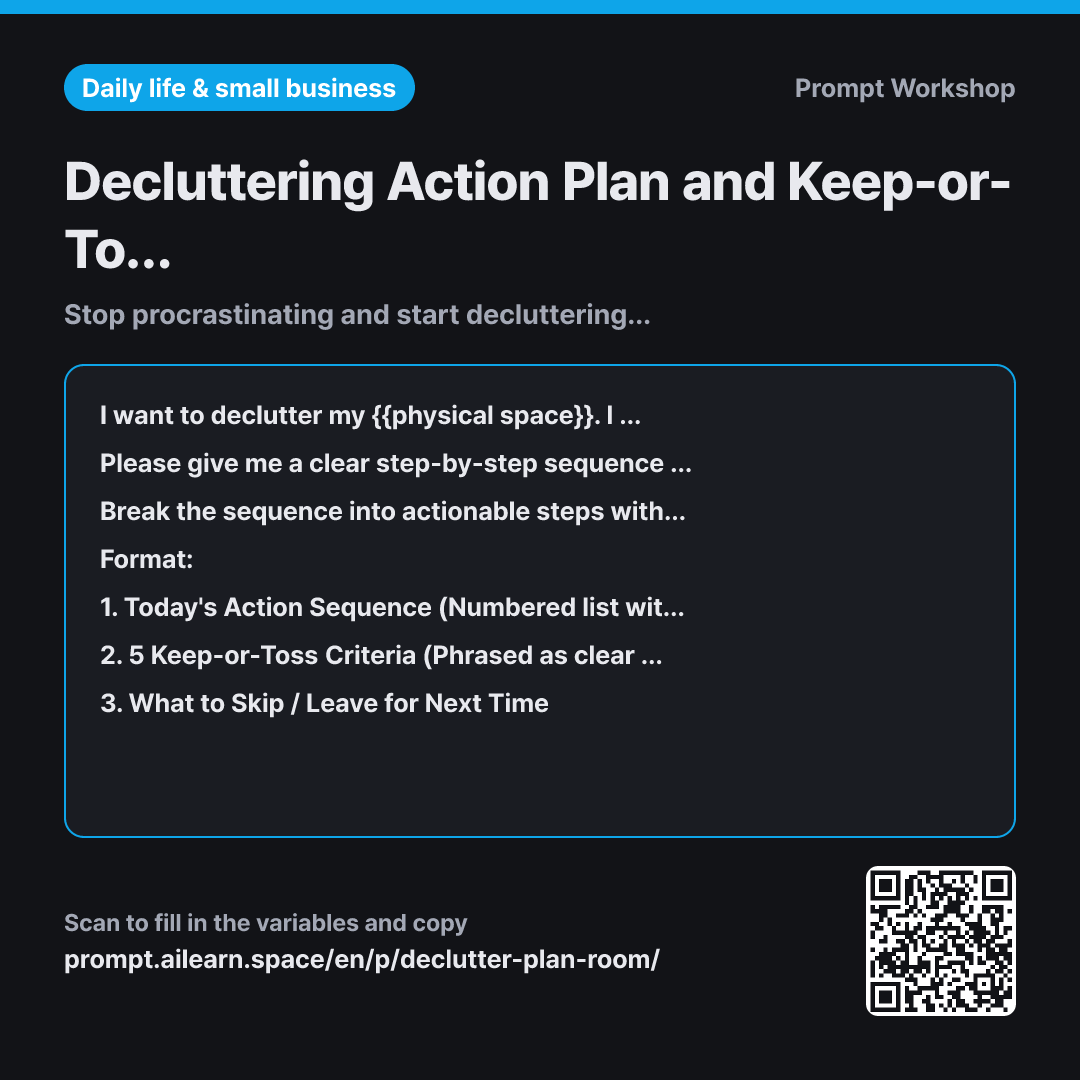
When people look up decluttering guides, they often find generic tips like "focus on one area at a time" or "sort before organizing." While true, very few people actually open a drawer after reading that. Decluttering stalls not because we lack methods, but because we don't know what to do in the first 30 minutes.
Requesting both an action sequence and decision criteria in the Task paragraph forms the backbone of this prompt. Having only a sequence leaves you hesitating over individual items, while having only criteria leaves you unsure of which drawer to open first. Having both moves your hands immediately.
Attaching time estimates to each step prevents the plan from overflowing. When asking AI for a decluttering plan without time limits, it often yields an all-day project that leaves a massive pile in the middle of the room after two hours. Specifying the time forces the AI to trim the steps, and including a "good enough for today" milestone ensures your room is better than yesterday even if you stop halfway.
The three-part Format is designed for practical execution. With numbered steps, yes/no criteria, and a skip list, you only need to check your screen three times while working. Asking for criteria as yes/no questions delivers clear answers on the spot (e.g., "Have you used this in the past year?") rather than subjective debates.
The Constraints section prevents two common pitfalls. First, slipping into storage shopping, which ends up adding clutter instead of reducing it. Second, stalling in front of sentimental items. Asking for a way to defer decisions rather than forcing discards generates practical solutions—like boxing items with a future review date—so you can finish the session without emotional burnout.
Unfamiliar terms? See Aha AI: chain-of-thought, prompt
Compared with a bad example
My room is super messy. How should I organize it? Give me some tips.
Without specifying the space or available time, you will only get generic blog advice. You'll receive broad concepts like "empty, sort, assign a spot" and minimalism theories, with zero actionable steps for your 3-hour afternoon window. You'll nod along, but your drawers will stay untouched.
Variations
When You Only Have 30 Minutes
I only have 30 minutes to spend on my {{physical space}}. Pick just one single spot that will create the biggest visible difference.
Create a 6-step sequence in 5-minute increments, with only one single action per step. To avoid stalling while sorting, let me place any item requiring heavy deliberation into a "Later Box" and move on. Do not suggest buying organizing supplies.
When time is tight, tackling too broad an area leads to failure. Restricting the task to one spot, 5-minute blocks, and a deferral box ensures you finish within 30 minutes.
Decluttering with Family
I will be decluttering my {{physical space}} with my family for {{available time}}. We have two adults and one child working together.
Divide the tasks by person. Give the child tasks that feel like a game, and assign decision-heavy tasks to the adults. Include a single 5-minute wrap-up activity that we can all do together at the end.
Sentimental items: """ {{sentimental item}} """
When multiple people declutter together, time is often wasted waiting on each other. Separating decision-making tasks from simple manual tasks keeps everyone moving without delays.
Related prompts
Last updated 2026-09-02 · Found a mistake? Let us know