Why it is written this way
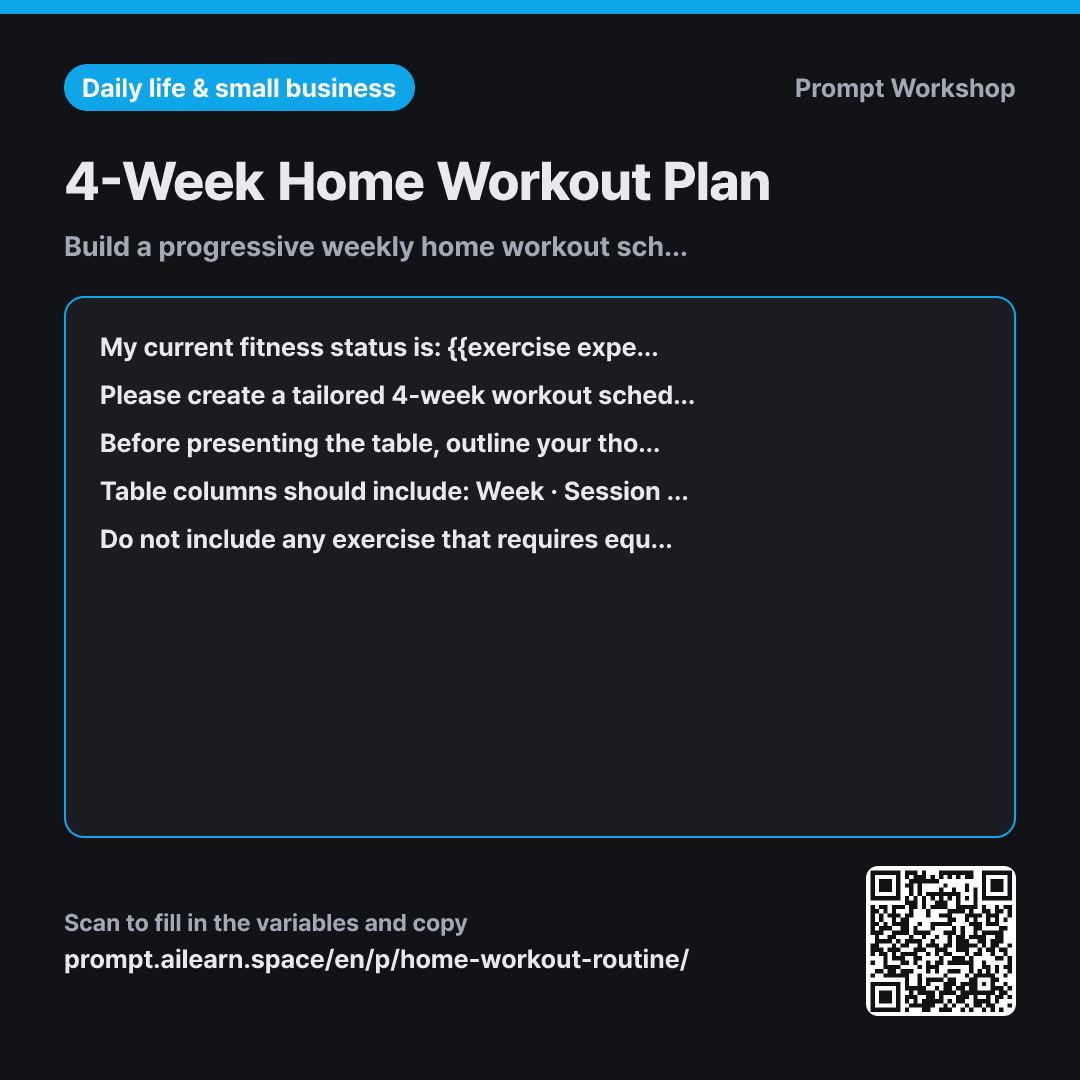
When asked to create a home workout routine, AI often defaults to demanding textbook programs right from Week 1—like 3 sets of push-ups and 50 squats. If someone returning from a 2-year hiatus tries that, they will burn out in three days. The core goal of this prompt is to establish a realistic, approachable starting point.
In the context paragraph, specifying fitness background, frequency, time, and gear anchors the baseline. In particular, "used to work out but took a long break" establishes a unique starting point distinct from a total beginner or an active athlete. Omitting equipment details often leads the AI to casually insert pull-up bars or kettlebell swings.
Constraining the task to 4 weeks ensures a structured progression rather than just a single day's routine.
Requiring the step-by-step thought process makes the reasoning behind the starting intensity visible. Without this, it's hard to understand why a certain rep range was chosen; with the rationale stated upfront, you can easily ask the AI to dial back Week 1 if needed.
The constraints set two vital guardrails: capping weekly progression at ~10% to prevent overtraining, and establishing clear boundaries around medical advice. Joint or muscle pain must always be assessed by a medical professional, not an AI.
Unfamiliar terms? See Aha AI: chain-of-thought, output-format
Compared with a bad example
Make me a 4-week home workout routine.
Without context on current fitness level or equipment, the AI assumes an average active adult. The output usually ends up as a generic 40-minute daily full-body blast featuring gear you don't own, with arbitrary jumps in intensity that double the workload by Week 3.
Variations
Low-Impact Routine (Knee/Back Friendly)
My current fitness status is: {{exercise experience}}, and I work out at home. I can do {{available weekly sessions}}, with {{single session duration}} per session. My available equipment is: {{owned equipment}}.
Please create a low-impact 4-week workout plan that minimizes stress on the knees. Exclude jumping movements and deep knee flexion, replacing them with joint-friendly alternative exercises targeting the same muscle groups. Format the plan into a table: Week · Session # · Exercise Name · Sets & Reps.
This plan is not medical rehabilitation or treatment; do not attempt to diagnose pain or suggest clinical remedies. Include a single-line note at the very top stating that any active pain must be evaluated by a healthcare professional first.
A variation designed for joint-friendly movement. It firmly restricts clinical prescriptions and places the medical disclaimer at the very top for immediate visibility.
Express 10-Minute Maintenance Plan
Please create a scaled-down express workout plan for an unusually busy week where I need to cut {{single session duration}} in half. My fitness status is: {{exercise experience}}, and my available equipment is: {{owned equipment}}. I might also struggle to hit {{available weekly sessions}} this week.
First, provide a 2-line guideline explaining the criteria for what exercises to drop and what to keep. Then, provide a concise table showing only the essential exercises per session. Each session must be completed within 10 minutes.
A variation for high-stress weeks to maintain momentum instead of quitting entirely. Seeing the criteria for essential exercises helps you make smart workout adjustments on your own later.
Model notes
Some models tend to copy-paste Week 1 into Weeks 3 and 4 without meaningful progression. If that happens, verify the progression by asking: "Please explain in one sentence exactly what increased in Weeks 3 and 4 compared to the previous weeks."
Related prompts
Last updated 2026-09-02 · Found a mistake? Let us know