Why it is written this way
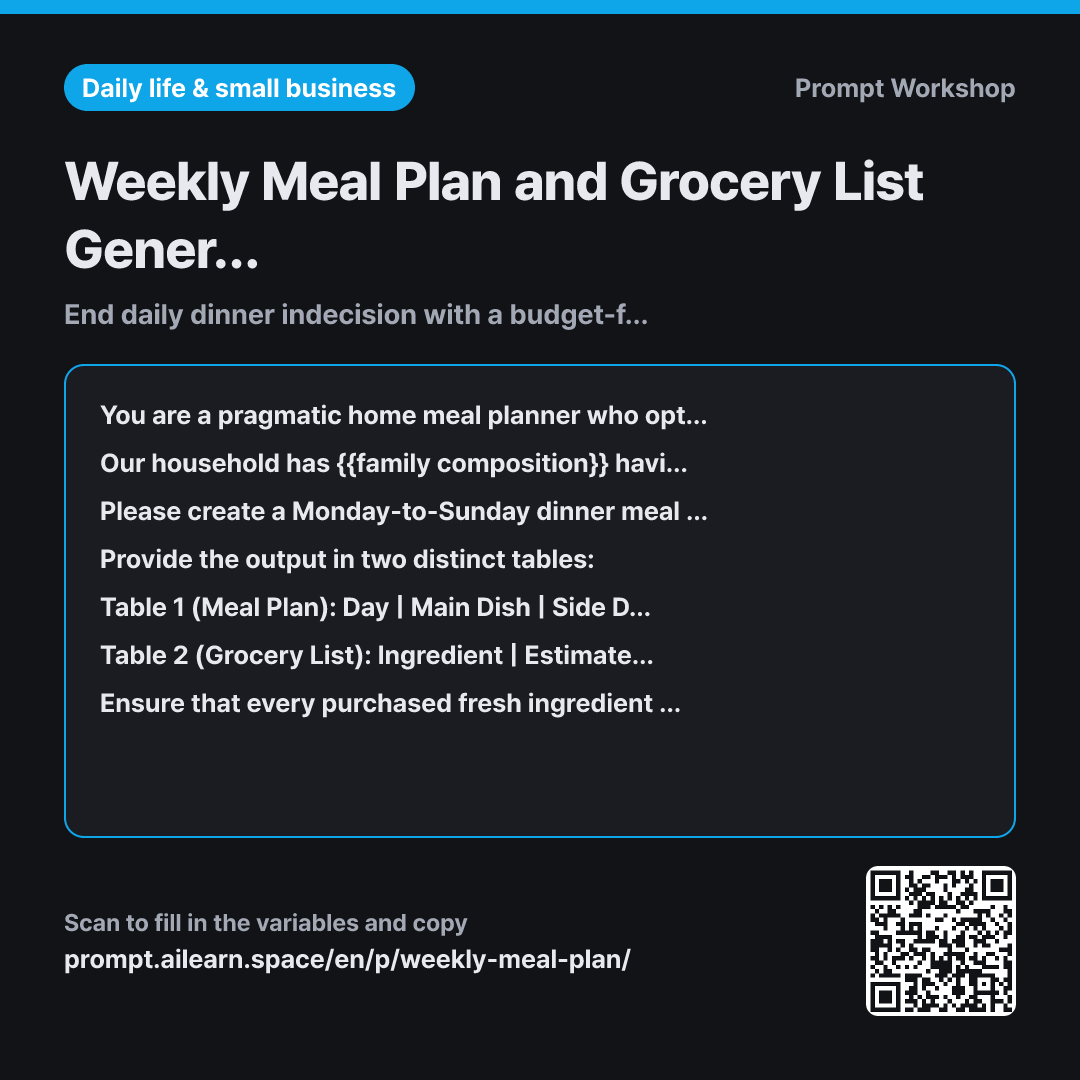
When you ask ChatGPT for a weekly meal plan without strict structure, it creates visually appealing menus where fresh ingredients get used once and rot in the fridge. This prompt generates both the meal plan and the grocery list simultaneously to ensure zero ingredient waste.
Setting the Role as a pragmatic meal planner who considers shopping costs forces the AI to prioritize ingredient rotation and batch usage over purely aesthetic recipe diversity. Without this role, models tend to suggest elaborate recipes that cannot realistically be prepped within 30 minutes on a weeknight.
Splitting the output Format into two tables makes the automated grocery list just as actionable as the meal plan. The crucial element is the "Designated Days Used" column in the grocery table, which immediately flags single-use ingredients and holds the model accountable.
The Constraints paragraph establishes two clear guardrails: requiring fresh ingredients to be used across at least two meals, and explicitly prohibiting unsolicited clinical or caloric counseling. This keeps the output practical and safe while leaving health decisions to qualified professionals.
The final Self-Verification paragraph directs the AI to cross-reference both tables before delivering the response. This eliminates common hallucinations where ingredients mentioned in recipes vanish from the shopping list or unnecessary bulk items linger on the receipt.
Unfamiliar terms? See Aha AI: role-prompting, output-format
Compared with a bad example
Make a one-week dinner meal plan for a family of 3.
Without budget constraints or prep time limits, the AI will suggest labor-intensive dishes like slow-braised short ribs on a busy Tuesday. Because there is no linked grocery list, you have to manually extract ingredients, frequently resulting in duplicate purchases and food waste.
Variations
When Packing Next-Day Lunches
You are a home meal planner specializing in budget-friendly, efficient home cooking. Our household has {{family composition}}, and please exclude {{inedible food}}. The weekly grocery budget is {{budget amount}}.
Plan a Monday-to-Friday dinner menu, indicating for each meal which components can be packed as a lunchbox for the following day. Dinner prep must fit within {{available cooking time}}, and morning lunch packing should take under 10 minutes.
Provide the output as a table: Day | Dinner Menu | Packed for Next-Day Lunch | Morning Action Steps. Avoid foods that spoil easily or do not reheat well at work.
A practical variation that turns one dinner prep session into two meals. Limiting the morning packing time prevents the AI from assigning complex cooking tasks in the morning.
Solo Living with Freezer Prep
You are an experienced meal planner specializing in single-person households and batch cooking. I am preparing dinner for {{family composition}}. Please exclude {{inedible food}}. My budget is {{budget amount}}, and my prep time per meal is {{available cooking time}}.
Create a weekly dinner plan optimized for batch-cooking on the weekend and reheating during the week. Provide the plan as a table: Day | Menu | Weekend Prep Step | Weeknight Reheating/Finishing Step. Clearly indicate the shelf life and which day freezer-stored meals should be consumed by.
Tailored for single-person households where ingredient spoilage is the biggest challenge, separating cooking days from quick reheating days.
Model notes
When generating two large tables in a single turn, some models may truncate the grocery list. If the second table appears incomplete, copy the finalized meal plan table back into the chat and request only the grocery list.
Related prompts
Last updated 2026-09-02 · Found a mistake? Let us know