Why it is written this way
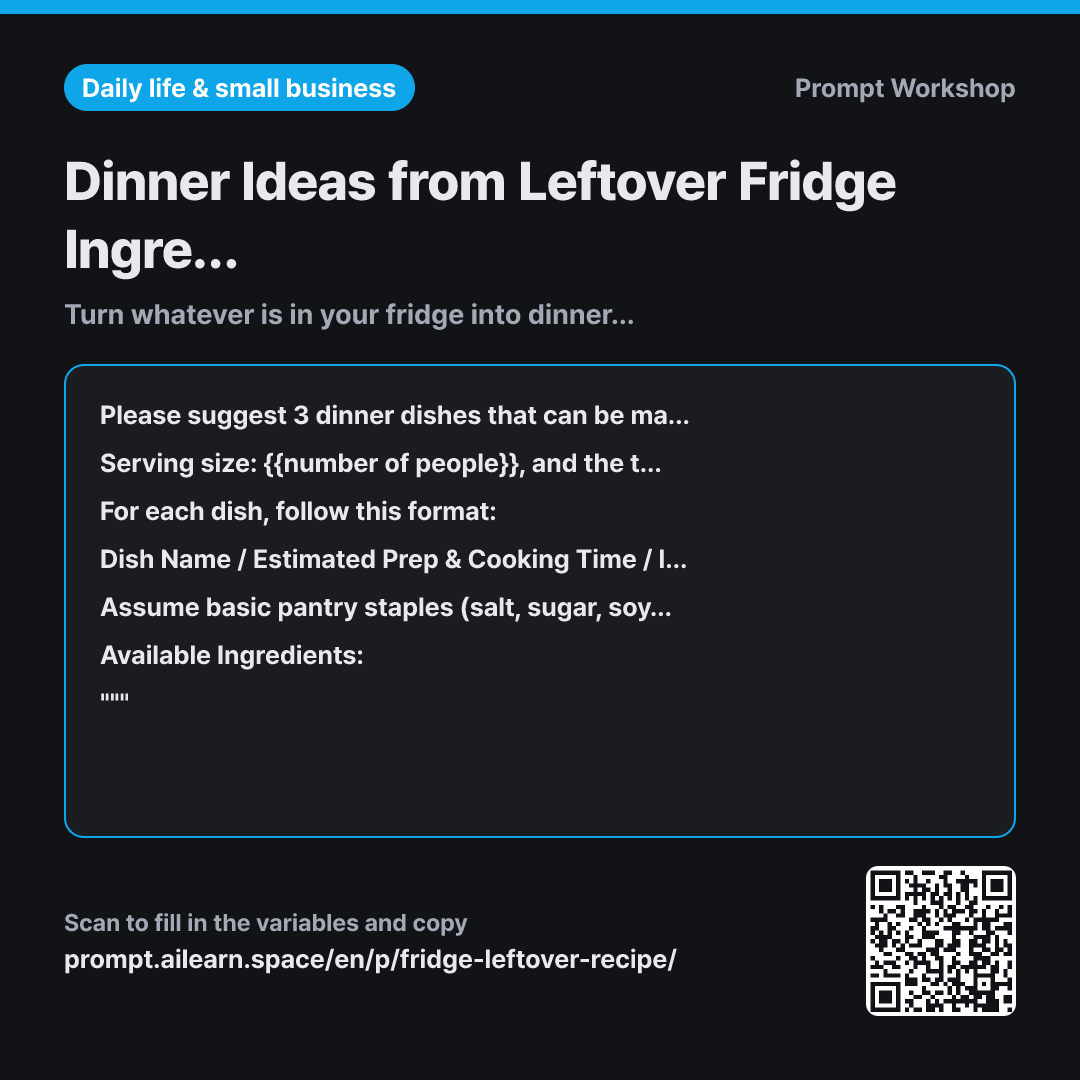
The most common problem when asking AI for recipe recommendations based on fridge contents is that unlisted ingredients sneak into the answer. If you input seven ingredients and the AI responds with "It would be great to add shrimp and bell peppers here," you end up having to go grocery shopping. This prompt dedicates most of its constraints to preventing that single scenario.
Opening the Task paragraph with "using ONLY the ingredients listed below" sets a strict boundary from the first sentence. Specifying 3 dishes is also crucial: without a set count, AI might either give an overly detailed recipe for just one dish or merely list names for ten.
Fixing the output Format ensures you get only the essential information needed to pick a dinner menu. Placing the cooking time upfront forces the AI to automatically filter out recipes that exceed the 30-minute limit. The closing "tip on using leftovers" helps maintain a continuous meal plan with existing groceries.
Defining basic pantry staples as exceptions in the Constraints prevents the AI from assuming you don't even have salt or cooking oil, which leads to bizarre cooking methods. The explicit instruction to omit dishes requiring extra purchases prevents the AI from picking a dish first and casually sneaking missing ingredients into parentheses. Requesting varied cooking styles ensures you don't get three variations of stir-fry.
Unfamiliar terms? See Aha AI: hallucination, output-format
Compared with a bad example
I have eggs, zucchini, onion, tofu, ground pork, kimchi, and scallions. What should I make?
Just tossing ingredients without stating servings or time limits leads to inconsistent portion sizes and arbitrary recipes. Unlisted ingredients creep in (like "try adding minced shrimp"), cooking times are omitted, and you might get recommended a 40-minute braised dish after a long workday. Most of all, explaining one single recipe at length isn't helpful when you're just trying to decide what to cook tonight.
Variations
When Ingredients Need to Be Used Quickly
Identify which of the following ingredients should be used first before spoiling. Suggest 2 dishes that use the maximum amount of those perishable items, scaled for {{number of people}}. Total cooking time must be within {{total cooking time}}.
For each dish, state first which ingredients are being used up and in what quantities, followed by a 4-step cooking process. Do not use any ingredients outside this list.
""" {{available materials}} """
Shifts the evaluation criterion from "delicious meal" to "clearing out the most ingredients." Specifying how much of each item gets depleted makes the rationale behind each recommendation immediately clear.
When Cooking for Kids Together
Suggest 3 dinner dishes for {{number of people}} using ONLY the ingredients below. To make it suitable for both adults and children at the same table, provide a mild base version along with instructions on how adults can add spicy seasonings later. Total cooking time must be within {{total cooking time}}.
Do not use any ingredients outside the list. Since I must personally verify potential allergens, repeat the full ingredient list for each dish.
""" {{available materials}} """
Designed to satisfy two different palates from a single cooking pot. Asking the model to repeat the ingredient list serves as a safety check for the user to inspect for allergens directly.
Model notes
When provided with a long list of ingredients, some models tend to drop items listed in the middle. After receiving the output, follow up with: "List any ingredients from my input that were not used in any of the 3 dishes." This quickly reveals remaining items.
Related prompts
Last updated 2026-09-02 · Found a mistake? Let us know