Why it is written this way
When you ask ChatGPT for gift recommendations, it typically spits out a generic list of ten items: massagers, gift cards, vitamins, or scarves. It looks like a standard search engine result, leaving you just as undecided as before. The core issue is that the AI knows nothing about the recipient.
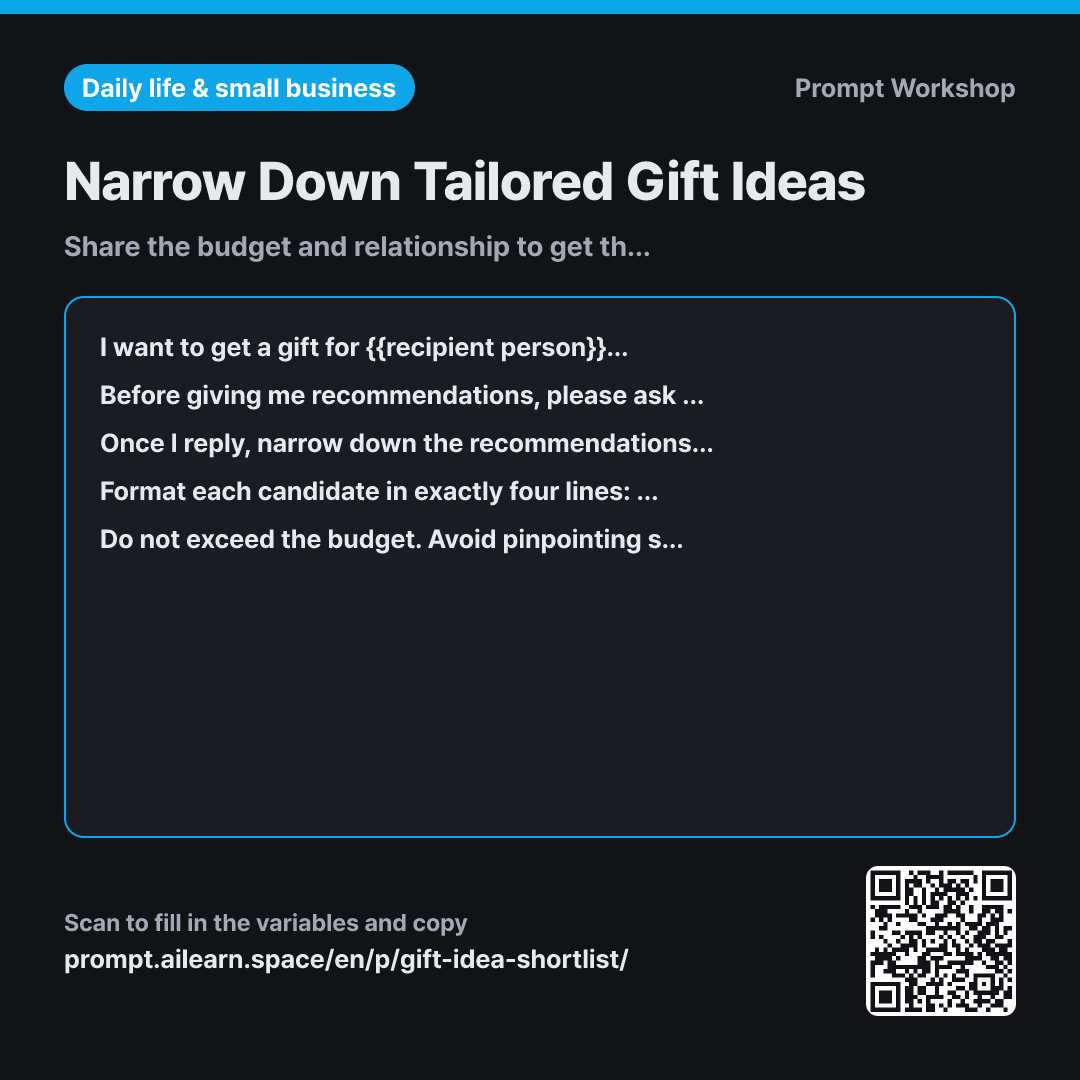
Clarification is the key component of this prompt. Instead of asking for instant answers, prompting it to "ask for missing information first" makes the AI check what the person already owns or what daily frustrations they might have. That single exchange turns generic lists into genuinely viable candidates. Adding multiple-choice options lowers the friction of answering so you do not skip it.
Context (relationship and situation) is crucial because the ideal gift varies dramatically depending on the occasion, even with the same budget. For instance, a birthday dinner and a hospital get-well visit require completely different approaches. Capping the ideas at three with distinct angles makes comparison simple.
Requiring a one-line explanation of "why it fits this person" makes final decision-making easier. Having clear reasoning lets you weigh options side-by-side and immediately spot and discard any weak suggestions.
Constraints prevent two common pitfalls. Barring specific product names prevents hallucinations about discontinued or nonexistent items; focusing on categories lets you easily search for real items yourself. Limiting generic/safe gifts to one ensures you have a baseline safe bet without making the entire list boring and unhelpful.
Unfamiliar terms? See Aha AI: prompt, hallucination
Compared with a bad example
Recommend a birthday gift for my mom with a $80 budget.
Without a single line explaining who your mother is, the AI relies purely on demographic statistics. It churns out generic items like massagers, ginseng, tote bags, or travel vouchers—half of which she might already own. Furthermore, it often confidently quotes specific product names and prices that turn out to be out of stock or completely inaccurate upon searching.
Variations
For Someone Who Has Everything
I need to get a gift for {{recipient person}}, who is my {{interpersonal relationship}}, for {{current situation}}. My budget is {{budget amount}}, but they already own pretty much everything they need, so I want to avoid adding clutter.
Instead of physical objects, please suggest three candidates focused on intangibles—such as shared time, high-end consumables, or services that take care of chores for them. For each candidate, honestly state in one line "what might make the recipient feel burdened or hesitant."
Giving physical objects to someone who has everything often just adds burden. This variant shifts the focus to consumables and experiences while highlighting potential points of hesitation.
Bulk Gifting the Same Item to Multiple People
I want to hand out the same gift to multiple people for {{current situation}}. The budget is {{budget amount}} per person.
Please suggest three product categories that are safe and universally appealing, even if I don't know everyone's personal tastes. For each option, write one line on "who this might not work for" and one line indicating the level of effort required for packaging or handing it out.
When gifting in bulk, avoiding mistakes is more important than catering to niche tastes. Knowing who might not like the item and the logistics effort needed speeds up the decision.
Related prompts
Last updated 2026-09-02 · Found a mistake? Let us know