Why it is written this way
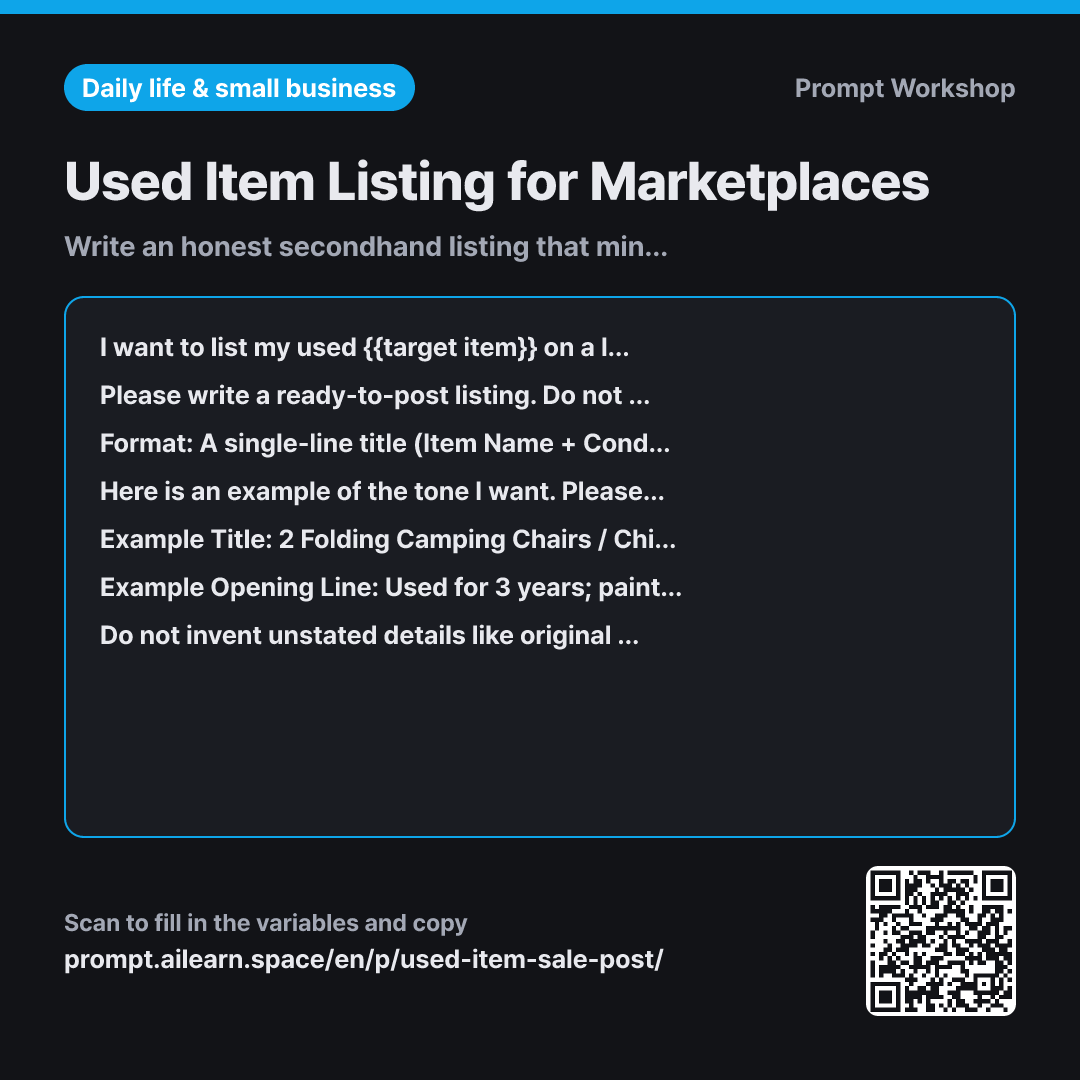
When you ask AI to write a secondhand listing, it usually outputs generic sales hype. Fluff like "gently used" or "pristine condition" might attract initial messages, but buyers will likely back out on the spot when they see the item in person or demand a refund later. This prompt is designed to bring flaws front and center to eliminate wasted trips.
Specifying "scratches, defects, and missing parts at the very beginning" in the Task instruction is key. If you simply ask for an "honest description," the AI will tuck the flaws away at the very end. Setting the sequence ensures buyers see the flaws without scrolling; anyone who still messages you is already accepting of the condition.
Providing an Example locks in the desired tone. Listings packed with hype read very differently from factual, straightforward writeups. Showing just a sample title and opening line is enough for the AI to emulate the exact sentence length and candid tone.
Setting Constraints prevents two common issues: hallucinated details (like inventing an original purchase price or warranty status, which causes disputes) and omitted deal terms. Standardizing the last line to cover location, shipping, and negotiation policy significantly cuts down on repetitive messages asking "Will you ship?".
Wrapping the item condition inside """ delimiters is intentional. If terms like "priced to sell" or "no lowballs" are mixed into the condition notes, the AI might misinterpret them as formatting instructions and alter the entire prompt's tone. Separating data from instructions keeps your input treated purely as factual reference.
Unfamiliar terms? See Aha AI: few-shot, output-format
Compared with a bad example
Write a listing to sell my camping chairs secondhand. Used for 3 years, selling for $30.
Without condition details provided, the AI fills in the blanks with generic praise like "Excellent condition with barely any wear." Posting that will lead to arguments on the spot when the buyer notices chipped paint. The lack of deal terms also invites repetitive inquiries.
Variations
When precise sizing matters (clothing, shoes)
I want to sell my used {{target item}}. Usage period: {{usage period}}, desired price: {{desired target price}}.
Since fit is crucial for this item, buyers often ask about measurements. Please place blank measurement placeholders at the very top of the listing for me to fill in (e.g., [Shoulder Width], [Total Length]). Then follow with Condition → Highlights → Transaction Terms, keeping the entire text around 100 words.
Item condition details: """ {{current status}} """
AI cannot guess exact garment dimensions, so leaving structured brackets prevents hallucinations. Listing measurements upfront drastically reduces sizing inquiries.
Responding to lowball offers
I listed {{target item}} for {{desired target price}}, and a buyer sent an offer asking for a discount.
Please write two short, 2-line response templates: one politely declining, and one stating the lowest price I am willing to accept. Keep the tone courteous yet firm so it does not invite endless back-and-forth haggling.
Vague negotiation replies drag out conversations. Having both decline and counter-offer templates ready lets you quickly copy and paste the right response.
Related prompts
Last updated 2026-09-02 · Found a mistake? Let us know