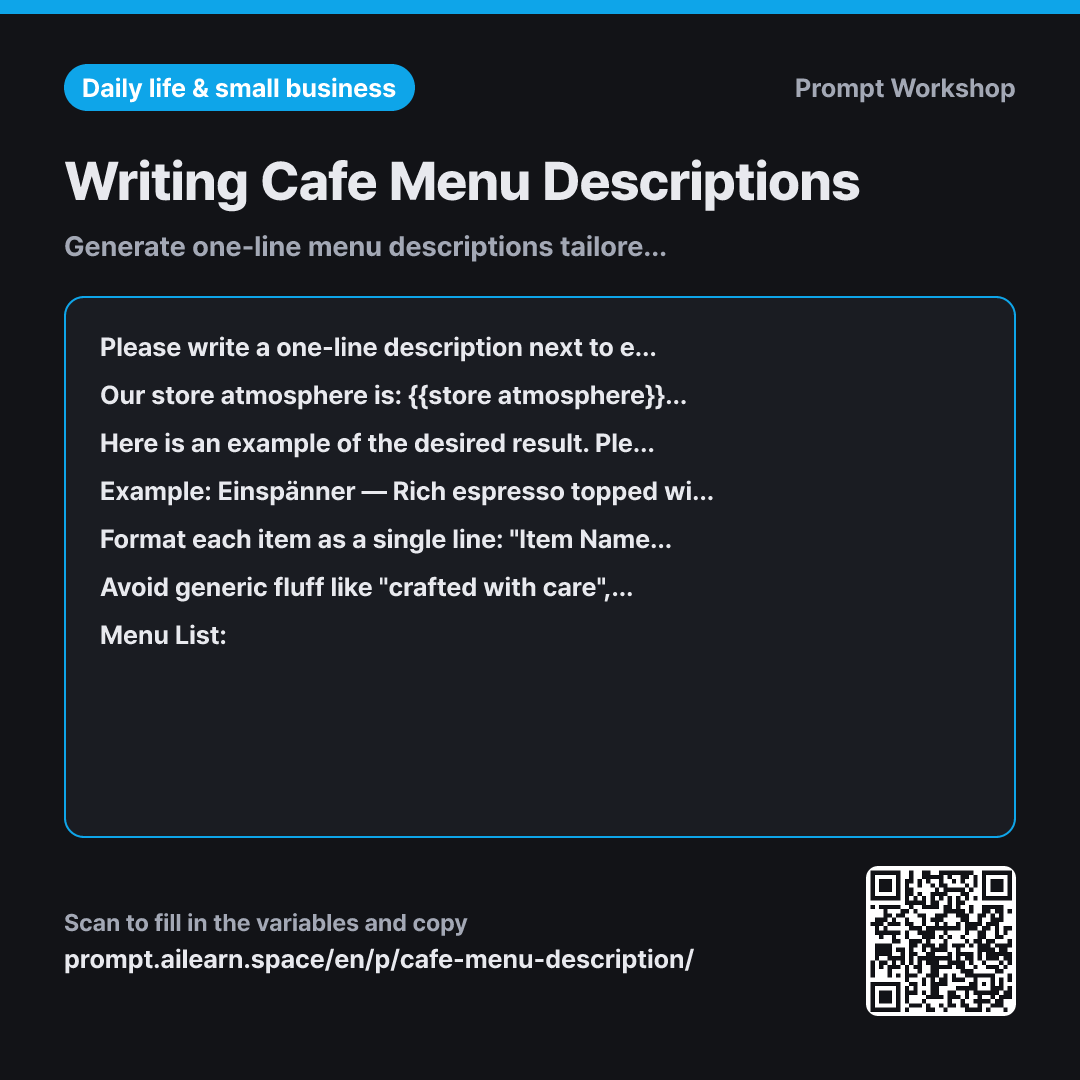
Why it is written this way
When asking an AI to write menu descriptions all at once, the lengths often come out wildly inconsistent—some items get a few words, while others get two full sentences, ruining the layout of a printed menu board. This prompt prevents that by demonstrating the exact target output upfront.
Providing a single line for the Einspänner as an example is the most effective element. Showing a finished line works far better than saying "keep it concise and ingredient-focused" multiple times. The AI immediately infers the length, hyphen formatting, sentence ending, and degree of adjectives. This few-shot approach is especially powerful for menu copywriting.
Specifying the "Item Name — Description" format and word limit reinforces the example as a safety net. With only one example, models tend to write longer descriptions toward the end of the list; setting a numeric constraint keeps lengths uniform all the way to the last item.
In the constraints paragraph, clear guidelines establish what to exclude and what to include. Fluff words waste valuable space without helping the customer decide. Instead, factual details like flavor and sweetness guide purchasing choices. Preventing the AI from inventing unverified bean origins or allergen data is critical, as customers take menu descriptions as factual truth.
Unfamiliar terms? See Aha AI: few-shot, output-format
Compared with a bad example
Write some descriptions for a cafe menu
Americano, Vanilla Latte, Strawberry Latte, Matcha Cream Latte, Basque Cheesecake
Without length criteria, some items get three words while others get two full sentences. Cliche phrases like "exquisite flavor and rich aroma" make all five items sound identical, and unverified details like organic status or specific coffee bean origins may be made up. The AI also frequently scrambles the menu order, forcing you to rearrange items manually.
Variations
For Delivery App Menu Listings
I want to write descriptions for the menu below to use on a food delivery app. Our store atmosphere is: {{store atmosphere}}.
Please write two lines per item. The first line should describe what it is (under 15 words), and the second line should suggest the best occasion to order it (under 12 words). Tailor the descriptions for customers choosing solely based on text and photos. Mark any unverified details with [Verify].
""" {{menu list}} """
Delivery app customers rely entirely on photos and copy to make decisions, so they need more contextual info than in-store diners. This variant expands the line count and adds situational pairing recommendations.
For English Menus with Cultural Items
Please translate and adapt the following menu items and descriptions into English for international guests. Our store atmosphere is: {{store atmosphere}}.
Keep traditional Korean item names phonetically transcribed with a brief explanation in parentheses. Keep each description under 12 words. Do not replace unique Korean ingredients with Western approximations; keep the original term and explain it simply.
""" {{menu list}} """
A common pitfall in food translation is substituting culturally distinct ingredients (like misutgaru or injeolmi) with loose Western approximations. This variant strictly prevents such substitutions.
Model notes
When processing lists longer than 10 items, some models noticeably shorten descriptions toward the bottom. Submit items in batches of five, using your favorite output line in the example placeholder to maintain consistent length and tone.
Related prompts
Last updated 2026-09-02 · Found a mistake? Let us know