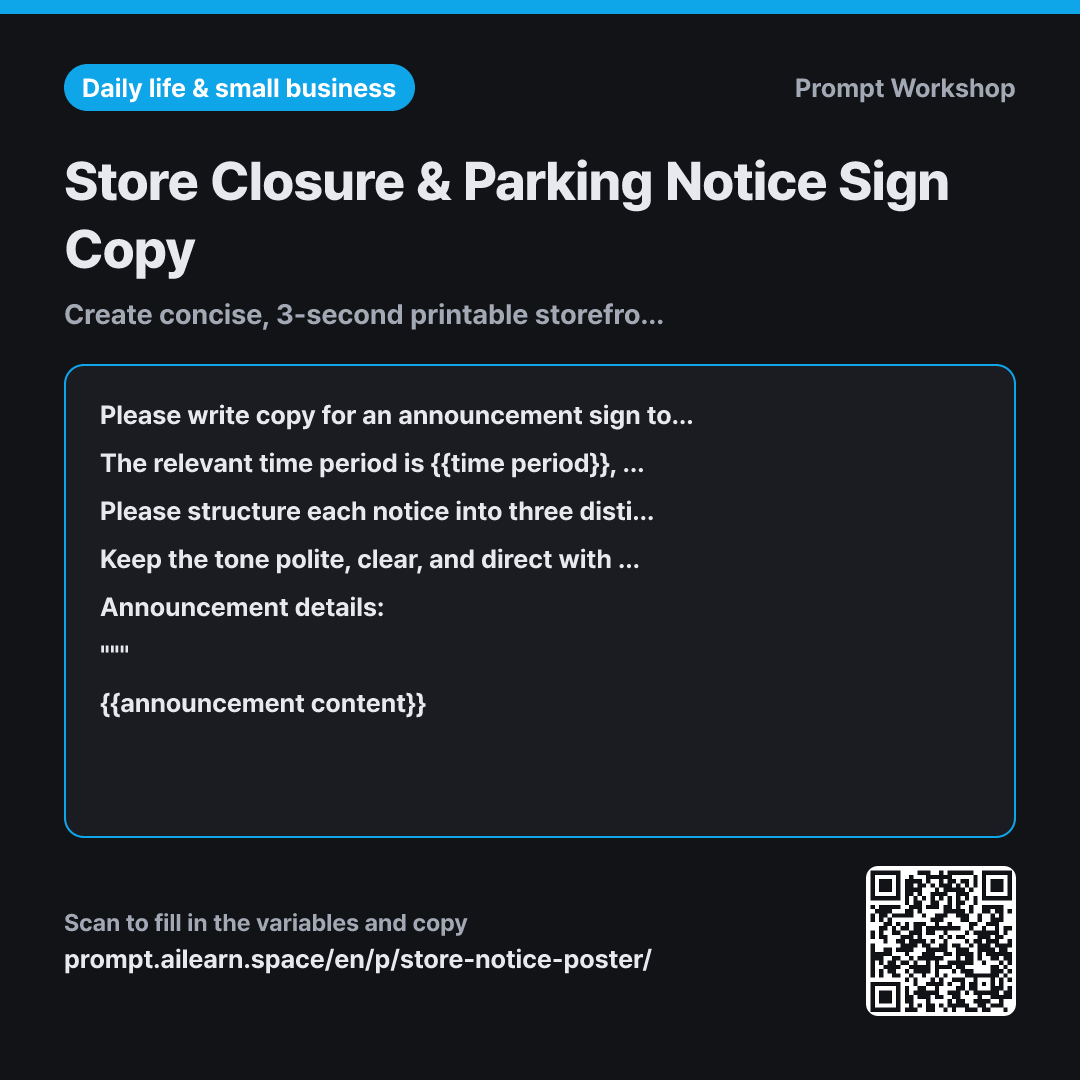
Why it is written this way
If you ask an AI to write a store closure notice without strict constraints, it will generate a lengthy letter starting with "We would like to express our deepest gratitude to our valued customers." A five-line paragraph posted on a door will simply be ignored. For storefront signs, readability is everything—brevity is performance.
The Task specifies "post on a storefront door" upfront to set the medium. The required text length differs drastically across SMS, Google Maps updates, and door signs. Adding "read in 3 seconds" and "single page" guides the AI to automatically minimize filler words.
Structuring the output Format into three distinct blocks is the core of this prompt. Dividing it into a large headline, two-line body, and contact line creates a layout ready for direct printing. Without explicit block divisions, AI tends to cram all details into one dense paragraph. This same layout works equally well for parking notices and temporary closures.
The Constraint section prevents two common pitfalls: fabricating missing information and excessive apologies. Incorrect dates or fake phone numbers lead to operational headaches, so requiring [ ] placeholders ensures human verification. Limiting apologies keeps the crucial reopening dates front and center.
Unfamiliar terms? See Aha AI: output-format, prompt
Compared with a bad example
Write a store closure notice. We are closed for summer vacation from August 12 to 15.
Without formatting guidelines, the AI returns a wall of text dominated by greetings and apologies. Lacking a designated headline, you have to manually edit and reformat the text. Reopening dates get buried mid-paragraph, forcing confused customers to call. The AI might also invent unmentioned reasons like "due to internal circumstances."
Variations
When you need a parking notice
Please write a parking notice sign to post outside {{store name}}. Drivers should be able to read it clearly from inside their cars.
Provide 1 top headline line (under 5 words) and 2 description lines below (under 10 words each). Clearly distinguish where drivers CAN park versus where they CANNOT park. Do not fabricate parking capacity, rates, or operating hours not mentioned below; mark missing info with [ ].
""" {{announcement content}} """
Unlike closure notices, parking signs must clearly contrast allowed vs. prohibited actions. This contrast is built directly into the format.
When posting across text messages and online maps
Please adapt the following announcement into three different lengths based on the exact same facts. The time period is {{time period}}, and the store name is {{store name}}.
1) Storefront door sign — 1 headline line and 2 short description lines, 2) SMS text notification — 1 single paragraph under 160 characters, 3) Google Business Profile announcement — 2 clear sentences under 50 words. Ensure all dates and reopening times are strictly consistent across all three.
""" {{announcement content}} """
When publishing announcements across multiple platforms, date discrepancies happen easily. Generating all versions simultaneously with strict consistency constraints prevents mismatches.
Model notes
LLMs frequently struggle with exact character or word counts. After receiving the output, follow up with: "Please count the words/characters in the headline and description lines." This lets you inspect the exact lengths and trim only the overflow lines.
Related prompts
Last updated 2026-09-02 · Found a mistake? Let us know