Why it is written this way
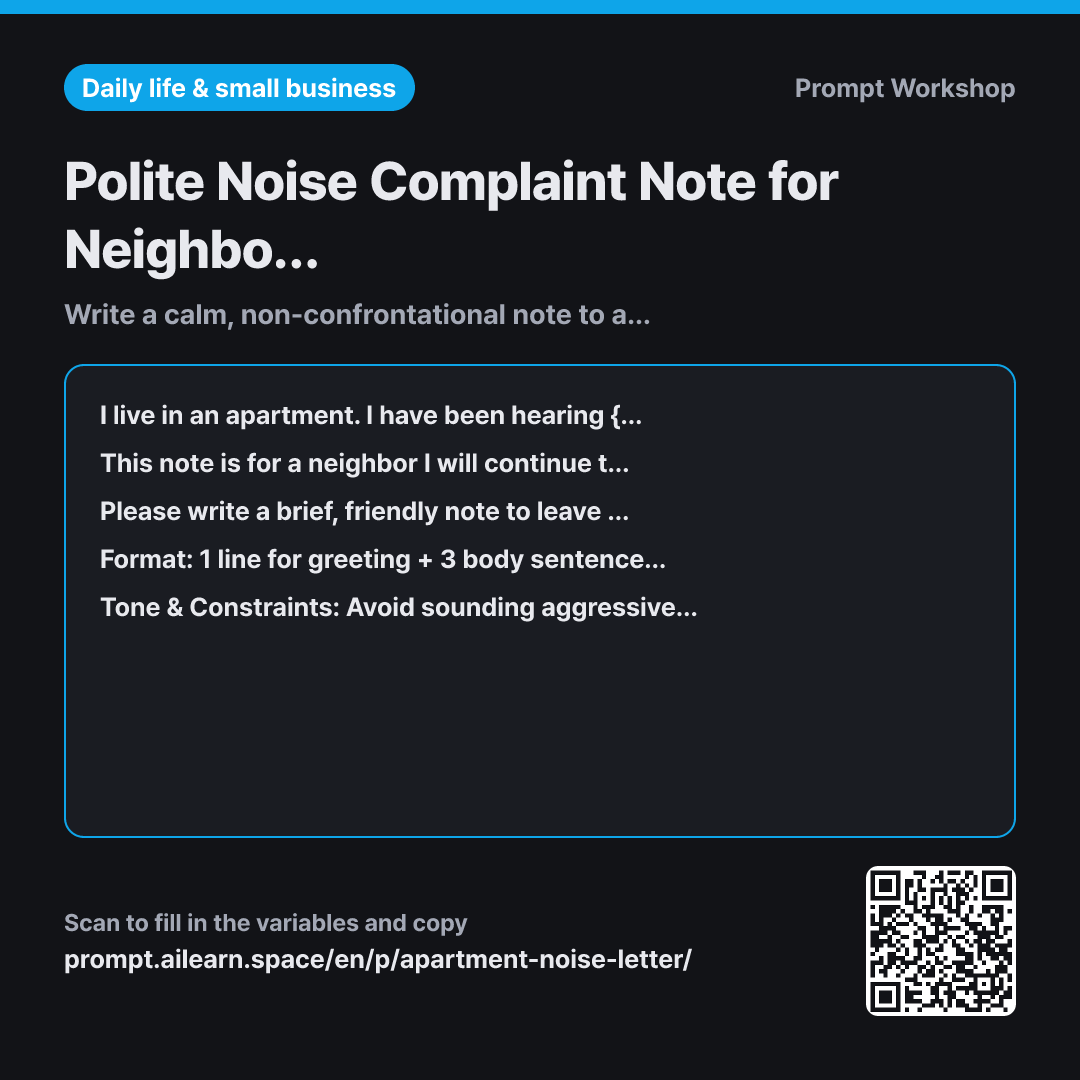
When drafting a noise complaint note on your own, irritation inevitably creeps into the second sentence. That single defensive or angry line turns a simple request into a confrontation, prompting defensive pushback instead of cooperation. This prompt strips away emotional vent while keeping the essential facts needed to encourage a behavioral shift.
There is an intentional design behind having two Context paragraphs. The first lays out the facts (noise type and timeframe), while the second informs the AI that "we will keep bumping into each other in the building." Without this relationship context, the model defaults to formal, legalistic warnings typically found in generic complaint templates. A note meant for someone you share an elevator with every day should read very differently from a formal notice.
Separating the Task to clearly state the {{desired outcome}} is the crux of this prompt. Most complaint notes merely list grievances without offering actionable steps, leaving the reader confused and resentful. Specific requests—such as placing a rug or watching footfalls late at night—give your neighbor a concrete, manageable action.
Structuring the Format into three sentences (Fact → Impact → Request) also serves as an organic length limit. As notes get longer, past grievances accumulate, making the reader feel accused by a laundry list of faults. The Constraints filter out aggressive punctuation, accusatory phrasing, and legal threats. Bringing up regulations in an initial note creates conflict rather than dialogue.
Once generated, read the note aloud as a final check. If any sentence naturally causes your vocal tone to rise aggressively, trim it. The goal of this note is not to win an argument, but to secure a quiet evening starting tonight.
Unfamiliar terms? See Aha AI: context-window, prompt
Compared with a bad example
Write a note complaining about noise to my upstairs neighbor. Their kids run around all night and I can't sleep.
Providing a single line of context causes the AI to produce an overly formal, detached notice like "Your immediate cooperation is requested." Because it omits the specific timeframe and concrete desired action, the recipient will not know what to adjust. Conversely, it might capture the raw emotion directly ("I can't sleep at night"), which will only lead to an awkward confrontation with the property manager the next morning.
Variations
Follow-Up When Noise Persists
I am still hearing {{noise type}} from upstairs during {{time slot}}. I previously left a polite note, but there has been no change for {{total duration period}}.
Please write a second, follow-up note. Mention briefly that I reached out once before, but without blame or resentment. My desired outcome remains {{desired outcome}}, and please add one closing sentence suggesting we briefly chat at a mutually convenient time to work something out. Keep the length around 60–80 words.
Repeating the exact same request on a second note rarely works. Adding a friendly invitation to talk opens up the next constructive step.
Advance Notice to Neighbors About Potential Noise
I want to give my neighbors a heads-up that my unit might produce {{noise type}} during {{time slot}} for about {{total duration period}}.
Please write a short, considerate notice to post outside my door. State clearly in one sentence what kind of noise might occur and until when, follow with one sentence explaining the steps we are taking to minimize it, and conclude by inviting them to reach out if it causes any disruption. Avoid over-apologizing and keep it under 60 words.
A preemptive note from the resident generating noise. Giving advance notice makes the disruption far more tolerable to neighbors.
Related prompts
Last updated 2026-09-02 · Found a mistake? Let us know