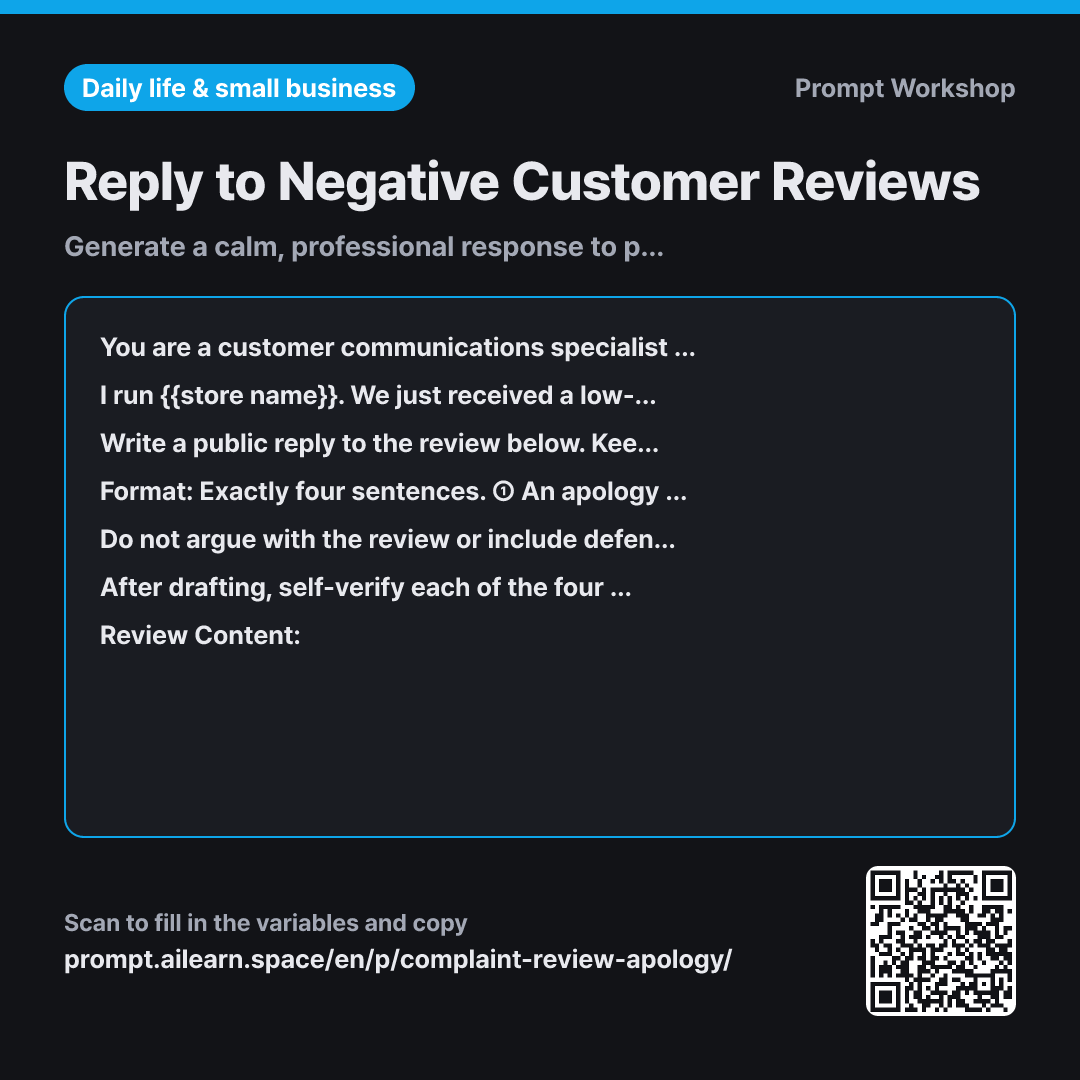
Why it is written this way
Most failed replies to negative reviews suffer from a single flaw: letting frustration slip through. Copying generic apology templates often feels disconnected from the specific situation, while writing manually tends to inject raw emotion. This prompt explicitly establishes the premise that the true audience is the next potential customer browsing the page.
Setting the role as an online reputation specialist shifts the recipient of the message. When asked simply for an "apology reply," AI focuses on appeasing a single reviewer. A reputation specialist, however, writes for the broader public. The context paragraph collects internal facts separately for the same reason—without it, the AI blindly assumes all customer claims are absolute truth and offers excessive, ungrounded apologies.
Structuring the format into four clear sentences (Apology → Fact → Action → Re-invitation) prevents emotional defensiveness. It starts with a concise one-sentence apology and immediately pivots to actionable steps that future diners want to see. The constraints block defensive arguments, prevent making unauthorized compensation promises, and ensure private customer details are not exposed in a public forum.
Finally, the self-evaluation prompt asks the model to review its own output against all four requirements before finalizing. Wrapping the raw review in """ delimiters ensures any hostile language in the review is treated strictly as data rather than prompt instructions.
Once posted, replies rarely notify reviewers when edited. Before posting, do a quick visual check to ensure the promised actions are feasible and no sensitive customer details were repeated.
Unfamiliar terms? See Aha AI: role-prompting, prompt-injection
Compared with a bad example
Please write an apology reply to this review.
(Paste review)
Without providing verified facts or available measures, the AI will invent unrealistic promises like "We will fix this immediately" or "We will issue a full refund." Lacking length constraints, the apology drags on for five sentences, burying the practical actions prospective diners actually care about.
Variations
Short Reply for Delivery Apps
Write a reply to a delivery review received for {{store name}}. The verified facts are {{factual relation}}, and what we can offer is {{available action measure}}.
Write exactly two sentences: one sentence for an apology and one sentence for our action measure. Skip generic pleasantries like "Thank you for your valuable feedback" and start directly with the main point.
Review Content: """ {{review content}} """
Delivery app interfaces often display only the first two lines of a merchant reply. Skipping generic intros ensures both the apology and the action measure remain visible without truncation.
Addressing Inaccurate or Misleading Claims
Write a reply to the following review posted for {{store name}}. The verified facts are {{factual relation}}.
First, list the points in the review that do not match our verified facts. Next, write a four-sentence reply that addresses the facts calmly without sounding confrontational. Avoid phrases like "That is incorrect" or "You are mistaken," and instead objectively explain our standard operating procedures.
Review Content: """ {{review content}} """
Listing discrepancies first allows the business owner to review factual gaps clearly. The response itself avoids direct confrontation, ensuring the tone remains calm and professional rather than argumentative.
Related prompts
Last updated 2026-09-02 · Found a mistake? Let us know