Why it is written this way
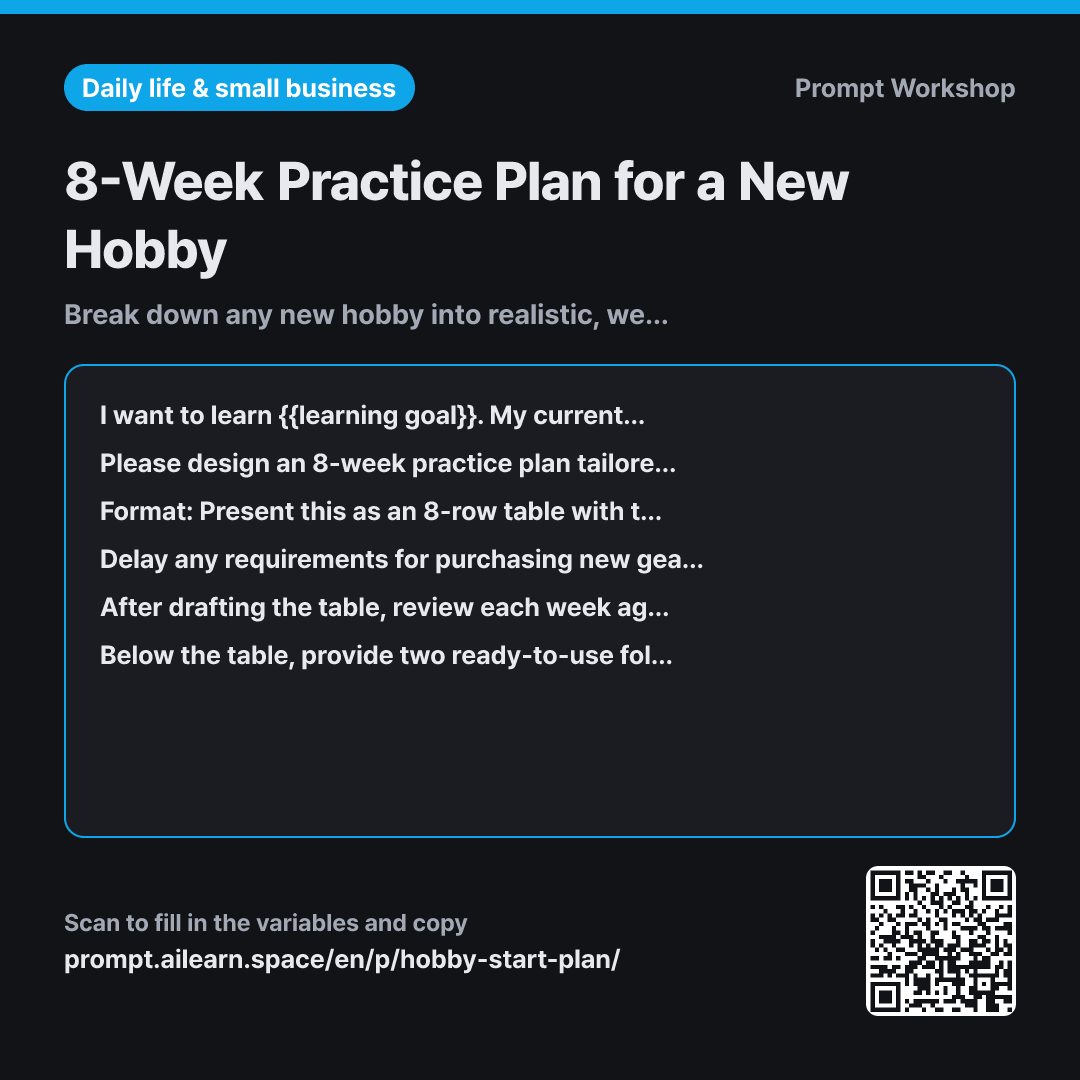
When asking AI to build a hobby learning plan, it often schedules an hour a day right from Week 1. While this looks ambitious and exciting initially, missing just one session after a late workday makes the whole plan feel ruined, leading many to quit entirely. This prompt prioritizes achievable sustainability over idealized intensity.
Including both current proficiency and realistic practice time in the context is crucial. Instead of a vague estimate like "3 hours a week," breaking it down into chunks like "20 minutes on 3 weekday evenings" prompts the AI to size tasks to fit within a single 20-minute window. The "Single Session Task Breakdown" column in the format ensures this bite-sized pacing.
Setting a clear "Completion Benchmark for the Week" prevents self-taught schedules from drifting aimlessly. Without explicit criteria, learners cannot evaluate their progress, leading to burnout before the routine becomes enjoyable.
Postponing gear purchases and paid courses until after Week 5 also minimizes dropouts. Buying equipment immediately adds financial pressure, which can turn into avoidance. Surviving the first 4 weeks before investing is much safer.
The verification step forces the AI to audit its own plan. While drafted weeks may sound reasonable on paper, they often exceed realistic time limits starting around Week 3. Asking it to trim overloaded weeks and show only the revised result delivers a calibrated schedule. Finally, generating follow-up adjustments beforehand ensures you can easily tweak the plan in a couple of weeks (e.g., "This is too overwhelming; please cut the workload from Week 3 onward in half") without starting from scratch.
Unfamiliar terms? See Aha AI: output-format, self-consistency
Compared with a bad example
I want to learn guitar, make me an 8-week plan.
Without proficiency level or available time constraints, the AI assumes 30–60 minutes of daily practice. Week 1 gets packed with eight chords and four strumming patterns, alongside hallucinated book titles and paid courses. Worst of all, lacking weekly completion benchmarks leaves the learner uncertain of progress, usually resulting in abandonment by Week 3.
Variations
When you only have 10 minutes a day
I want to learn {{learning goal}}, but I can only dedicate 10 minutes per day. My current level is {{current proficiency level}}.
Please create an 8-week plan where every single practice session strictly takes 10 minutes or less. Include setup and pack-down time within that 10-minute limit. Format the plan as a table with three columns: "Week / Daily 10-Minute Task / Weekly Completion Benchmark".
When practice time is extremely tight, setup and wrap-up can eat away the entire session. Accounting for setup time dramatically increases the realism of micro-practice plans.
Adjusting the plan after 2 weeks of practice
I followed the 8-week plan for {{learning goal}} for 2 weeks. Here is what I actually managed to accomplish: {{current proficiency level}}
Please recalibrate the remaining 6-week schedule. Use my actual sustained practice volume as the baseline. Keep the ultimate goal as {{target goal}}, but if that now seems unrealistic, provide two alternative scaled-back goals as well.
Plans rarely work perfectly on the first try; they need calibration based on real data. Rebuilding the remaining weeks around what was actually completed makes the rest of the journey much more attainable.
Related prompts
Last updated 2026-09-02 · Found a mistake? Let us know