Why it is written this way
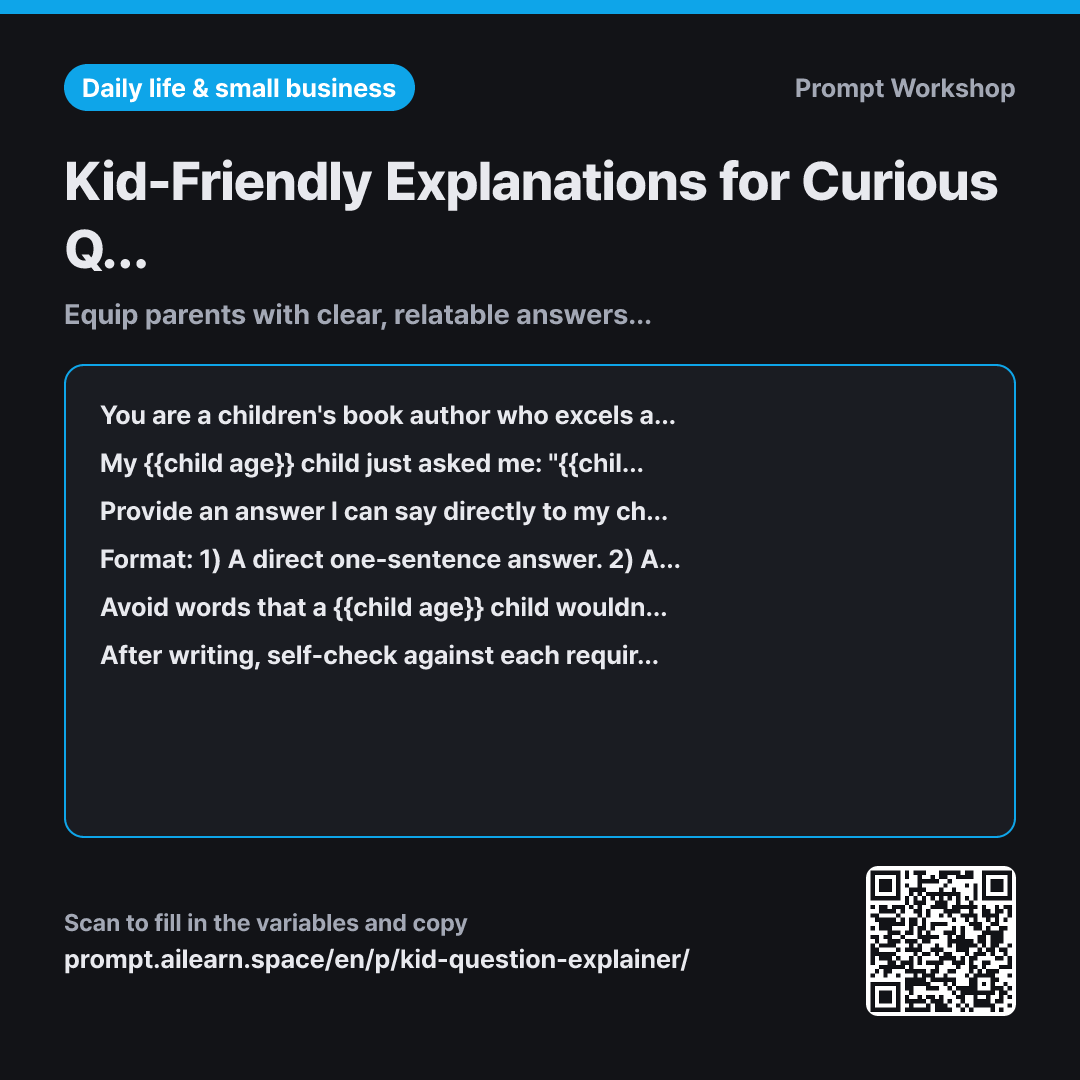
Reading standard AI answers directly to a child often results in them losing interest midway through. Simply asking to "explain simply" often prompts the AI to deliver adult-level explanations shortened by a couple of sentences—like an abridged encyclopedia entry. This prompt reinforces at every step that the intended listener is a child.
Assigning the Role of a children's book author changes the starting point of the explanation. While a teacher or scientist might focus on technical steps in chronological order, a children's author begins with a scene familiar to the child and bridges outward from there. When looking for kid-friendly AI explanations, this intuitive entry point matters far more than mere technical precision.
Repeating the age within the Constraints section keeps the model grounded. Even if age is specified early on, AI tends to drift back into adult language over longer passages; keeping the age constraint close to negative rules significantly counters this habit. The instruction to admit unknown facts is equally vital: children frequently ask deep questions where science has no definitive answer, and AI has a habit of hallucinating confident explanations.
Finally, the Self-Check instruction forces an internal review step. Generating everything in a single pass often leaves one or two difficult words behind. Instructing the AI to verify the conditions and present only the final result hides the drafting process and delivers a clean, ready-to-use answer.
Including a likely follow-up question prepares parents for real-world conversations, which rarely end with one answer. Having that next one-liner ready keeps parents from stumbling and teaches the child that asking questions leads to satisfying discoveries.
Unfamiliar terms? See Aha AI: role-prompting, hallucination
Compared with a bad example
Explain why rainbows form so a 6-year-old can understand.
Even with the age specified, generic prompts often produce answers like "light refracts through water droplets." Without instructions to use analogies, word limits, or follow-up prep, parents still have to translate the response. When the child asks "What does refract mean?", the parent is left stuck on the spot.
Variations
Short Bedtime Answer
My {{child age}} child asked this right before going to sleep: "{{child question}}"
Provide an answer in exactly three sentences. Sentence 1: A direct answer to the question. Sentence 2: An explanation using an everyday analogy the child knows. Sentence 3: A gentle wrap-up phrase like "Let's explore more about it tomorrow!" Avoid any difficult vocabulary.
At bedtime, long explanations backfire. Capping the response at three sentences with a designated wind-down line prevents the conversation from dragging out.
With Follow-Up Activity
Here is a question from my {{child age}} child: "{{child question}}"
Write an explanation to tell my child in about 100 words. Below it, suggest two quick activities we can do together using common household items (2 lines each). Only suggest materials easily found at home or in the kitchen, and strictly exclude activities involving fire, heat, or sharp tools.
Kids quickly forget verbal explanations alone. Setting clear safety and material constraints produces practical, low-effort activities you can do immediately.
Related prompts
Last updated 2026-09-02 · Found a mistake? Let us know