Why it is written this way
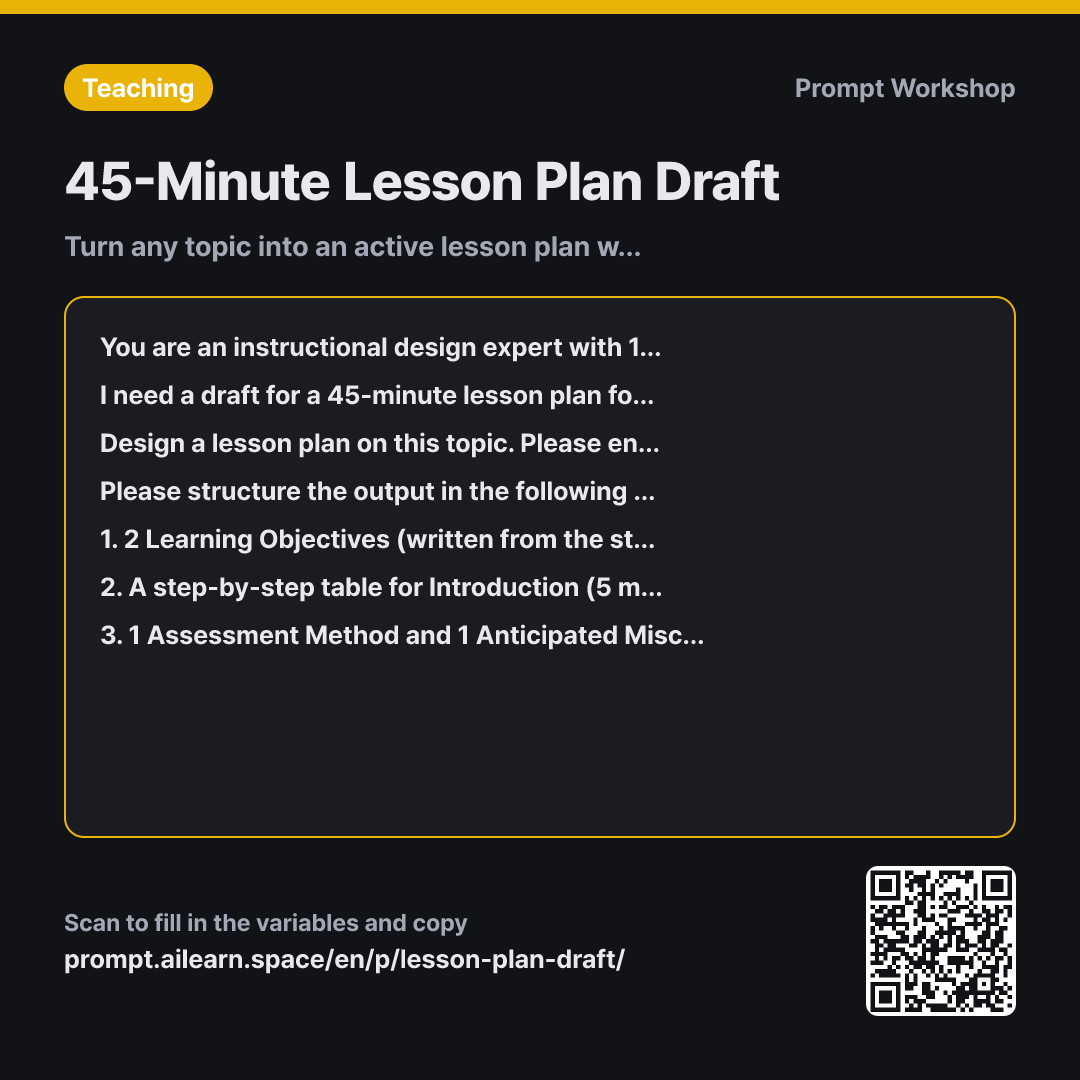
A lesson plan is a highly structured document, making it an ideal task for AI. However, if you don't define the format, the AI will default to its own structure, forcing you to waste time reformatting everything into your school's template. That is why the format section of this prompt is the most detailed. Specifying three numbered sections and the exact table headers allows you to copy and paste the result directly into your lesson template.
Adding "15 years of experience" in the role is not just decorative text. Defining teaching experience prompts the AI to provide pedagogical insight—such as identifying common pitfalls—rather than simply reciting standard textbook outlines. The "anticipated misconception" requirement in the final section directly leverages this expertise. The context provided by the grade level and topic directs this judgment effectively; the misconceptions around "changes of state" differ significantly between 4th grade and 8th grade.
In the task section, the requirement that "student activity occupies more than half of the total class time" is the single most impactful instruction. Without this constraint, AI-generated lesson plans skew heavily toward teacher-led lecturing. If you want an active, student-centered classroom, adjust this time ratio accordingly.
The constraint instructing the model not to fabricate content is crucial for educational planning. AI models frequently invent non-existent lab video titles or textbook page numbers. It is safer to have the AI list the required resource types so the teacher can select actual materials. Finally, asking for instructions "in direct speech" provides ready-to-use verbal prompts for the teacher during class.
Unfamiliar terms? See Aha AI: role-prompting, hallucination
Compared with a bad example
Create an 8th grade science lesson plan about changes of state.
While all essential keywords are present, it lacks formatting requirements and pedagogical constraints. The result will likely be a lecture-heavy plan where teacher explanations dominate the period, requiring extensive restructuring to fit standard formats. Key elements like misconceptions and assessments are usually omitted unless explicitly requested.
Variations
Include Student Worksheet
You are an instructional design expert with 15 years of experience teaching {{academic subject}}. Please create a student worksheet for the main activity phase (30 minutes) of a lesson on "{{main central topic}}" for {{student grade level}} students.
Structure: 1 Essential Question → 3 Check-for-Understanding Questions (Easy, Medium, Hard) → 1 Pair Discussion Prompt → 1 One-Sentence Summary Box for key takeaways. Provide an answer key and scoring criteria separately at the end of the worksheet. Keep all student-facing text clear, concise, and concrete.
Request this in the same conversation right after generating the lesson plan to get a worksheet that perfectly matches the planned activities.
For Lower Elementary
You are an instructional design expert with 15 years of experience teaching elementary {{academic subject}}. Create a 40-minute lesson plan on "{{main central topic}}" for {{student grade level}} students.
Break the lesson into 3–4 short activities, ensuring no single activity exceeds 10 minutes, and include a physical movement or hands-on making component in each activity. Structure the response in this order: 2 Learning Objectives → Step-by-Step Table (Teacher Activity, Student Activity, Materials, Time) → 1 Wrap-up Activity. Keep all spoken instructions to students limited to one clear action per sentence.
Tailored for younger students with shorter attention spans by explicitly constraining activity length and structure.
Model notes
If you ask for specific national or state curriculum standard codes, the AI may hallucinate them. Paste your specific standards directly into the prompt and add: "Align with these standards:"
Related prompts
Last updated 2026-09-02 · Found a mistake? Let us know