Why it is written this way
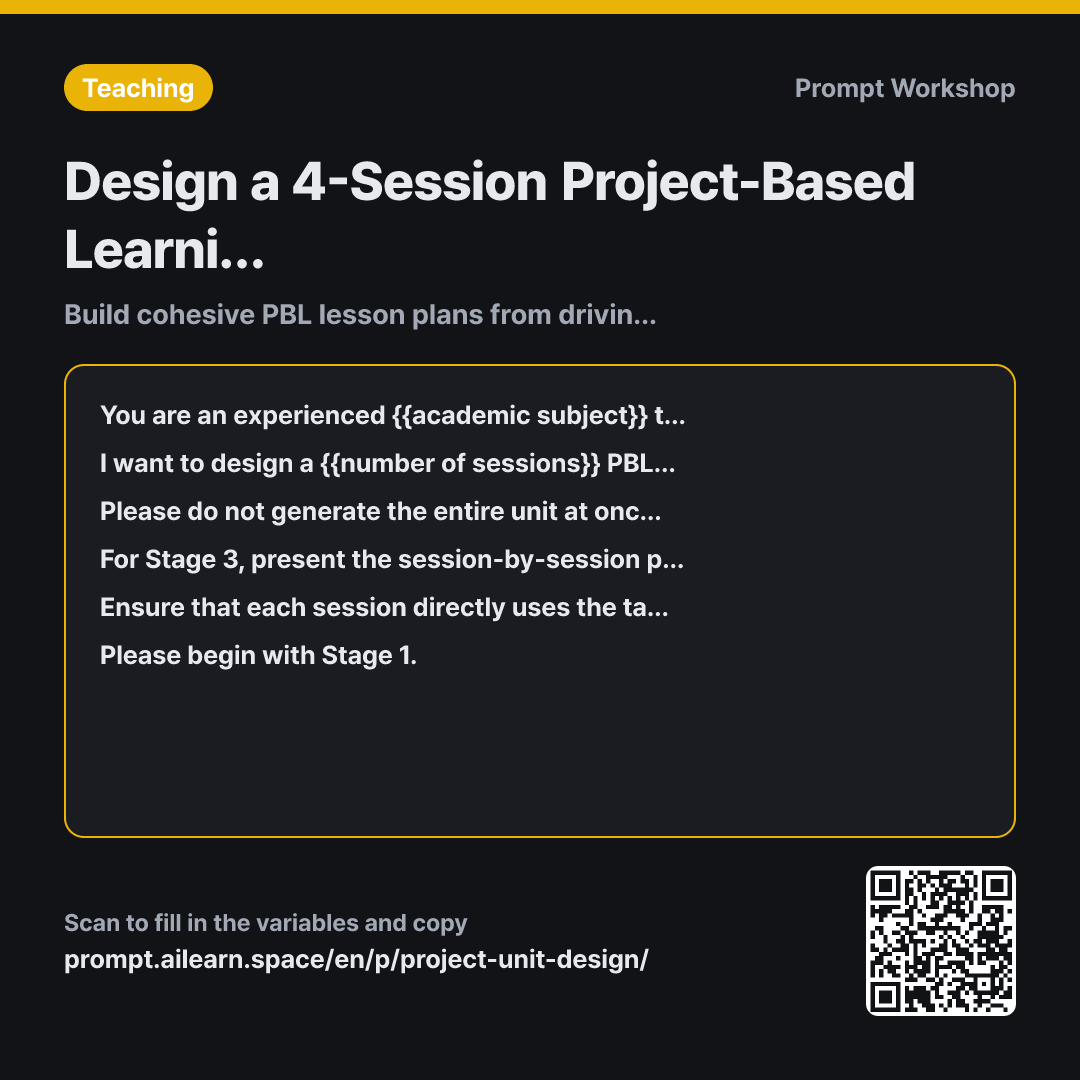
Asking ChatGPT to design a full PBL unit in a single prompt usually generates a generic plan with disconnected sessions—researching on day 1, discussing on day 2, building on day 3, and presenting on day 4. Because outputs from one session are not passed to the next, students end up restarting from scratch every class.
Breaking the planning into three sequential stages is the core structure of this prompt. The driving question determines the deliverable, and the deliverable determines the session breakdown. Inverting this order forces irrelevant activities into the lesson. Halting at each stage to wait for teacher approval is critical because the choice made at each step changes the entire trajectory of the unit.
Including specific context—class size, group size, and available tools—ensures feasibility. Without these constraints, the AI often includes unrealistic field trips or expert interviews. The "Tangible Milestone Produced" column in the format connects each session to the next, forcing the AI to define what concrete output must be handed over before designing the activities.
The [Check Data] placeholder under constraints prevents students from wasting time searching for hallucinated contest names or fake statistics. Setting an explicit homework limit keeps the project manageable without overwhelming students' evenings.
Unfamiliar terms? See Aha AI: context-window, hallucination
Compared with a bad example
Create a 4-session PBL unit plan for 9th-grade social studies on improving local bus routes.
This will return a generic table that could fit almost any topic. Without a central driving inquiry question, it is unclear what students are investigating. Because the final deliverable only appears in the last session, the first three sessions feel like disconnected busywork. Group roles and grading rubrics are omitted unless explicitly requested, forcing the teacher to rebuild them later. Without constraints on student tools and field trips, impractical tasks like in-person site visits often slip in.
Variations
Cross-Curricular Interdisciplinary Unit
I want to design a {{number of sessions}} interdisciplinary PBL unit for {{student grade level}} students on "{{project core topic}}", combining {{academic subject}} with another subject. First, propose 2 candidate partner subjects that naturally fit this topic along with the instructional role each subject would play. Once I select one, generate a session-by-session table showing which subject covers what activity and what materials or artifacts must be handed over between the two teachers.
The biggest challenge in interdisciplinary units is handoff logistics between teachers. This variant builds that coordination directly into the lesson table.
Presentation & Assessment Only
Please design the final presentation session for a {{student grade level}} project on "{{project core topic}}". Provide a detailed timing agenda allowing 6 groups to present within one class period, 4 peer-evaluation questions for student listeners, and a 3-criterion teacher rubric (using a 3-level scale with observable behavioral descriptors). Ensure the rubric prioritizes evidence of the inquiry process over superficial polish.
Use this when your unit content is ready, but you need a concrete presentation schedule, peer feedback sheet, and scoring rubric.
Model notes
After each stage produces an output, continue in the same conversation thread to request the next stage. Starting a new chat will lose the chosen inquiry question and deliverable context.
Related prompts
Last updated 2026-09-02 · Found a mistake? Let us know