Why it is written this way
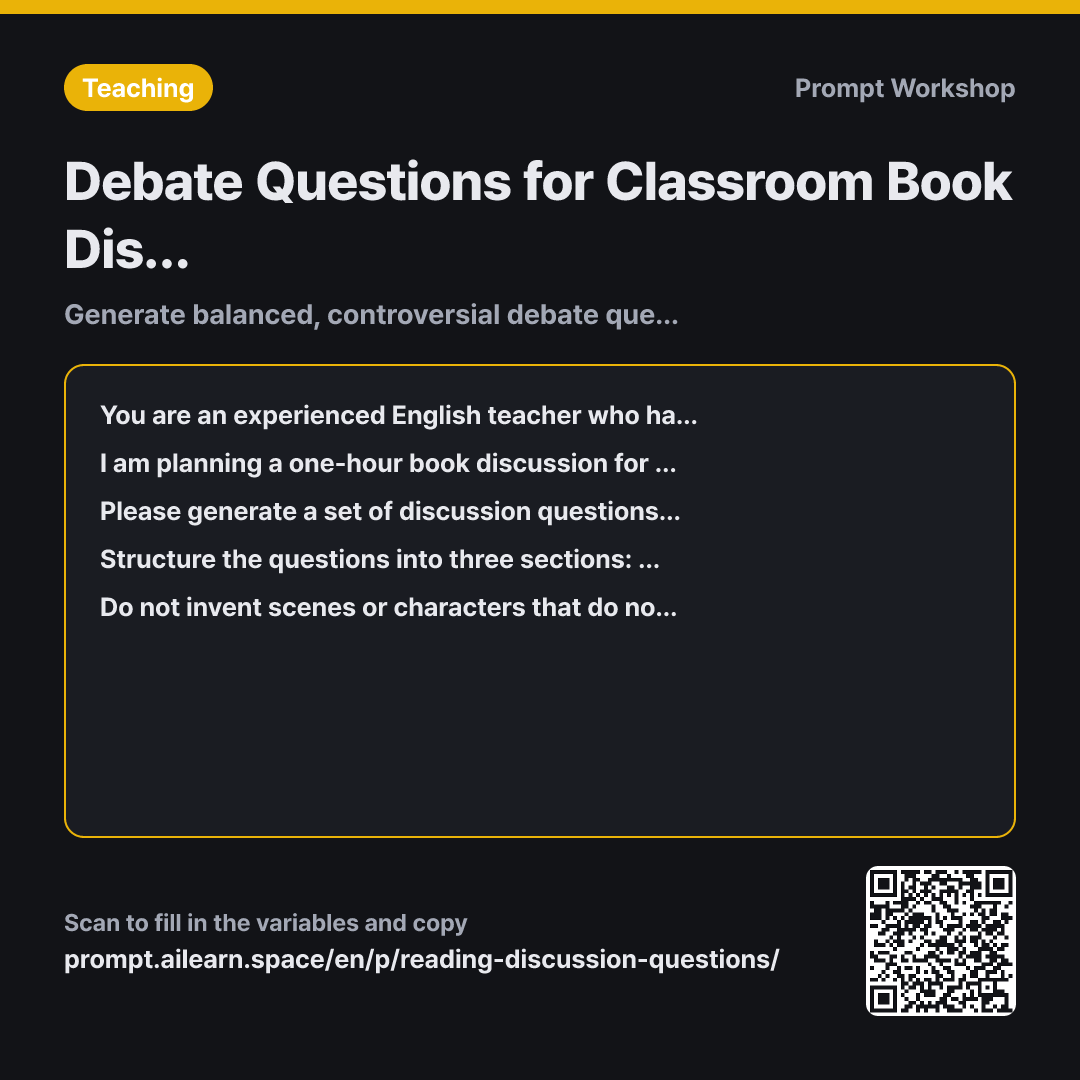
When you ask AI for book discussion questions, it typically generates generic comprehension checks like "Why did the main character make that choice?" While helpful for verifying reading comprehension, these fail to start a debate. When questions lead to a single obvious answer, students have little to say to one another, and the session turns into a few isolated student presentations.
The Task section explicitly cuts out "plot-recall questions" to prevent this issue. When simply told to make good questions, AI tends to play it safe with factual recall. You must specify what to omit so debatable topics can take their place. Assigning the Role of a teacher who "knows which questions spark genuine disagreement" serves the same purpose—specifying teaching expertise refines the quality of the output far better than a generic job title alone.
The three-part Format matches the natural arc of a 60-minute lesson: warming up recall, clashing over controversial issues, and reflecting on personal relevance. Requiring one argument for each side allows the teacher to vet the balance beforehand. If compelling arguments only exist for one side, the question is not truly debatable and should be dropped.
The Constraints prevent two common pitfalls: AI hallucinating book details to support an argument, and phrasing that leads students toward a preferred stance. A question like "Wasn't it wrong for the character to...?" ends the debate before it starts. Checking against these constraints ensures ready-to-print questions that spark real classroom engagement.
Unfamiliar terms? See Aha AI: role-prompting, hallucination
Compared with a bad example
Create 10 book discussion questions for The Giver
Asking for an unconstrained list yields a random mix of plot quizzes and vague reflections. Questions like "What was your favorite scene?" produce varied answers, but they do not challenge peers or spark a debate. Without supporting arguments provided for each side, the teacher must manually evaluate every question and verify whether the referenced scenes actually exist in the book.
Variations
For a structured formal debate
I am preparing a structured debate for {{student grade level}} students on "{{published book title}}". Please select a single central debate topic. In a structured table, provide the reason for choosing this topic, 3 opening arguments for the affirmative, 3 opening arguments for the negative, and 2 cross-examination questions each side can ask the other. Cite the specific scene or chapter in the book where each piece of evidence comes from, and do not include details not present in the text.
Narrowing down to a single resolution shifts the prep work to constructive speeches and cross-examinations. Use this for structured, competitive debate formats.
For individual reading worksheets
Please create an individual reading worksheet for {{student grade level}} students based on "{{published book title}}". To support independent writing, indicate the number of blank lines to provide for each answer, and add "There is no single correct answer" next to open-ended questions. Structure the worksheet with: 1 pre-reading question, 2 comprehension check questions, 3 critical-thinking reflection questions, and 1 short paragraph writing prompt.
Use this variant when transitioning from oral discussion to independent written work. Labeling open-ended questions helps students express opinions freely without second-guessing.
Model notes
AI models occasionally misremember specific plot points. Verify that the evidence provided for each debate topic corresponds to actual scenes in the book before distributing the materials to students.
Related prompts
Last updated 2026-09-02 · Found a mistake? Let us know