Why it is written this way
Without a prepared question sequence, classroom questioning tends to default to simple recall. Questions like "What year did this happen?" or "What was this called?" are easy to ask and yield quick answers, but they stop student thinking right there. Conversely, receiving a random list of ten questions creates mixed difficulty levels without a clear pedagogical sequence.
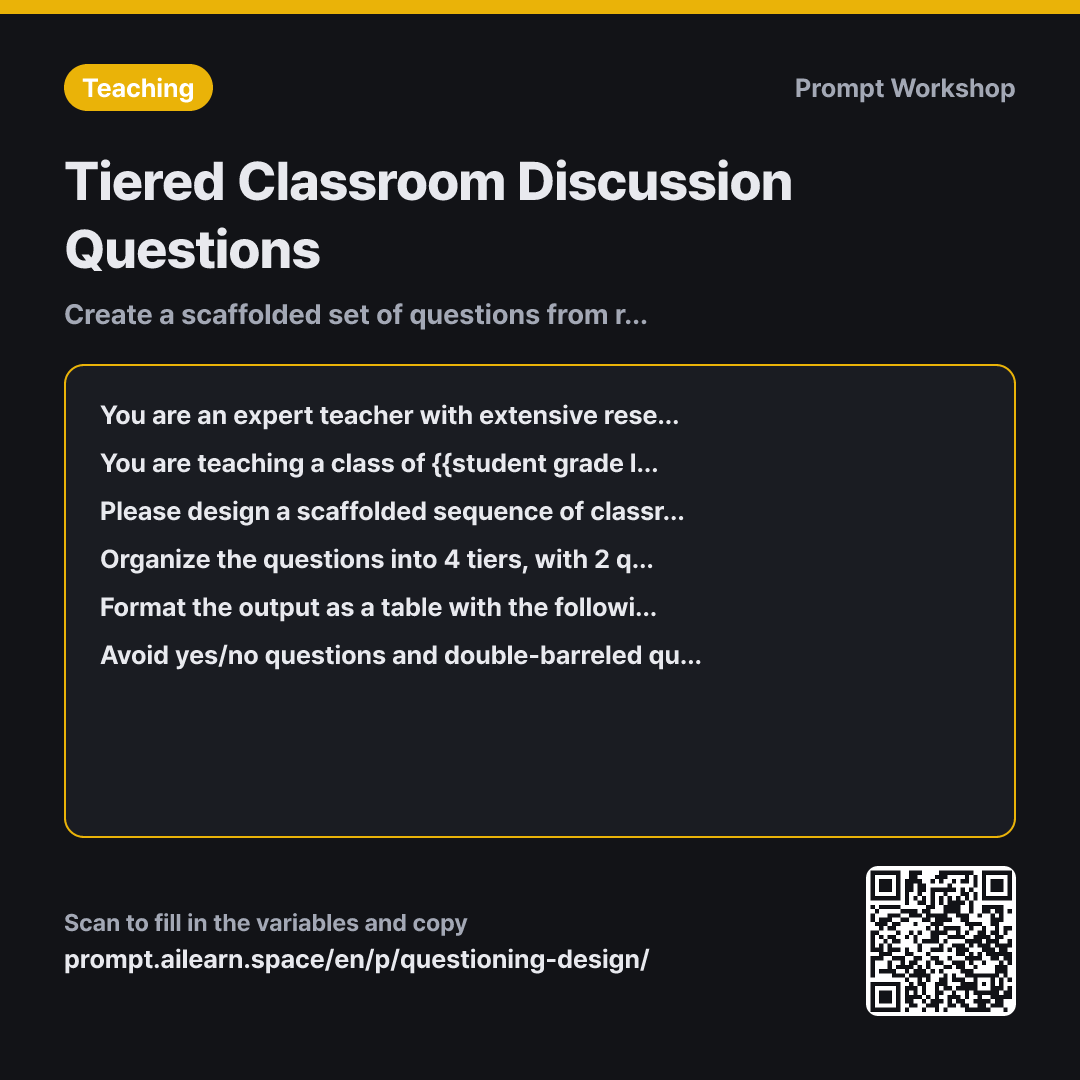
This is why the fourth paragraph splits questions into four tiers, ensuring that later tiers build on earlier answers. The key to cultivating higher-order thinking is not just crafting difficult questions, but sequencing them properly. Students who have verified facts can explain reasons, and those who can explain reasons can apply concepts to new situations.
Specifying in the role that the teacher "understands the distinction between closed-ended recall questions and open-ended questions" fundamentally improves Tier 2 and beyond. Without this, Tier 3 questions often collapse into single-answer trivia. Detailing the classroom dynamic in the second paragraph also ensures that Tier 1 includes accessible entry points for quieter students.
The follow-up scaffolding question in the format table is crucial in real classrooms. When a student struggles, the teacher can guide them with a smaller stepping stone rather than simply giving away the answer. The "Expected Key Takeaway" column serves as a progress marker for the teacher to gauge when to advance to the next tier.
The three constraints prevent common questioning pitfalls: yes/no questions stifle participation, compound questions cause students to answer only the second half, and prohibiting fabricated outside statistics stops AI hallucinations.
Unfamiliar terms? See Aha AI: chain-of-thought, role-prompting
Compared with a bad example
Make 10 classroom questions for 6th graders about the American Civil War
While this produces 10 questions, most are basic recall like "Who was the president during the Civil War?", alongside a few overly broad questions students cannot reasonably answer. Without a difficulty progression, the teacher must manually reorder them, and lacking scaffolding prompts forces the teacher to answer for the student when they get stuck.
Variations
When Small-Group Discussion Prompts Are Needed
Please create 3 discussion questions for {{student grade level}} students working in small groups of 4 on the topic "{{main central topic}}".
Ensure each question has no single correct answer and sparks differing opinions. Include 2 sample contrasting viewpoints for each question. Also, provide 1 conversation-starter prompt per question to help groups when discussion stalls. Do not introduce questions that bias toward specific religious or partisan political stances.
Since group discussions thrive on divergent views, this variant replaces tiered recall questions with balanced, debate-driving prompts.
When Quick Exit-Ticket Questions Are Needed
Please create 3 exit-ticket check questions for all {{student grade level}} students to answer on paper at the end of the lesson on "{{main central topic}}".
Include 2 questions that can be answered in a single sentence, and 1 question requiring students to summarize today's core concept in their own words. Below each question, add one line for "What indicates solid understanding" and one line for "What indicates a need for reteaching".
Designed for the final 5 minutes of class. Including clear assessment criteria helps the teacher immediately identify what to review at the start of the next lesson.
Related prompts
Last updated 2026-09-02 · Found a mistake? Let us know