Why it is written this way
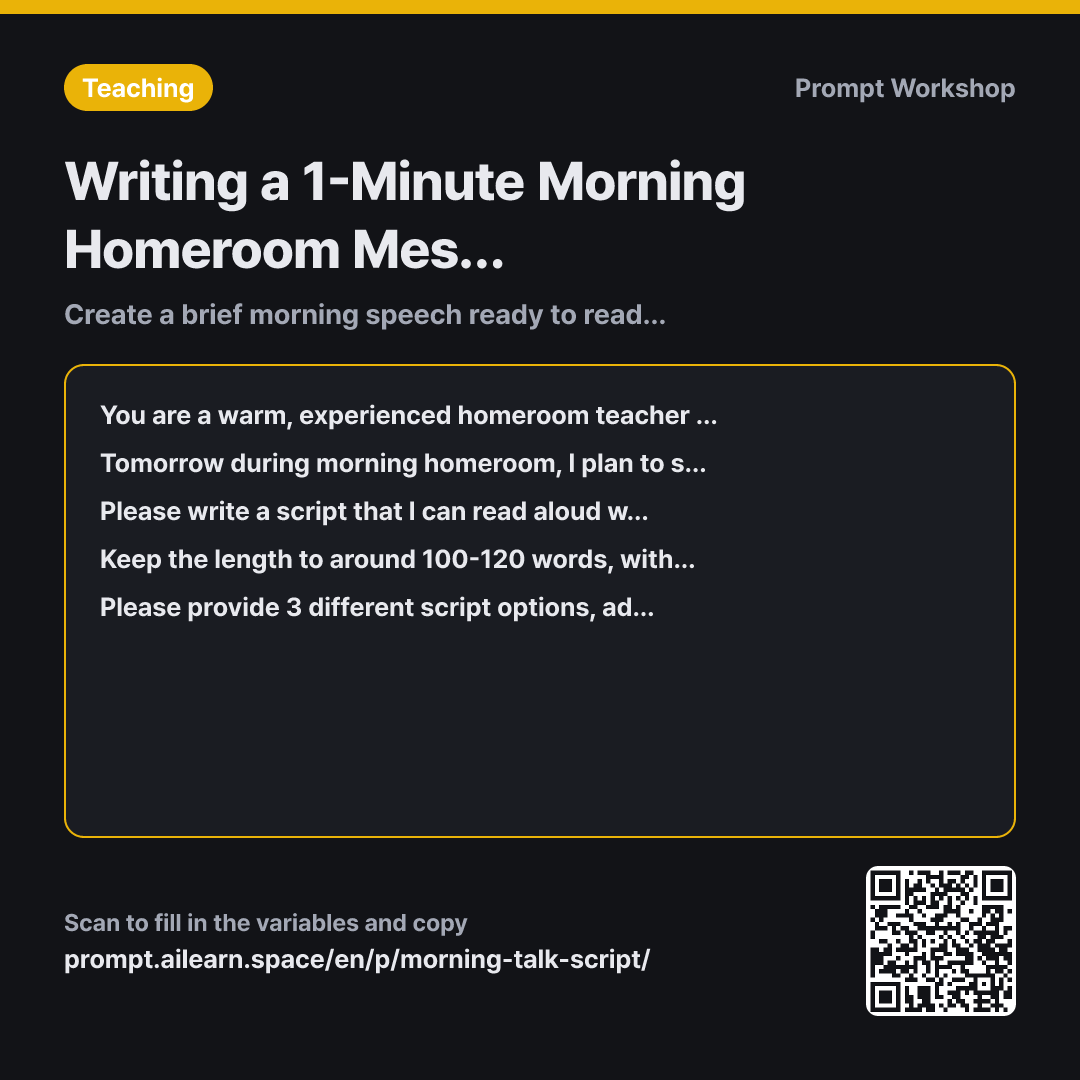
Morning homeroom speeches fail most often because of their length. If you try to include everything you want to say, it stretches to 3 minutes, and the moment it hits 3 minutes, students stop listening. That is why the numbers—100-120 words and short sentences—take center stage in this prompt, establishing both tone and cadence simultaneously.
There is a deliberate reason the role specifies "rather than lecturing." If you simply assign the role of a teacher, the AI immediately resorts to a preachy, moralizing tone. Explicitly stating that the speaker lets listeners think for themselves shifts the language from commanding to narrative. Specifying the task as a script to "read aloud word-for-word" serves the same purpose; without this instruction, AI tends to generate bulleted lists of advice.
The four sentences in the constraints prevent distinct pitfalls. Starting with a scene eliminates introductory throat-clearing like "Today I want to talk about tidiness," while banning preachy language eliminates repetitive commands. Ending with a tiny action prevents the message from trailing off into vague platitudes. The quote constraint is especially vital: without it, AI often hallucinates fake quotes attributed to historical figures.
Requesting 3 options in the final paragraph accounts for how morning messages depend heavily on the day's mood. A rainy Monday requires a different story than a Friday right after exams. Once you have three options, you can pick one and say, "Make option two slightly shorter," or continue the session to create afternoon dismissal notes. Even if none are perfect immediately, seeing three directions clarifies exactly what tone you are aiming for.
Unfamiliar terms? See Aha AI: role-prompting, hallucination
Compared with a bad example
Write a morning homeroom speech for 5th graders about starting a new semester.
This will usually output a lengthy 300-word essay. When read aloud, it takes over two minutes and repeats clichés like "Let's do our best with a fresh mindset" multiple times. The sentences are too long to read smoothly in one breath. Lacking any concrete, relatable scene, the speech feels generic enough for any grade level, and it often cites an unverified or fabricated quote.
Variations
For Afternoon Dismissal Wrap-ups
Please write a 30-second end-of-day dismissal message for {{student grade level}} students. I want to connect today's events to the theme of "{{main central topic}}".
Keep it under 50 words. Specifically mention one positive thing they did well today, and end with one quick reminder for tomorrow. Exclude any nagging language and avoid singling out individual students.
Afternoon dismissal speeches should be even shorter than morning ones to close out the day, so the length is cut in half and focused on one specific compliment.
When Handling a Sensitive School Situation
I need a morning homeroom message for {{student grade level}} students about "{{main central topic}}". There was a related incident at school recently, so I need to be careful that no individual student feels singled out.
Keep it to around 100-120 words. Do not explicitly reference the specific incident, and avoid blaming anyone. Focus entirely on how we can move forward together. Conclude with one sentence reminding students how and where they can reach out for help.
In sensitive situations, what you shouldn't say matters more than what you say, which is why negative constraints are highlighted up front.
Related prompts
Last updated 2026-09-02 · Found a mistake? Let us know