Why it is written this way
When asking AI to create special education materials, the most common failure mode is generating a generic "easy version" without understanding the student's specific support needs. Simply making the font larger or cutting the number of questions produces unusable worksheets. What is needed is not arbitrary simplification, but an alternative pathway that bypasses the student's specific roadblocks.
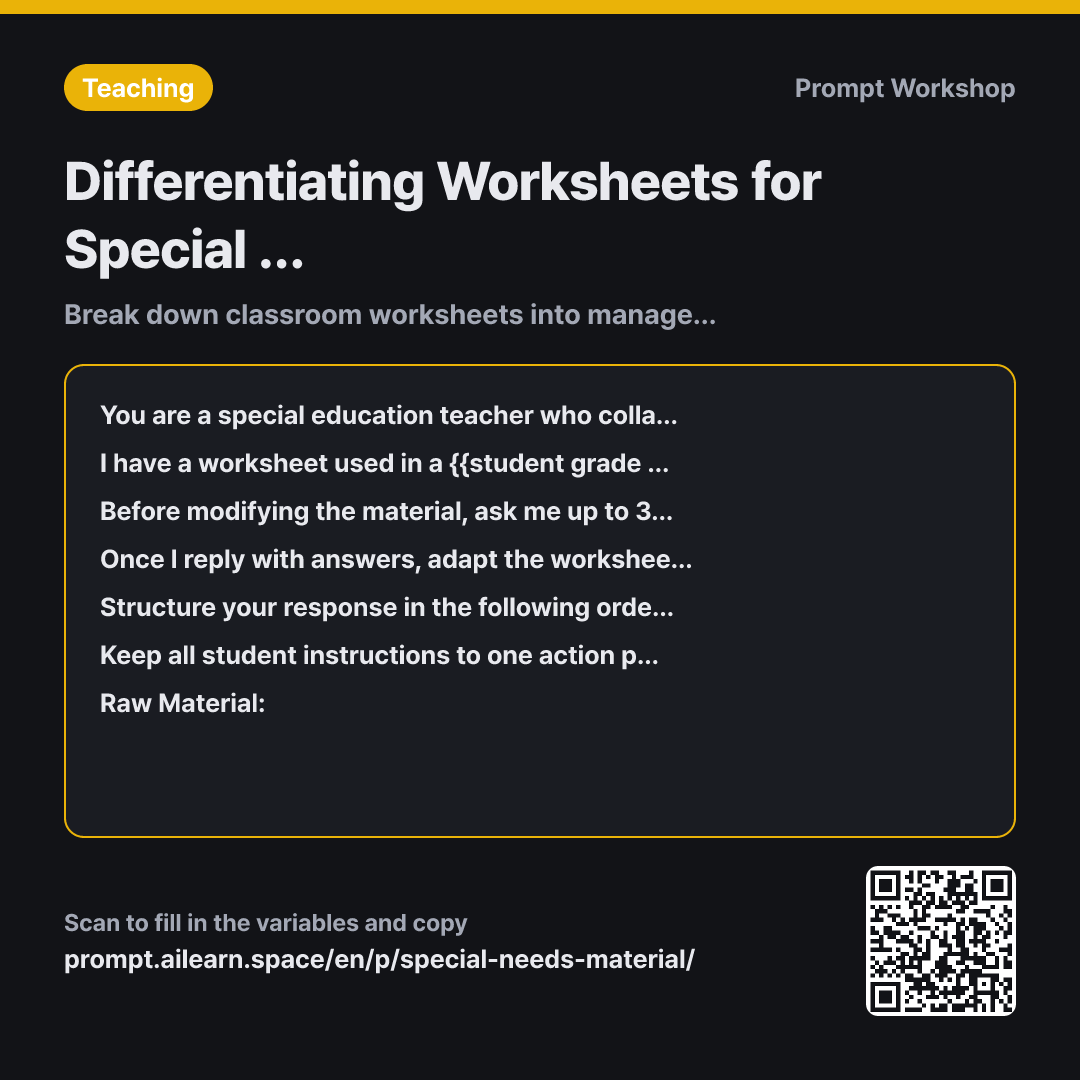
Setting the role as "a special education teacher collaborating with general education teachers" anchors the right instructional perspective. Adapting general education materials for inclusion requires maintaining alignment with the original activity, unlike creating standalone special education tasks from scratch. Requesting a comparison table preserves this connection, ensuring the student feels part of the same classroom lesson at the same time.
The follow-up questioning mechanism in the third paragraph serves as a safety check. A brief profile cannot capture every nuance, and if the AI fills those gaps with assumptions, the resulting material will be off-target. Adding "Do not ask for medical diagnoses" prevents the model from probing for private, identifying medical details.
The format section locks down four concrete components teachers actually need in practice. In particular, the side-by-side verbal prompts and completion criteria are often more valuable than the worksheet itself, as teachers have no time to improvise support strategies mid-lesson.
The constraints ("do not lower the objective" and "do not diagnose") prevent two critical risks: the former prevents tasks from degrading into mere coloring exercises, while the latter stops the AI from making unsubstantiated clinical assumptions. Wrapping the raw material in """ prevents worksheet instructions from being confused with the prompt's meta-instructions.
Unfamiliar terms? See Aha AI: role-prompting, prompt
Compared with a bad example
Make this worksheet easier for a special ed student.
(paste worksheet)
"For a special ed student" provides zero information about what kind of support is actually needed. The output will simply cut the question count in half and swap words for simpler vocabulary—which still leaves a massive barrier for a student who freezes on multi-step directions. It also provides no guidance on what the teacher should say or what constitutes successful completion, forcing on-the-spot improvisation during class.
Variations
Generating IEP Activity Lists
You are a special education teacher who collaborates with general education teachers to design adapted learning pathways. I am planning semester-long activities for a {{student grade level}} student with the following profile: {{student characteristics profile}}
Please suggest 8 structured activities suitable for repeated practice throughout the semester. For each activity, provide one sentence each for: the targeted skill/objective, estimated classroom duration in minutes, and how the teacher can assess progress. Sequence them starting from strengths the student already demonstrates and gradually expanding outward. Do not invent formal statutory standards or administrative policy language.
Use this when planning semester-level interventions rather than adapting a single worksheet. Explicitly restricts generating fictitious legal or administrative policy language.
Adjusting Assessment Methods Only
It is difficult for a {{student grade level}} student to take the assessment below in its current format. The student's profile is as follows: {{student characteristics profile}}
First, summarize in one sentence the core construct or knowledge this assessment aims to measure. Then, suggest 3 alternative response formats (such as verbal responses, multiple choice, or sequencing cards) that measure the exact same construct while accommodating the student's needs. Do not change what is being tested—only change how the student demonstrates mastery. Provide a 3-line scoring rubric for each method.
Raw Material: """ {{raw data material}} """
Use this when adapting assessment methods rather than learning materials. Requiring the core objective to be stated first prevents the assessment content itself from being accidentally watered down.
Model notes
If you have a worksheet file, attach it first before pasting the prompt. It is safer to remove student names, birthdates, and formal diagnoses, focusing only on the necessary classroom supports.
Related prompts
Last updated 2026-09-02 · Found a mistake? Let us know