Why it is written this way
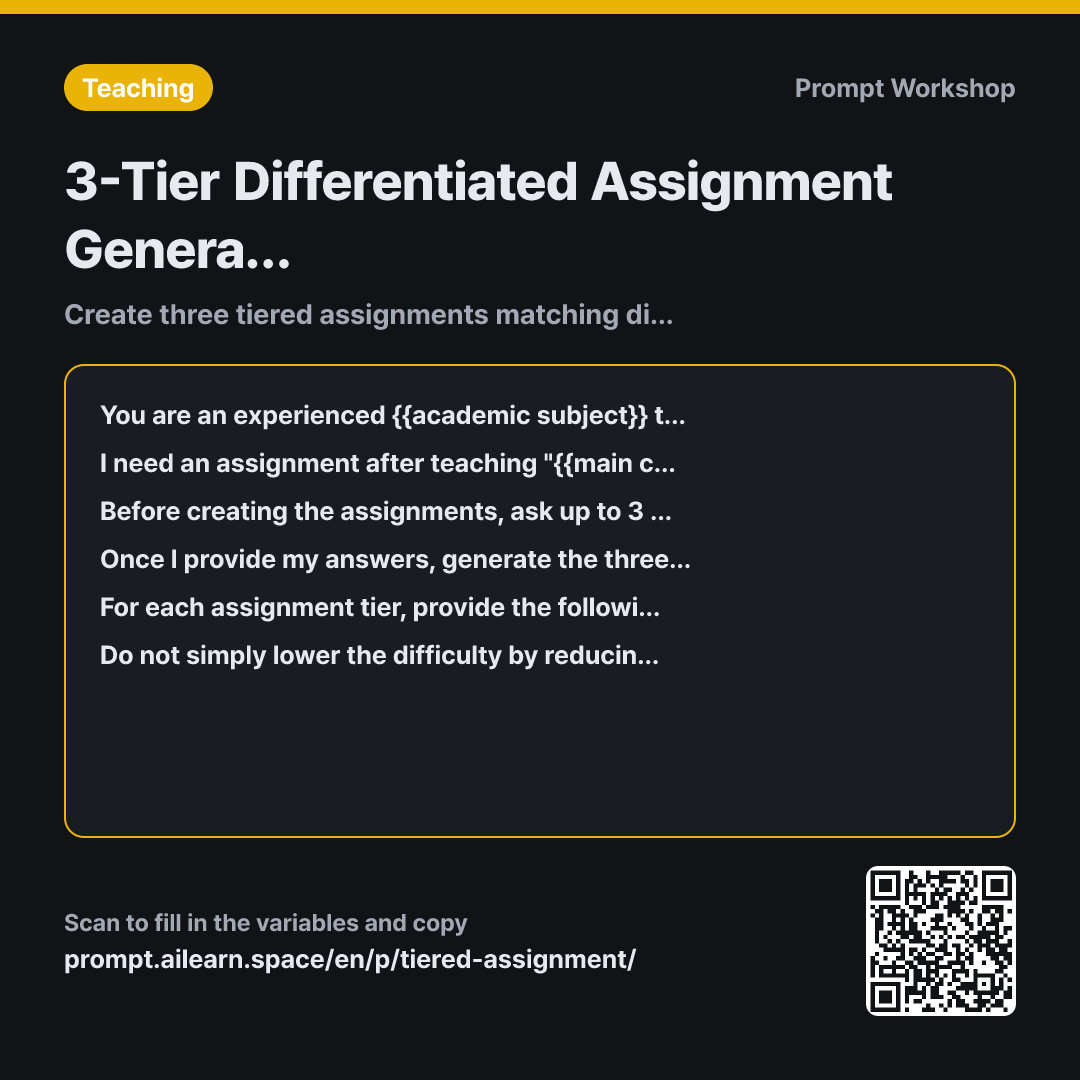
When asking AI to create differentiated assignments, it typically generates three versions that only differ in question count. Splitting work into ten, five, and three questions with the exact same format causes struggling students to hit the same obstacle while advanced students get bored. This prompt explicitly instructs the AI to differentiate cognitive demand rather than task volume.
Setting the Role as a teacher experienced with wide achievement gaps ensures the AI approaches the response assuming diverse starting points within one classroom, rather than stretching a standard baseline up and down. This naturally addresses classrooms where remediation and enrichment must occur simultaneously.
The Follow-up Questions in the third paragraph allow the AI to clarify essential context that teachers might not write upfront—such as class size, prior knowledge, or whether tasks are completed in class or as homework. Capping questions at three keeps the workflow efficient.
The Format section mandates explicit student instructions and completion criteria for each tier. Clear completion criteria stop students from repeatedly asking if they are finished, preserving the autonomy of tiered work. Requesting ready-to-read instructions also keeps the tone consistent across all three levels without requiring extra editing.
The Constraints prohibiting simple problem-count reductions ensure that even foundational tasks fulfill the core learning objective, while barring invented page numbers and standard codes prevents fabricated citations on student worksheets.
Unfamiliar terms? See Aha AI: role-prompting, output-format
Compared with a bad example
Make beginner, intermediate, and advanced differentiated math assignments on linear equations for 7th grade.
Using vague labels like "beginner, intermediate, advanced" provides no clear criteria for differentiation. The AI will likely output identical problem types with altered numbers, leaving foundational learners stuck in repetitive calculations without reaching the learning goal. Without clear completion criteria, students will interpret "done" differently, forcing the teacher to redesign all three sets.
Variations
Tiering an Existing Worksheet
You are an experienced {{academic subject}} teacher accustomed to classrooms with diverse skill levels. I already have a standard worksheet on "{{main central topic}}" for my {{student grade level}} class.
Instead of starting from scratch, use this worksheet as a baseline to create a scaffolded version and an extension version, while keeping the same core learning objective. For the scaffolded version, break complex questions into smaller sub-steps and provide a worked example for the initial step. For the extension version, do not add more questions; instead, remove one constraint or modify the prompt to allow multiple valid solutions. Include a 2-line rationale beneath each version explaining what was modified and why.
Use this when you already have an existing worksheet and want to create differentiated tiers without starting from scratch.
Differentiating Group Roles
I am planning a 4-person group activity for a {{student grade level}} {{academic subject}} class on "{{main central topic}}". Design four distinct group roles so that each member has a unique responsibility while contributing to a single cohesive deliverable.
For each role, provide: the core responsibility, what the final deliverable would lack without this role, and a 2-line student-facing instruction set. Ensure there is at least one accessible role where a struggling student can make a meaningful, non-trivial contribution without being relegated to a mere recorder or scribe.
Use this to differentiate within a collaborative group project rather than through individual worksheets, preventing lower-performing students from being sidelined.
Model notes
If the three tiers appear too similar, follow up with: "Explain in a single sentence how the required cognitive depth differs between the foundational and advanced tasks."
Related prompts
Last updated 2026-09-02 · Found a mistake? Let us know