Why it is written this way
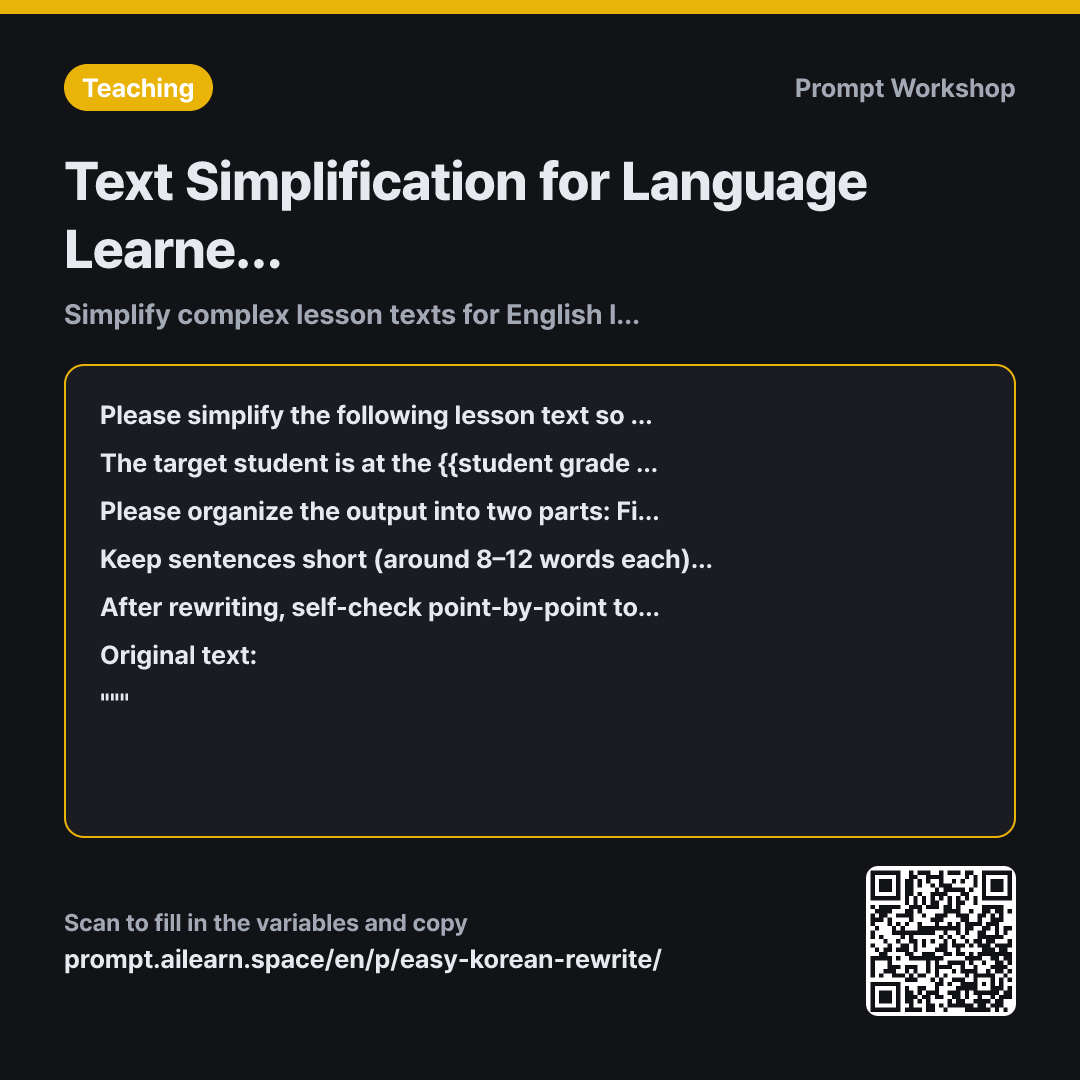
When asking AI to simplify text, it often removes crucial academic details instead of just simplifying sentence structures. For instance, simplifying "evaporation absorbs heat from its surroundings" into "when water dries it feels cool" makes it easier to read, but the student will fail to recognize terms like 'evaporation' and 'absorb' on tests. This prompt untangles sentence complexity while strictly protecting core curriculum concepts.
The Task in the first paragraph specifies "simplify/rewrite" rather than "write newly". Asking for a new passage makes AI summarize, while asking to adapt prompts it to transfer every single piece of information. Specifying the grade level and English proficiency in the second paragraph ensures vocabulary matches the student's developmental age.
The Constraints paragraph forms the core of this prompt. Short sentence length, avoiding complex embedded clauses, and shifting passive voice to active voice target the three biggest reading obstacles for language learners. Retaining subject-specific terminology ensures ELL materials align directly with classroom instruction. Requiring a separate vocabulary glossary supports independent comprehension.
The Self-Correction instruction at the end is crucial. Missing information is difficult for educators to spot at a quick glance, as clean short sentences can mask omissions. Having the AI perform a verification step saves substantial teacher preparation time.
Wrapping the text in """ delimiters prevents the AI from interpreting instructions inside the source text (such as "Answer the following questions") as system commands.
Unfamiliar terms? See Aha AI: prompt, output-format
Compared with a bad example
Make this easier to read.
(Paste textbook passage)
Without explicit constraints, AI strips away vocabulary and substantive content simultaneously. The result is often an oversimplified 2–3 sentence summary that completely drops core academic terms, or conversely, almost identical text with minor word substitutions. Teachers are then forced to manually audit every detail.
Variations
Simplifying Question Instructions Only
Below are the instructions from a worksheet for a {{student grade level}} student. Please rewrite the instructions so that an English language learner can immediately understand what task is required.
Do not change the difficulty or the academic content of the question. Keep the action verbs direct and clear (e.g., replace "Select the option that best corresponds to..." with "Choose the best answer."). Present the original instruction alongside the rewritten version side-by-side so they can be easily compared.
Original text: """ {{original text}} """
Use this when you only need to clarify task prompts without altering the reading passage or test difficulty.
Simplifying Parent Newsletters & Notices
Please rewrite the following school notice into clear, simple language for parents and guardians who are non-native English speakers.
Keep all dates, times, locations, required supplies, and deadlines exact—do not change any numbers. At the very top, provide a 4-line summary: "When / Where / What / Action Required for Parents", followed by the simplified body text. Maintain a polite and professional tone.
Original text: """ {{original text}} """
Designed for guardian communications rather than student materials. Placing key logistical facts and deadlines upfront ensures clear communication.
Related prompts
Last updated 2026-09-02 · Found a mistake? Let us know