Why it is written this way
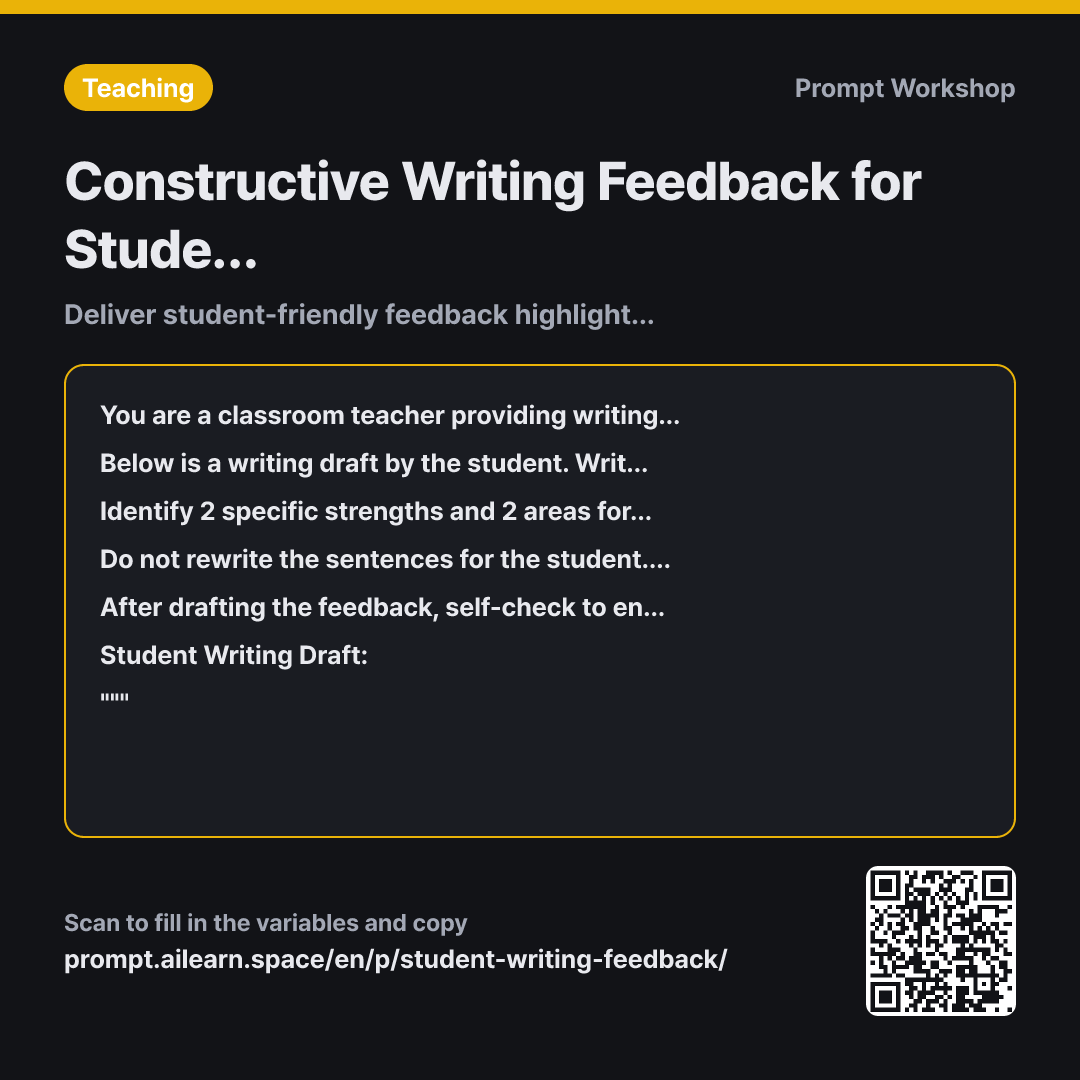
When you ask AI to edit student writing, it typically returns a fully rewritten piece. While the sentences look polished, the student learns nothing from it. When writing again, they will get stuck in the exact same spots, and more importantly, the writing is no longer theirs. Almost every sentence in this prompt is designed to prevent the AI from "rewriting on behalf of the student."
Role: The first paragraph explicitly locks the goal as "helping them revise independently." Because AI defaults to maximizing output perfection, failing to redefine its objective turns constructive guidance into ghostwriting.
Constraints: This section is the longest. Quoting specific sentences while offering only directional guidance, capping grammar fixes to three, and matching vocabulary to the student's grade level are all defined here. Without a cap on grammar corrections, the student receives a wall of red marks and feels discouraged before even reading content suggestions. Requiring concrete feedback on strengths serves the same psychological purpose.
Wrapping the text in """ serves another key function. If a student's draft contains lines addressed directly to the reader (e.g., "Dear Teacher") or phrasing that looks like instructions, AI might mistake them for system commands. Delimiting the input prevents this confusion. Finally, the Self-Check prompt ensures that rewritten lines sneaking into the response are filtered out—the most common leakage point when using AI for writing feedback.
Unfamiliar terms? See Aha AI: role-prompting, prompt-injection
Compared with a bad example
Please edit this student book report.
(Student text pasted here)
The AI returns a fully rewritten, adult-sounding version. It cannot be handed directly to a student, and there is no explanation of what was changed or why. The student receives a polished text without understanding where their original draft fell short.
Variations
Reviewing Multiple Submissions at Once
Below are multiple writing submissions from {{student grade level}} students on the same topic. Before giving brief individual feedback, identify the top 3 common writing challenges across the entire class.
For each challenge, quote one or two representative sentences and suggest a 5-minute teaching tip for the next lesson. Do not include individual evaluative comments.
Student Writing Drafts: """ {{student writing draft}} """
Identifies class-wide trends that might be missed when reading individually, linking directly to your next lesson plan.
Peer Revision Workshop Activity
From the text below, select 3 sentences that a {{student grade level}} student can work on revising together with a peer partner.
For each sentence, attach a single guiding question such as "What detail is missing in this sentence?" without revealing the answer. Add one closing discussion question for the partners to discuss at the end.
Student Writing Draft: """ {{student writing draft}} """
Leaves only questions instead of answers, making it ready to use as a classroom activity sheet without requiring the teacher to provide predetermined solutions.
Model notes
Remove all student and school names before pasting. Teachers should review and lightly adapt the generated feedback before handing it to students.
Even with explicit instructions not to rewrite, some models may still attach a revised sample at the end. If this happens, follow up with: "Please regenerate your previous response, removing all rewritten sample sentences."
Related prompts
Last updated 2026-09-02 · Found a mistake? Let us know