Why it is written this way
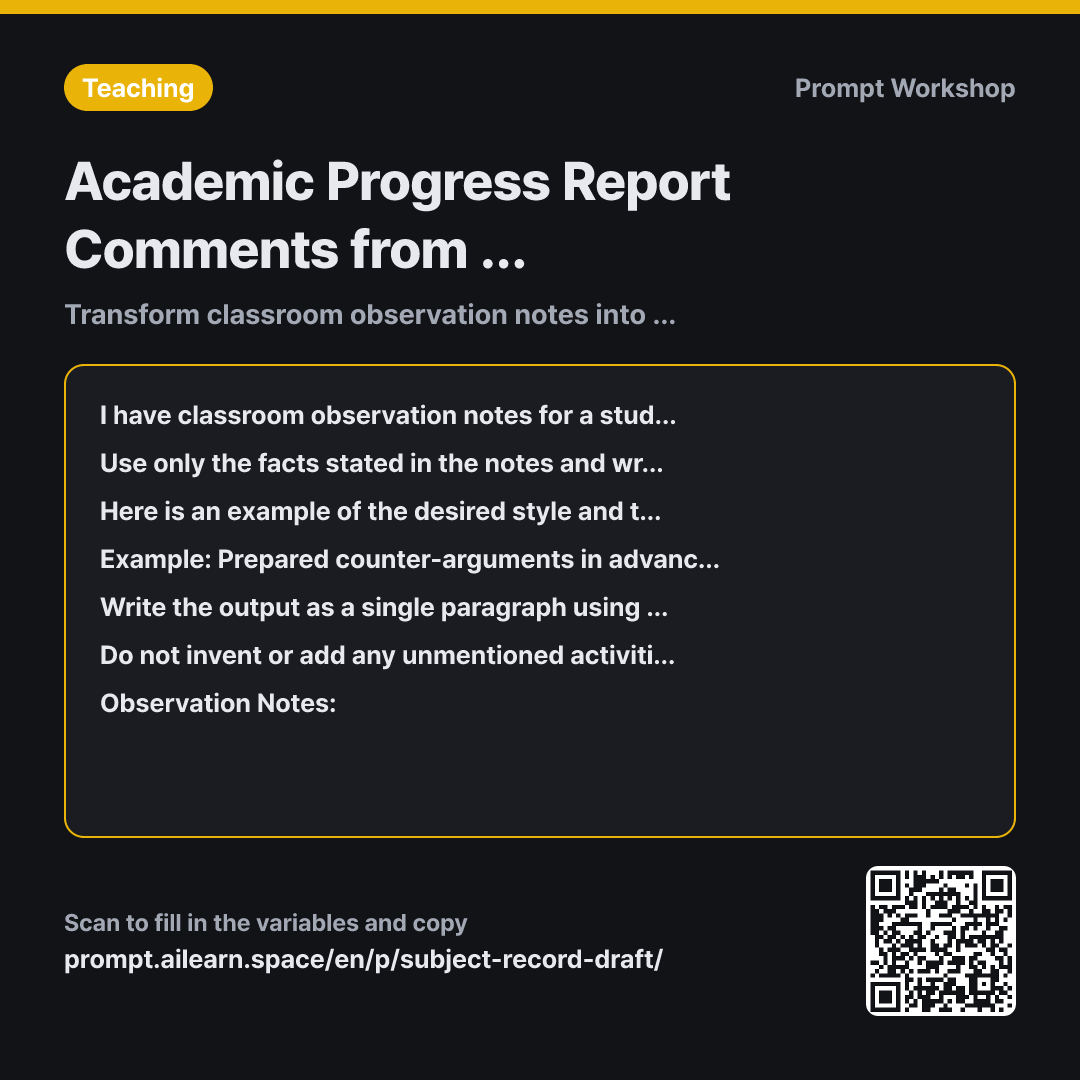
The biggest risk when drafting student evaluation records with AI is that the text often sounds deceptively polished. AI models frequently invent plausible-sounding details that were never in the original notes (e.g., "achieved excellent results in presentations"), making factual errors hard to spot at a glance. Official school records must be strictly factual, which is why this prompt forces the AI to provide explicit evidence for every sentence.
Format: The requirement to map each output sentence to the corresponding raw note serves as a safety check. If an AI generates an unsubstantiated sentence, the mapping table clearly shows a blank reference. The teacher can quickly audit the generated output by glancing at the list rather than re-reading the entire draft.
Context & Examples: The example provided in the third paragraph anchors the formal, objective reporting tone. Without a reference style, AI often defaults to conversational phrasing or generic praise letters.
Constraints: The instructions explicitly prohibit two elements: unrecorded facts and generic clichés. Banning clichés naturally keeps the output concise—if the notes are brief, the draft should be brief as well. Finally, enclosing the raw notes in """ delimiters prevents personal reminder notes (e.g., "check later") from being misinterpreted as instructions.
Unfamiliar terms? See Aha AI: few-shot, hallucination
Compared with a bad example
Write a 400-character student report comment based on the notes below:
(Paste observation notes)
While this prompt hits the target length, the AI fills the required space by making up unobserved behaviors and generic praise. Without an evidence map, the teacher has to compare the draft against the original notes line by line to detect hallucinations.
Variations
When Observation Notes Are Too Brief
Here are classroom observation notes from {{academic subject}}. Before drafting a report comment, evaluate what can reliably be written based solely on these notes.
List all verifiable facts from the notes, and highlight any areas that currently lack sufficient evidence for a formal record. Then, suggest three specific student behaviors or skills to observe in upcoming classes. Do not draft the final comment yet.
Observation Notes: """ {{observation notes}} """
When you only have two or three lines of notes, forcing a full draft often results in fabricated details. Use this variant to identify evidence gaps first.
Batch Writing for Multiple Students
Below are classroom observation notes for multiple students in {{academic subject}}, identified only by numbers.
For each student number, write an objective draft of around {{character count}} characters. Ensure each student's unique strengths and actions are differentiated so that the comments do not sound repetitive. Avoid using identical phrasing across students, and list the supporting note excerpt for each generated sentence.
Observation Notes: """ {{observation notes}} """
Writing comments one student at a time often leads to repetitive sentences. Batching multiple students helps the AI deliberately vary phrasing across individual profiles.
Model notes
Remove student names and paste only anonymized notes. The output is a working draft; teachers must verify factual accuracy and ensure compliance with their institution's reporting guidelines.
The more strictly you demand an exact character or word count, the more likely the model is to invent unsupported details. Adding a clause like "Write only as much as the notes support, and leave it short if details are limited" significantly reduces hallucinations. Teachers must personally verify that the final text aligns with their school's official reporting guidelines.
Related prompts
Last updated 2026-09-02 · Found a mistake? Let us know