Why it is written this way
When asking AI to write a full assessment plan all at once, the task, rubric, and student handout often fail to align. For example, the prompt might describe a research paper, but the rubric evaluates presentation posture, and the handout explains a different task altogether. Generating all three at once causes the AI to lose track of consistency across documents.
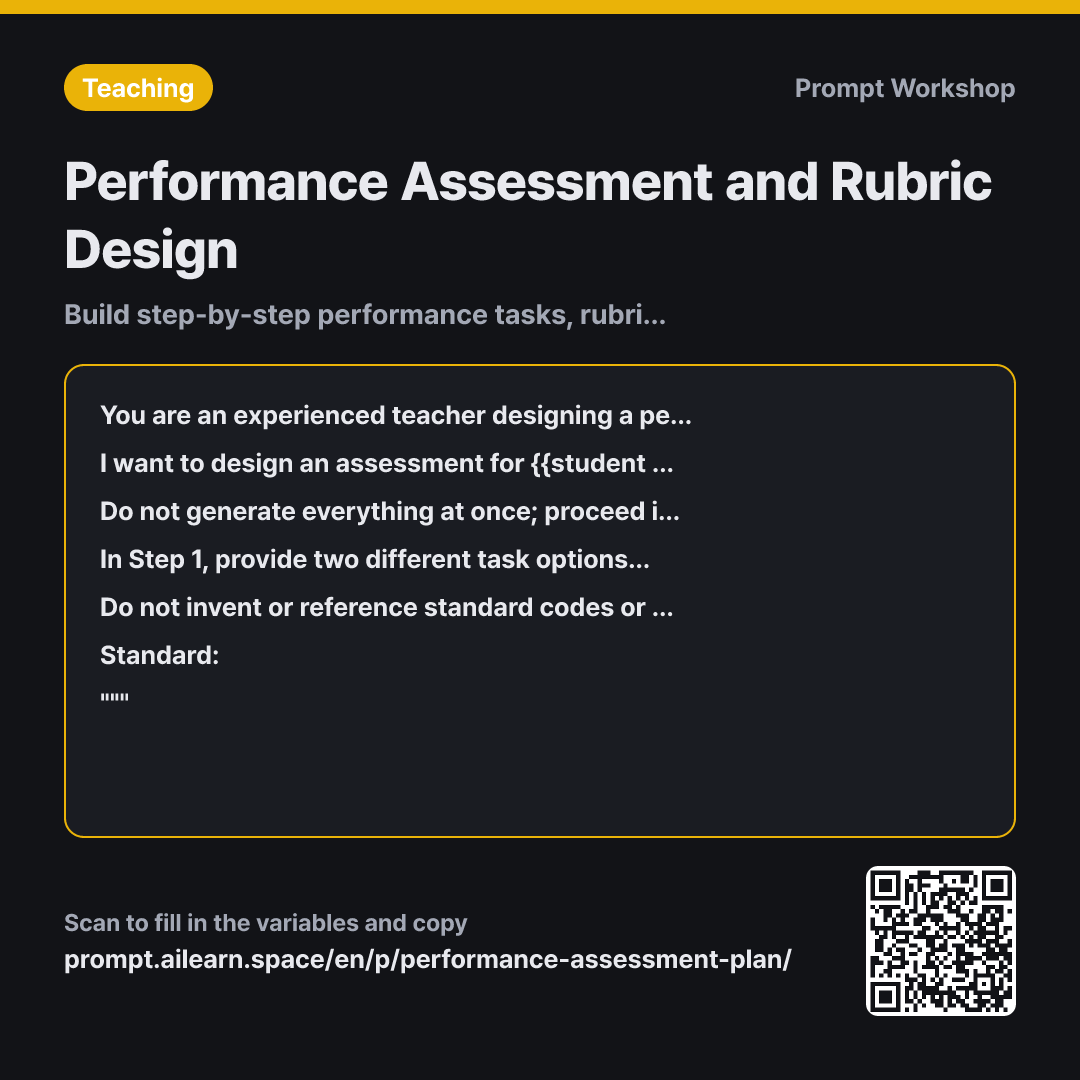
This prompt resolves that issue by breaking down the workflow into three sequential steps. You finalize the task first, generate the rubric based on that chosen task, and finally summarize the rubric into student-facing guidelines. Because each output serves as the input for the next stage, the documents stay perfectly aligned. The instruction "only proceed when I reply with 'Next'" establishes a necessary pause.
In the role section, specifying "assessments where scores can be clearly justified" is critical for evaluation design. This constraint prevents the AI from proposing open-ended, subjective creative tasks that are hard to grade objectively, steering it toward tangible, observable student artifacts. In the format section, asking for two task options in Step 1 gives the educator room to choose rather than forcing revisions on a single imperfect idea.
Finally, the constraints prevent two common pitfalls: hallucinated curriculum standard codes (which AI frequently invents) and overly specific, identifiable student scenarios that may leak bias.
Unfamiliar terms? See Aha AI: chain-of-thought, hallucination
Compared with a bad example
Create an 8th grade science performance assessment plan. Topic: reducing cafeteria food waste.
This produces a generic, one-page assessment plan. While it contains a task, rubric, and handout, they often contradict one another—such as rubric criteria measuring skills the task never asked students to demonstrate. It might also hallucinate official-looking standard codes that do not actually exist.
Variations
When you only need a rubric fast
Please generate only the grading rubric for a {{student grade level}} {{academic subject}} assessment on "{{assignment topic}}".
Create a 4-level scoring table with 3 evaluation criteria. In each cell, write one clear sentence describing the observable student behavior in the final deliverable. Under each criterion, include one line explaining which part of the provided standard it assesses.
Standard: """ {{achievement standard}} """
Use this when the assignment prompt is already set and you just need a reliable rubric.
Reviewing an existing task for fairness
I previously ran a performance task in {{student grade level}} {{academic subject}} on "{{assignment topic}}". Before running it again, please help me audit potential issues.
Identify: 1) areas where students could easily copy/paste from the internet without thinking, 2) factors where access to home resources or materials could create an unfair advantage, and 3) points where different graders might score inconsistently. For each issue identified, provide a one-sentence concrete fix to improve the task design.
Use this when you need a pre-implementation audit. Fairness and grading discrepancies are difficult to fix once the assignment has been launched.
Model notes
Because AI models can hallucinate standard codes, paste the actual standard text rather than codes, and add your official curriculum codes directly into the final output.
In multi-step conversational prompts, long message threads can sometimes cause the AI to drift from earlier decisions. When prompting to move to Step 2, re-pasting your selected task option ensures the rubric matches the assignment perfectly.
Related prompts
Last updated 2026-09-02 · Found a mistake? Let us know