Why it is written this way
If you simply ask an AI to write short-answer questions, it often defaults to vague prompts like "Explain the separation of powers." While the question itself is not incorrect, it is impossible to grade objectively. Students will not know how much detail is required, leading to widely varying answers and forcing the teacher to draft a grading rubric from scratch.
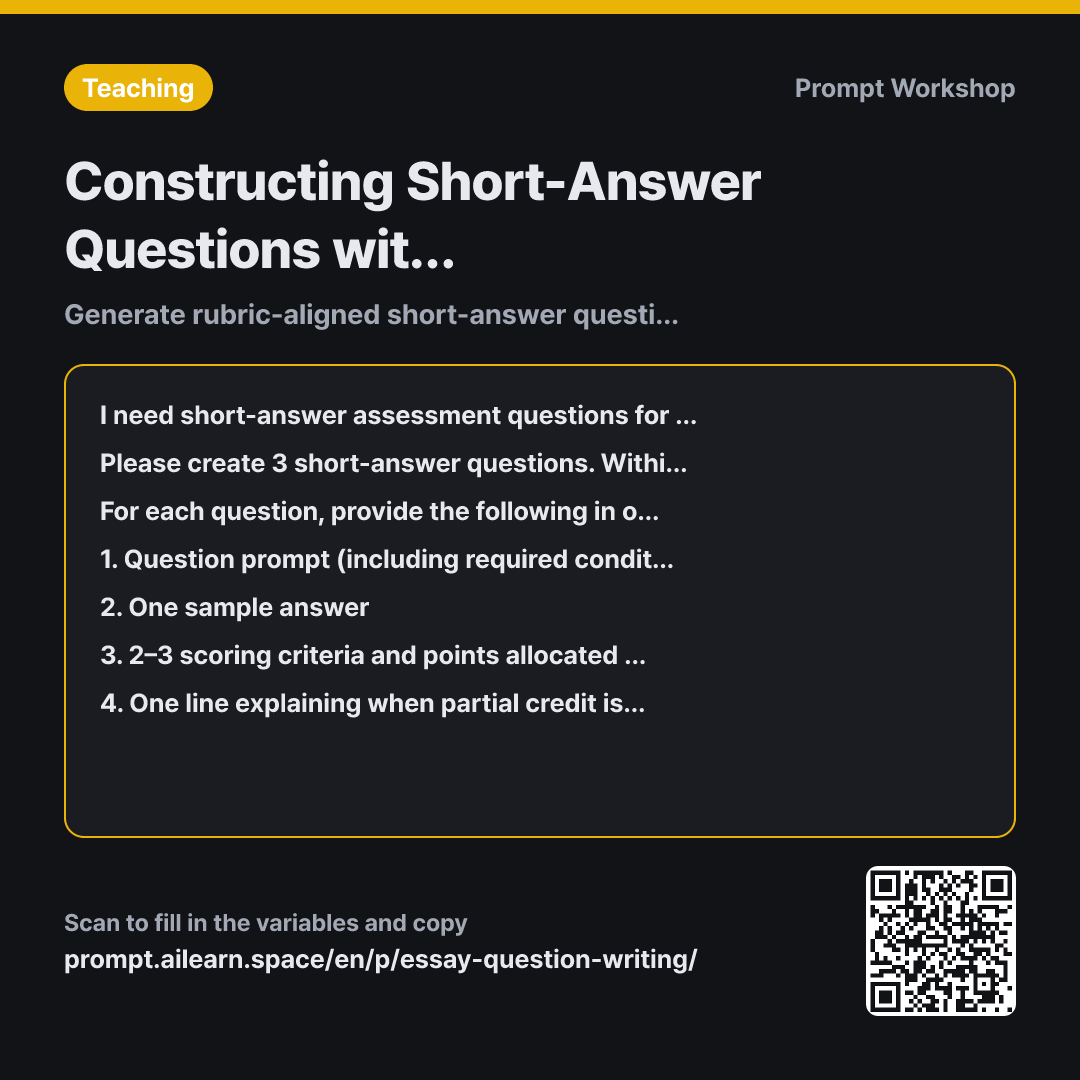
The "condition-based question" specified in the Task paragraph resolves this problem. Embedding criteria like "Based on..." or "In comparison with..." creates a defined structure for the student's answer, which directly serves as the scoring rubric. Restricting conditions to 2–3 ensures students can realistically complete the task within a 5-minute timeframe.
Requesting sample answers and point breakdowns in the Format paragraph allows for immediate quality review. Inspecting the sample answer makes it obvious whether the prompt is realistic to answer; if the response feels forced or excessively long, the conditions were poorly designed. Getting clear partial credit criteria also prevents grading ambiguity during evaluation.
The Constraints paragraph eliminates subjective debate-style prompts. AIs often default to "State your opinion on...", which fails to assess factual comprehension of the lesson material. Finally, the self-verification step in the last paragraph prevents the common issue where sample answers omit one of the required conditions specified in the prompt.
Unfamiliar terms? See Aha AI: output-format, self-consistency
Compared with a bad example
Make a short-answer question about the separation of powers for 9th-grade civics.
(Paste textbook content)
You will get three prompts, but most will end with vague instructions like "Explain" or "Describe." Without specific conditions, neither students nor teachers know what constitutes a full-credit answer. Sample answers and point values won't be provided unless explicitly requested, forcing you to develop the rubric from scratch.
Variations
Including sample responses for grading calibration
Please create 2 short-answer questions for {{student grade level}}, and provide three sample student responses for each question: full credit, partial credit, and zero credit.
Beneath each sample response, write a one-line explanation for why that score was awarded. Construct the partial credit response such that it misses exactly one required condition.
Unit Content: """ {{unit content}} """
When multiple teachers are grading the same exam, sharing these three benchmark responses significantly reduces scoring variance across graders.
Using as exit ticket comprehension checks
Please create 2 quick short-answer questions to be used during the final 5 minutes of class for {{student grade level}}. Answers should be no longer than two sentences.
These questions are designed to identify where students get stuck rather than simply assigning grades. For each question, include a one-line guide: "Answering like this indicates mastery of..." and "Answering like this indicates a misunderstanding of...".
Unit Content: """ {{unit content}} """
Because this is intended for formative check-ins rather than formal grading, you receive diagnostic interpretation guidelines instead of point breakdowns.
Model notes
If you ask for more than three questions at once, the conditions for later questions often overlap with earlier ones. After generating, following up with "Check if all three questions test distinct concepts" helps the AI identify and diversify any redundant items.
Related prompts
Last updated 2026-09-02 · Found a mistake? Let us know