Why it is written this way
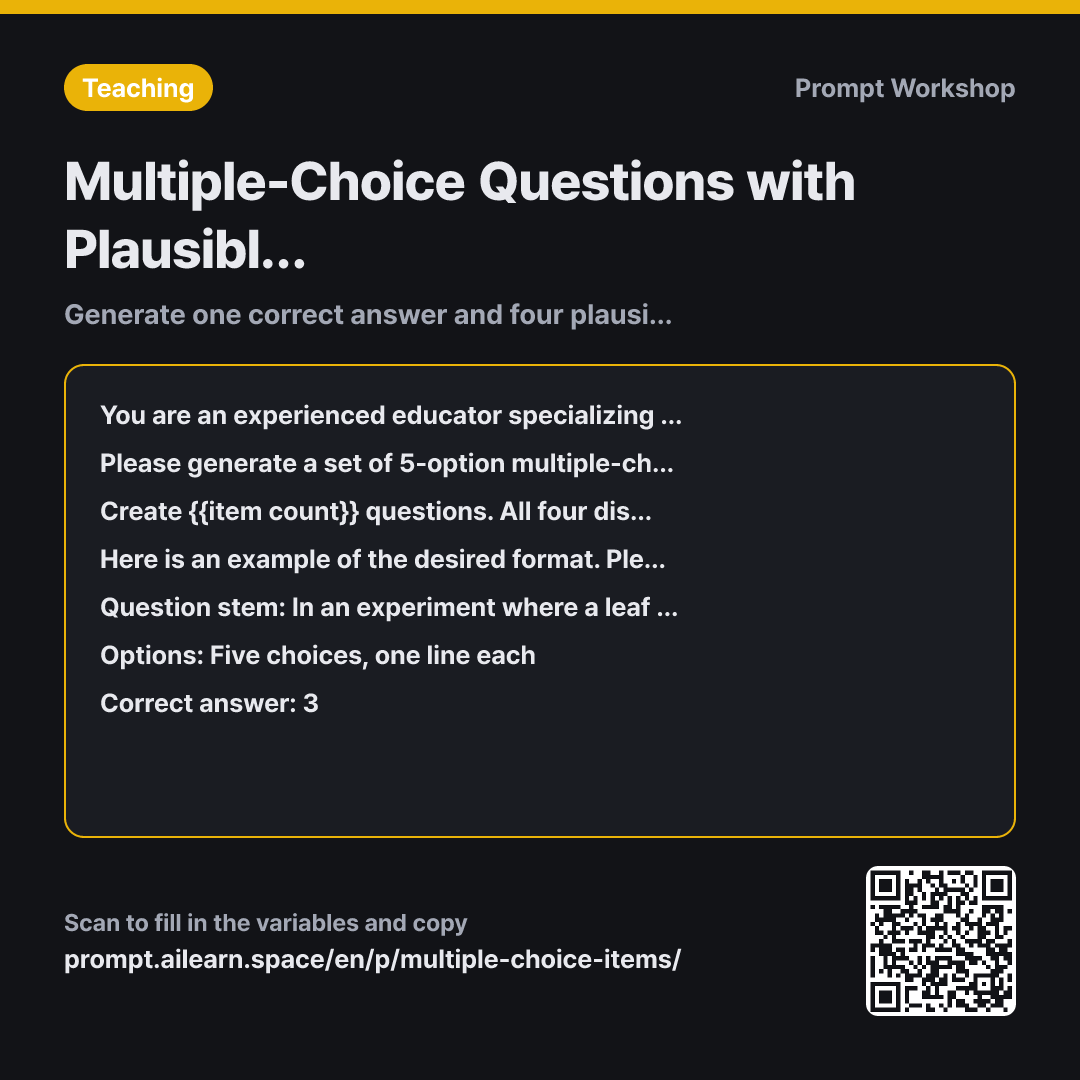
When using AI to generate multiple-choice questions, the output often fails due to poor distractors. While the question stem and the correct answer look reasonable, the other choices are frequently so absurd that students can identify the correct answer through simple elimination without actually mastering the concept. This prompt prioritizes distractor quality over mere volume.
In the Role paragraph, specifying that you "understand common student misconceptions" guides the origin of the distractors. Without this direction, AI tends to generate incorrect options by merely tweaking superficial phrasing. The instruction in the Task paragraph to avoid obvious throwaway options reinforces this safeguard.
The fourth paragraph provides a concrete Example. Presenting a fully formed question communicates the desired structure far more reliably than abstract descriptions. Explicitly showing a format with "Distractor rationales" forces the model to construct distractors grounded in genuine student misunderstandings rather than drafting random choices and inventing post-hoc justifications. Teachers can also review these rationales directly to gauge item discrimination.
Finally, the concept summary table requested in the Format section allows quick verification that items do not over-index on a single concept, while the Constraint on answer key distribution prevents the model's default tendency to cluster correct answers around options 2 and 3.
Unfamiliar terms? See Aha AI: few-shot, hallucination
Compared with a bad example
Make 5 multiple choice questions for 8th grade science on photosynthesis.
While this prompt returns formatted questions, distractors often look like obvious blunders (such as "Photosynthesis only happens at midnight"), rendering the test ineffective for assessing true understanding. Without explicit rationales, educators must manually evaluate every distractor, and questions frequently overlap on the exact same concept.
Variations
When revising distractors for existing questions
Here is an assessment item for {{student grade level}} {{academic subject}} on "{{curriculum unit}}". Keep the question stem and the correct answer intact, and regenerate only the distractors.
For each new distractor, write a one-line explanation of the specific misconception that would lead a student to select it. First, point out which current option is too obvious and unlikely to be chosen by any student. Do not modify the question stem.
Use this when a question stem is solid but lacks diagnostic discrimination. The key is strictly barring the model from altering the original stem.
When planning a complete unit assessment
Please create a unit test for {{student grade level}} {{academic subject}} covering "{{curriculum unit}}". It should contain {{item count}} multiple-choice questions.
First, list the core concepts that must be assessed in this unit, and provide a planning table mapping each question to a single concept. Once I review and confirm the table, proceed to generate the questions. Maintain a difficulty balance of Easy, Medium, and Hard at a 3:5:2 ratio.
Drafting questions immediately often leads to redundant concept coverage. Establishing the concept blueprint first ensures balanced topic distribution.
Model notes
Requesting more than 20 items at once degrades distractor quality; split your requests into batches of 5 to 10 questions.
When generating larger batches of questions, distractor rationales tend to become generic and correct answers skew heavily toward earlier options. It is best to request 5–10 items at a time. After receiving the output, a quick follow-up prompt such as "Show me a table of the answer key distribution and check for overlapping concepts" speeds up review. For data interpretation items, teachers should provide their own exact table or chart values.
Related prompts
Last updated 2026-09-02 · Found a mistake? Let us know