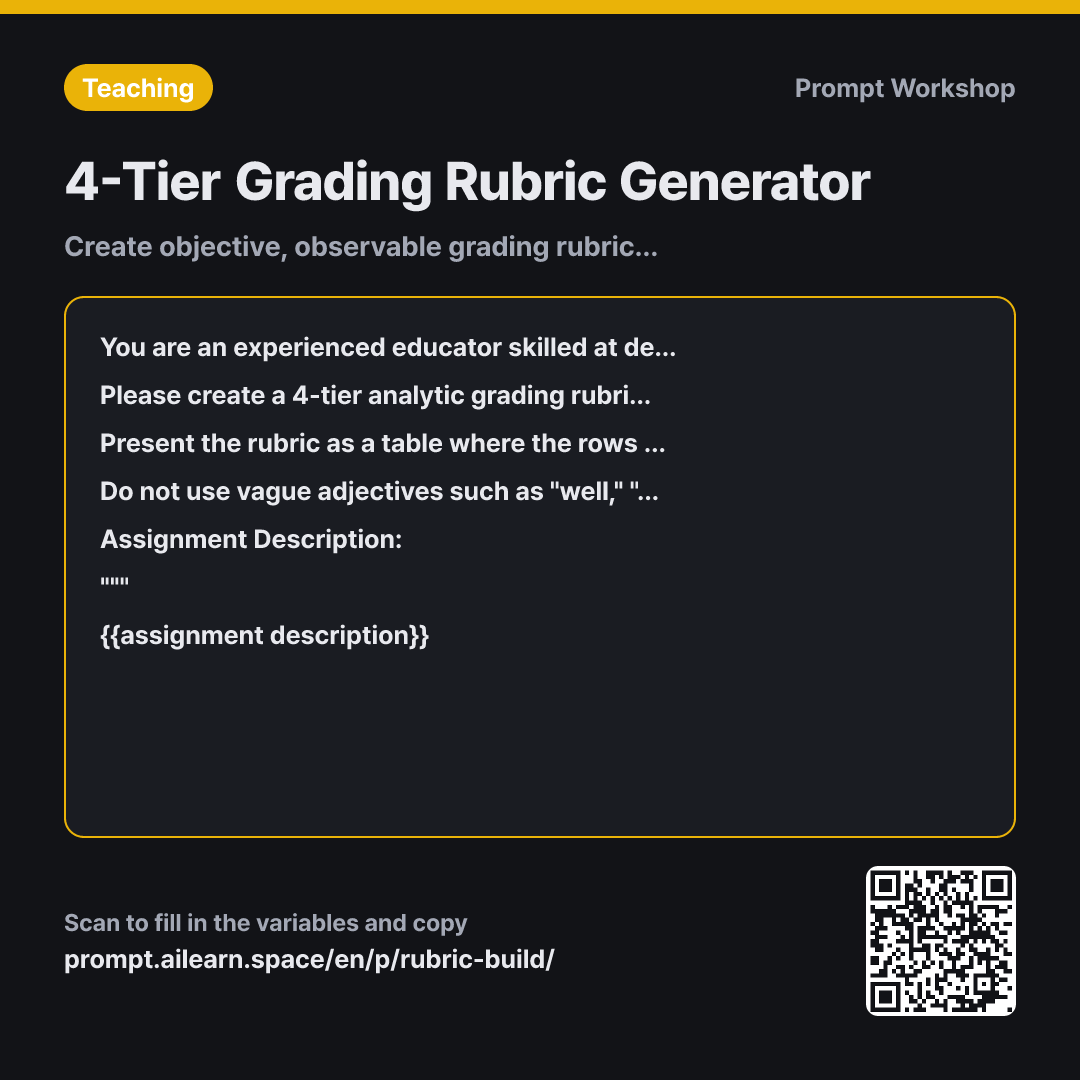
Why it is written this way
Standard AI-generated rubrics are often unusable because they rely heavily on vague adverbs (e.g., "Exemplary: Uses sources very appropriately / Proficient: Uses sources appropriately"). When rubrics lack concrete distinctions, grading defaults back to subjective teacher intuition. This prompt explicitly forbids vague adjectives.
The Role prompt ("maintain inter-rater reliability") sets the standard: a rubric is not just flowery text, but a calibration tool so multiple evaluators assign the exact same grade.
Requiring the teacher to input specific criteria in the Task prevents the AI from defaulting to generic, unmeasurable filler like "Creativity" or "Effort." Two to three targeted criteria are usually ideal.
The Format constraints ("observable behaviors" and "quantifiable measures") determine rubric quality. Knowing whether a student cited two sources versus one, or supported every claim with evidence, cuts grading time in half and provides transparent feedback. Finally, the built-in Self-Review instruction eliminates identical, redundant descriptions between middle tiers.
Unfamiliar terms? See Aha AI: output-format, self-consistency
Compared with a bad example
Make a grading rubric for a presentation on local community problems.
This returns a table, but it will use generic categories like Content, Organization, Delivery, and Creativity, with vague descriptions like "Excellent / Average / Needs Improvement." Teachers cannot objectively defend grades with such criteria when students ask for clarification.
Variations
Student-Facing Assignment Guide
Please adapt a grading rubric based on "{{evaluation factor item}}" into a student-friendly guide.
Instead of a table, provide two bullet points per criterion: "How to earn full points" and "Common pitfalls to avoid." Below that, create a 5-item self-check checklist for students to review before submitting. Use an encouraging, direct tone addressing the student.
Assignment Description: """ {{assignment description}} """
Translates formal criteria into student-friendly language. Sharing clear expectations upfront significantly improves submission quality.
Refining an Existing Rubric
Please review the rubric below and identify any cells that could lead to subjective or inconsistent scoring among different evaluators.
For each ambiguous cell, provide a one-line explanation of why it is vague, followed by a revised version using observable behaviors and quantifiable metrics. Do not change the existing criteria names or the number of tiers.
Rubric: """ {{assignment description}} """
Pinpoints and fixes ambiguous cells in an existing rubric without starting from scratch—ideal when adhering to standardized department templates.
Model notes
When tables are lengthy, the lowest tier (Beginning/Needs Improvement) can sometimes become overly brief. Adding "Ensure the lowest tier includes detailed, concrete descriptors of equal length to higher tiers" helps maintain balance. Testing the rubric by grading sample work alongside a colleague is the most reliable way to verify consistency.
Related prompts
Last updated 2026-09-02 · Found a mistake? Let us know