Why it is written this way
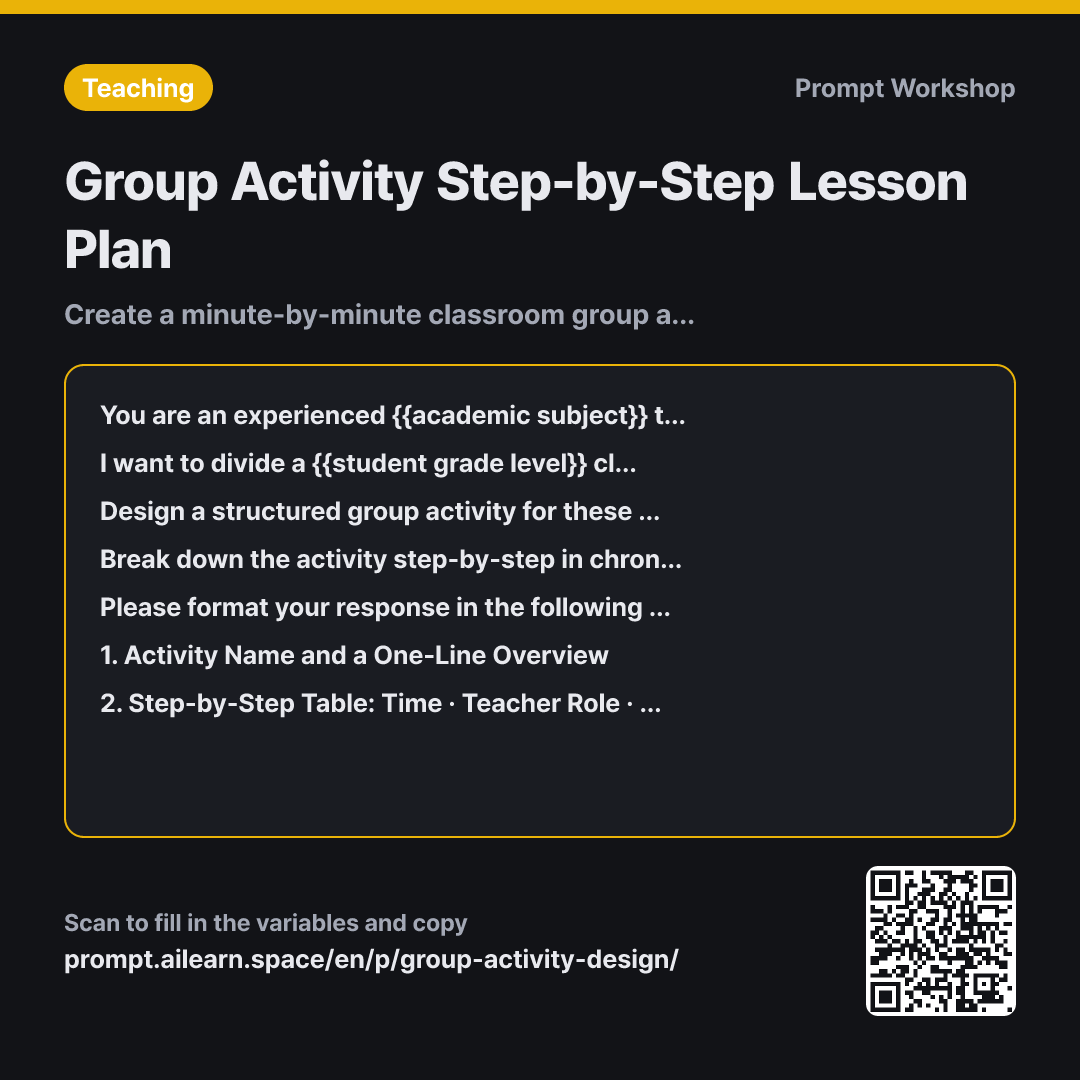
When asking AI for group activity ideas, it often returns flashy titles and lofty conceptual goals. The problem emerges when bringing that idea to a real classroom: without clear time management and defined roles, the first 5 minutes dissolve into confusion and wasted time. This prompt is engineered to generate a turnkey facilitation schedule, not just a vague idea.
Setting the Role with "Suggest only realistic, field-tested activities" filters out ideas requiring excessive preparation or supplies. Defining classroom setup and materials in the Context paragraph serves the same purpose. If you mention tablets or poster boards, it builds an activity around them; if you specify just a worksheet, it keeps the logistics simple and reliable.
The requirement to divide the plan into concrete Phases is the core of this prompt. Forcing the AI to place Time, Teacher Prompts, and Student Actions on the same row prevents generic statements like "students discuss." Providing exact teacher dialogue ensures you can read instructions directly during class, and capping it at 5 phases ensures the lesson fits within 45 minutes.
The fourth item in the Format section is what sets practical classroom design apart from typical ChatGPT responses. Scenarios like one student doing all the work or a group finishing early happen almost every period; having scripted responses ready keeps you composed and in control.
Unfamiliar terms? See Aha AI: role-prompting, chain-of-thought
Compared with a bad example
Give me some group activity ideas for analyzing ads in 8th grade English.
This prompt yields a generic list of 5-6 activity ideas with brief descriptions. While they may sound appealing, there is no time breakdown or role distribution, leaving the teacher to plan the entire lesson from scratch. Without specified materials, the AI may also assume access to resources not readily available, like individual tablets or poster paper.
Variations
When the Activity Is Already Chosen
I plan to conduct a group discussion on "{{main central topic}}" in my {{student grade level}} {{academic subject}} class. The activity itself is already decided; I only need the step-by-step facilitation schedule.
Create a 30-minute facilitation schedule for groups of {{group size}}. Format it as a table with three columns: Time, Teacher Signal, and Student Actions. Add a one-line visual checkpoint for each step so the teacher can verify progress at a glance.
Skips brainstorming activity ideas and generates only the facilitation timetable. Useful for converting an existing activity into a structured lesson plan.
When Including Final Presentations
I want to dedicate the final 10 minutes of our {{student grade level}} {{academic subject}} group activity on "{{main central topic}}" to group presentations. There are six groups of {{group size}} students each.
Design a method for all six groups to present within 10 minutes. Specify the speaking time per group, the task for listening students, and a concluding sentence for the teacher. Also, suggest one simultaneous sharing format that avoids sequential standing presentations.
Presentations often derail lesson timing, so this variant specifies exact time limits and active listening tasks.
Model notes
If teacher scripts make table cells too cramped, add: "Keep only Time and Student Actions in the table, and list numbered Teacher Scripts separately below it." Mentioning your classroom layout and total group count will also tailor student movement and room logistics.
Related prompts
Last updated 2026-09-02 · Found a mistake? Let us know