Why it is written this way
When asked to create a 12-week curriculum all at once, AI models typically spit out a standard, plausible-looking table of contents divided across 12 slots. However, this often disconnects from the actual target goal—for instance, mechanically listing grammar chapters from page one even when the goal is a specific test score or speaking benchmark.
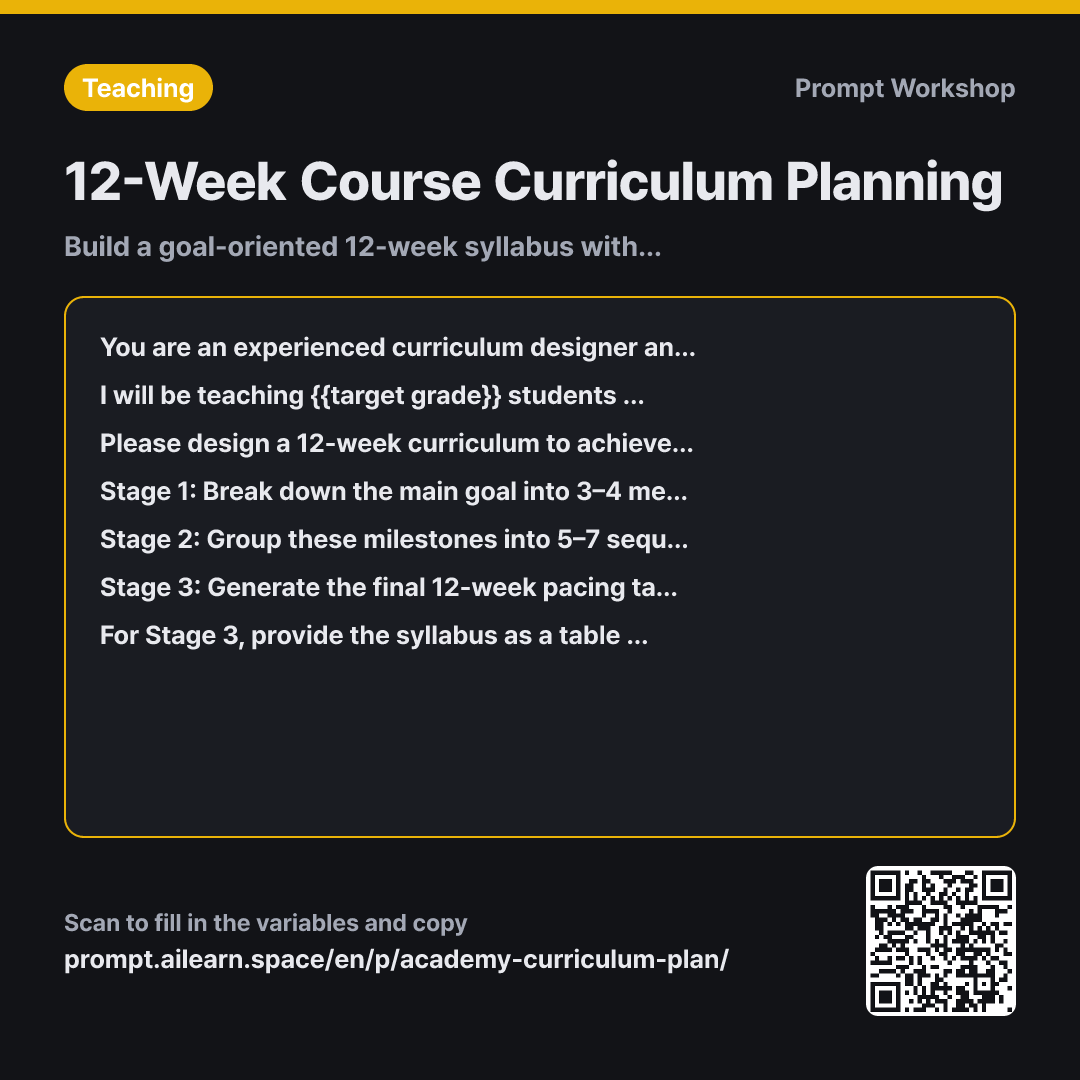
This prompt resolves that issue by chunking the process into three distinct stages: decomposing the goal into verifiable checkpoints, structuring them into sequential units, and only then mapping them into weekly slots. Because human review is required after each stage, misalignments are caught early before expanding into a 12-week plan. For 1-on-1 tutoring, Stage 1 alone serves as a strong initial diagnostic framework for parent consultations.
The Role definition emphasizes measurable student transformation over aesthetic completeness. Without this constraint, models output jam-packed schedules that collapse in reality the moment a single class falls behind.
The Format specifies the column "Learning Outcome (What students can actually do this week)" instead of just a topic title. Topic titles only show what was taught, not what was retained.
The Constraints mandating buffer weeks and prohibiting new units every week embed realistic learning delays and review cycles directly into the plan, while banning fictional book titles prevents misleading materials from reaching students or parents.
Unfamiliar terms? See Aha AI: chain-of-thought, output-format
Compared with a bad example
Create a 12-week curriculum for 8th grade English, 2 sessions a week for 90 minutes.
Without a clear target outcome or staging instructions, the AI fills 12 weeks with generic textbook chapters. The result is an overly rigid schedule that fails to clarify the underlying objective (exam prep, speaking fluency, etc.), making it impossible to adjust mid-way or prioritize essentials when classes fall behind.
Variations
4-Week Intensive Course
You are an experienced curriculum designer and instructor in {{academic subject}}. I am running a 4-week intensive vacation course for {{target grade}} students, meeting {{weekly class count}}. The overall goal is: "{{target goal}}"
Because 4 weeks is short, do not try to cover everything. First, select the single most critical and achievable sub-goal for this timeframe, along with your rationale. Wait for my confirmation before generating the weekly schedule.
Once approved, provide the schedule as a table with columns: Week | Topic | In-Class Activity | Homework | Assessment Method. For the final week, include a 3-line actionable roadmap for what students should continue practicing independently during the regular semester.
For shorter timeframes, prioritizing what to cut is essential. The AI proposes the narrowed focus, allowing human confirmation before syllabus generation.
Auditing an Existing Syllabus
I will paste my draft 12-week pacing guide for {{target grade}} {{academic subject}} below. The target goal is "{{target goal}}" with a class frequency of {{weekly class count}}.
Please audit whether the pasted schedule actually achieves this goal. First, break the goal down into 3–4 verifiable competencies. Then, cross-examine the schedule in a comparison table showing which weeks address each competency. Highlight any competencies never addressed, topics crammed into a single week, and periods lacking assessment checks. Suggest specific structural adjustments without rewriting the entire syllabus from scratch.
Use this variant when reviewing an existing plan. Explicitly instructing the model not to rewrite the entire curriculum keeps the original framework intact while pinpointing structural blind spots.
Model notes
If you ask for all 3 stages at once, the early assumptions often degrade in later steps. Verify each output step-by-step and prompt: "Stage 1 approved. Please proceed to Stage 2."
Related prompts
Last updated 2026-09-02 · Found a mistake? Let us know