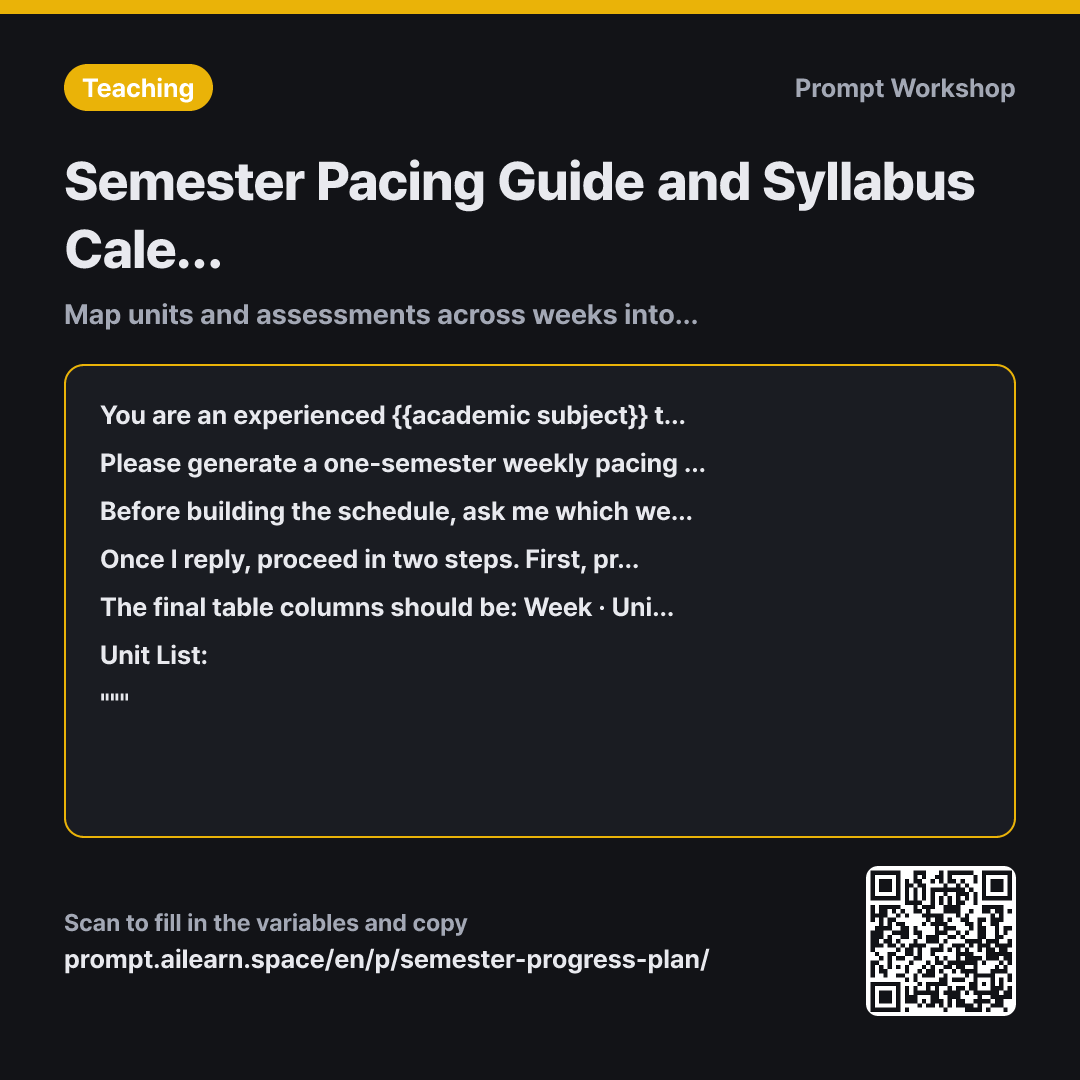
Why it is written this way
When you ask an AI to create a pacing guide without constraints, it simply divides the number of units evenly across the total number of weeks. The problem is that standard calendars ignore midterm weeks, sports days, field trips, and school assemblies. Because actual instructional weeks are much fewer, teachers inevitably fall behind by mid-semester and end up cramming the final unit into two frantic days.
The clarifying questions requested in the third paragraph fix this math upfront. Exam weeks and school events vary by institution and cannot be guessed by the model; if not prompted, the AI will assume every single week is fully available for new content. Capping the prompt at 3 questions prevents the model from overwhelming you with an interrogation before doing the work.
Structuring the workflow into two clear phases serves the same purpose. Reviewing the blackout schedule first guarantees that unit placement occurs only in genuine teaching weeks. Without this separation, models often place lessons into exam weeks while merely adding "Exam Week" in the notes column, leaving the teacher to manually shift the entire schedule later. Specifying this routine in the role persona anchors this logical sequence.
The five columns in the format match the essential requirements for administrative course plans. Marking multi-week unit parts ensures continuity even when a holiday interrupts instruction. Finally, the emergency buffer ("two lessons that can be condensed") offers a safety valve if pacing goes off track during the term. Pacing guides are tedious to officially revise once submitted, so identifying flexible buffer points early saves substantial administrative overhead.
Unfamiliar terms? See Aha AI: role-prompting, output-format
Compared with a bad example
Make a 9th grade English semester pacing guide.
(Pastes table of contents)
This produces a naive table that splits 6 units uniformly across 17 weeks. Because exam weeks and holidays are overlooked, the schedule overestimates teaching time by 3–4 weeks and scatters assessments arbitrarily. Following it will start new units right before midterms or double up units before finals. Fixing pacing mid-term requires recounting all remaining weeks from scratch, forcing you to rebuild the syllabus from zero.
Variations
Recalibrating a Delayed Schedule
Our pacing for {{student grade level}} {{academic subject}} is currently two weeks behind schedule. Please adjust our remaining semester plan to fit the remaining weeks. First, categorize the remaining units into essential exam topics versus condensable lessons, and wait for my confirmation before building the new weekly table. Below the table, explain what was trimmed and how it impacts upcoming assessments.
""" {{unit list}} """
Most helpful for mid-semester corrections. It aligns priorities on what to cut before regenerating the calendar.
Standalone Assessment Timeline
Please organize a semester-long assessment plan for {{student grade level}} {{academic subject}} into a structured table. The columns should be: Assessment Title · Week · Target Unit · Format (Written / Performance / Project) · Weighting (%) · Student Advance Notice Details. Distribute performance tasks evenly so they do not pile up in a single week, and do not place major projects in the week immediately preceding written exams. Fit this within {{semester week count}} and ensure total weighting sums to 100%.
""" {{unit list}} """
Useful when administrative department requirements require a dedicated evaluation matrix separate from daily pacing.
Model notes
Language models frequently make counting errors with multi-week schedules. When you receive the table, quickly verify that week numbers run sequentially from 1 to the end without skipped or duplicated rows.
Related prompts
Last updated 2026-09-02 · Found a mistake? Let us know