Why it is written this way
When you ask ChatGPT to write a teaching reflection, it often generates generic praise and fluff. Statements like "Student engagement was slightly lacking, but overall it was a meaningful session" may sound pleasant, but they do nothing to improve tomorrow's class. This is why teachers often repeat the same mistakes despite keeping reflection logs.
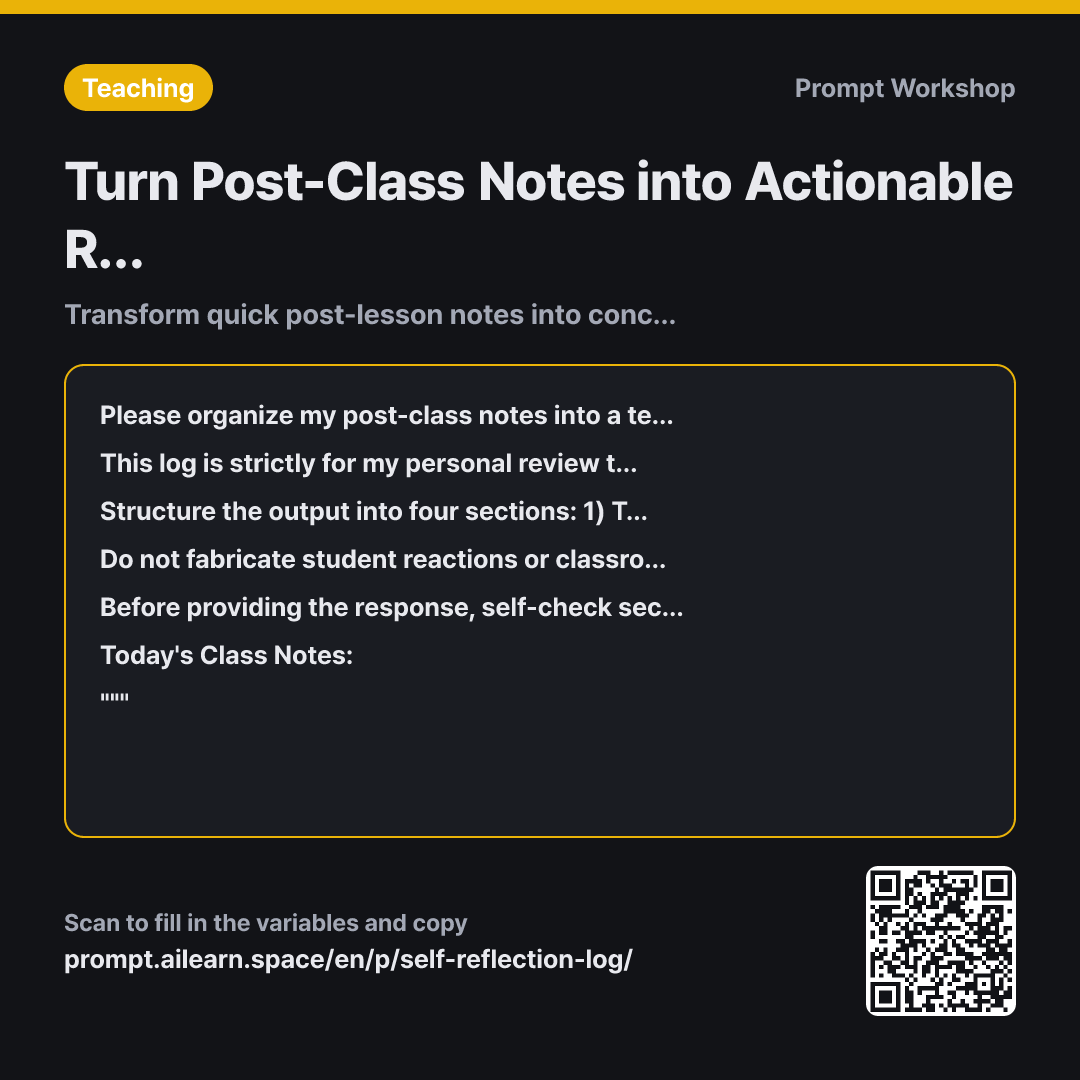
The task paragraph explicitly sets the tone as a "personal review" and bans self-congratulatory remarks. When an AI assumes an external audience, it naturally highlights positives first, filling half the response with unusable filler. The four-part format progressively narrows down from objective observation to concrete judgment: What happened → What deviated → The impact → Actionable change. This structure ensures the final action step is firmly rooted in evidence.
The constraint placed on item 4 is the core of this prompt. Vague commitments like "try harder" are not actions. Requiring a "when and what" statement forces practical changes like "Set a visual timer for the warm-up activity and cut it off at 5 minutes." The self-check instruction forces the model to evaluate its own recommendation before displaying the final result.
The constraints section prevents the AI from filling in gaps with imagined scenarios. Since post-class notes are often brief (just a few bullet points), models easily fabricate details like "students showed keen interest." Enclosing the raw text in """ delimiters clearly separates raw notes from instructions so shorthand fragments aren't misinterpreted as system commands.
Unfamiliar terms? See Aha AI: output-format, hallucination
Compared with a bad example
Write a teaching reflection log based on today's class.
(Paste class notes)
The AI expands the raw notes into a smooth narrative paragraph. Objective facts blend with vague evaluations (e.g., "Time management was challenging, but student participation was active"), and it hallucinates student reactions. It typically ends with a hollow resolution like "Next time, I will pay more attention to pacing," leaving tomorrow's lesson without a concrete action plan.
Variations
Weekly Aggregated Reflection
Below is a compilation of my teaching notes from this week. Instead of reviewing day by day, identify two recurring patterns or challenges across the entire week. For each challenge, provide: the specific note excerpts serving as evidence, the probable root cause, and one concrete action to test next week. Do not flag isolated, one-off occurrences as recurring issues.
""" {{class note}} """
Daily logs are easily swayed by day-to-day anomalies. Aggregating a full week helps distinguish one-time accidents from habitual teaching patterns.
Peer Debrief and Coaching
Please organize the notes below into a teaching debrief outline to share with a peer coach or colleague. Use these four sections: What I attempted · Where it diverged from expectations · What I feel uncertain about · 2 specific discussion questions for my colleague. Exclude self-congratulatory remarks and focus the most detail on the area of uncertainty. Do not invent details not found in the notes.
""" {{class note}} """
A personal reflection differs from peer sharing. Centering the notes around specific questions turns observation into a meaningful professional discussion.
Model notes
Five lines of quick notes jotted down right after class are plenty. If you wait too long, your memory rationalizes the experience and what went wrong fades away.
Related prompts
Last updated 2026-09-02 · Found a mistake? Let us know