Why it is written this way
When relying on AI to write extracurricular or career activity records, individuality is often the first thing lost. Providing only an activity title and date yields generic phrasing like "Participated enthusiastically in Career Exploration Day to explore future paths." This statement could apply to any student in the classroom because the specific actions were omitted.
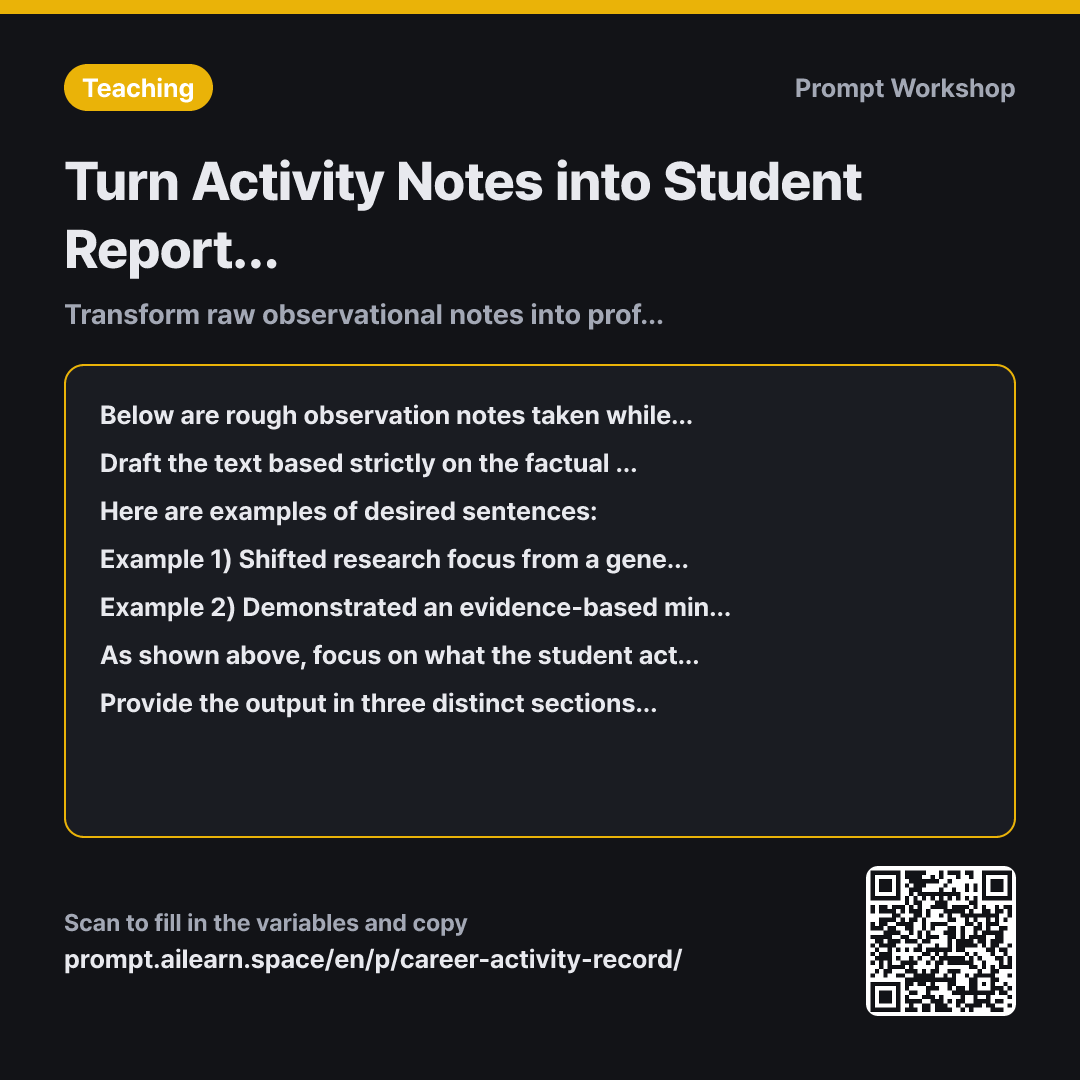
The two examples in the third paragraph do the heavy lifting in this prompt. While abstract rules about tone or sentence length often get ignored, concrete reference examples guide the model's structure and voice effectively. The two examples highlight key dimensions: one captures behavioral change and progression, while the other translates character and mindset into observable actions—the core requirements of meaningful student evaluation records.
The mapping table requested under format serves as an audit trail. Because school records must remain legally and factually defensible, linking each written claim back to specific observation notes ensures teachers can confidently verify and refine the draft. Any unlinked sentence indicates hallucinated content.
The constraints prevent two common pitfalls: fabricated accomplishments and empty superlatives. Banning adjectives like "active" or "diligent" in favor of specific evidence keeps the narrative authentic to that particular student.
Enclosing the memo within """ prevents raw student quotes or fragmented notes from being misinterpreted as operational instructions. Always review and adapt the generated draft to align with your institution's specific grading and reporting guidelines.
Compared with a bad example
Write a career activity report for a student who participated in career day and is interested in food and nutrition.
Supplying a broad summary instead of detailed notes forces AI to fill in the gaps with clichéd filler. The output will resemble "Showed great interest in food and nutrition during Career Exploration Day and developed future goals," completely missing the student's concrete effort of analyzing lunch menus. The resulting comment fails to distinguish the student from their peers and leaves no verifiable evidence to support the record.
Variations
Batch Processing Multiple Students
Below are observation notes for multiple students from the same activity. Please generate an individual activity report record for each student.
Write approximately 80-100 words per student, ensuring varied sentence openings and vocabulary across profiles. If notes for a student are sparse, do not invent details; keep the entry brief and add a note stating "Additional observation required." Identify students using the exact labels from the notes without inventing names.
Activity Log Memo: """ {{activity log memo}} """
Use this when documenting an entire group or class at once. It combines requirements for varied sentence phrasing with strict rules against artificially inflating sparse records.
Extracting Facts from Student Self-Reflections
Below is a self-reflection written by a student after completing an activity. Please extract only verifiable facts suitable for an official school record.
First, extract a bulleted list distinguishing between concrete actions the student took and self-reported changes in thinking. Next, synthesize those extracted points into a formal record of roughly 80-100 words. Filter out vague emotional comments like "It was fun" or "I learned a lot." For actions not directly observed by the teacher, clearly flag them as "Student-Reported."
Activity Log Memo: """ {{activity log memo}} """
Useful when teacher observation logs are sparse and student self-reflection sheets are used as supporting evidence. Differentiating direct observations from student statements is key.
Model notes
School reporting requirements, character limits, and conventions vary. Review institutional guidelines and edit the generated draft before finalizing official records.
Related prompts
Last updated 2026-09-02 · Found a mistake? Let us know