Why it is written this way
When asking AI to plan teacher PD, the most frequent failure is mismatched difficulty. A session on the same topic requires vastly different content for absolute beginners versus teachers who already use the tools daily. Generating an agenda without this context usually yields a bland, middle-of-the-road lecture that wastes everyone's time. This prompt ensures the AI asks for critical background first.
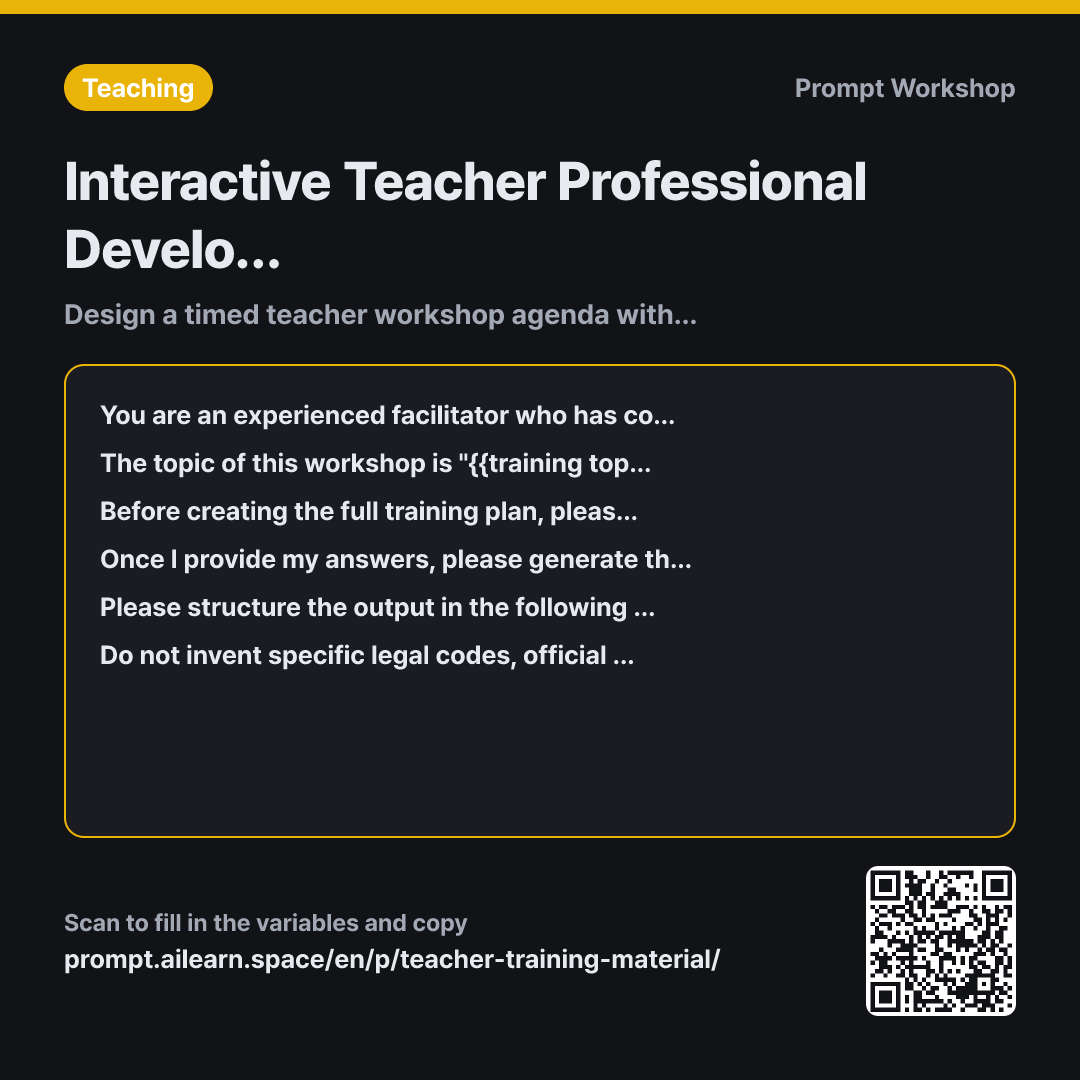
The follow-up question instruction in the third paragraph is the core mechanism. Knowing the audience's prior knowledge and whether attendance is mandatory or voluntary shapes at least half the session. Mandatory PD requires time upfront to establish buy-in and relevance, whereas a self-selected PLC would consider that a total waste of time.
Role and Context operate in tandem. Framing the persona as an "experienced facilitator who knows teachers are busy" eliminates generic icebreakers and theoretical lectures. Defining the outcome as "one concrete thing to try next week" anchors the success metric to practical classroom artifacts rather than test scores or abstract competencies, forcing the AI to dedicate time to hands-on work.
In the Format section, splitting the schedule into "Facilitator Activity" and "Participant Activity" columns makes passive listening visible at a glance. If the participant column repeatedly says "Listen," the agenda needs redesigning. Requesting a completed sample for the activity serves the same purpose: without a concrete model, participants waste valuable practice time asking what they are supposed to produce.
Finally, the Constraint barring invented policy numbers prevents AI hallucinations from being printed and cited in front of faculty.
Unfamiliar terms? See Aha AI: role-prompting, context-window
Compared with a bad example
Make a teacher training material about using AI in class for 90 minutes
With only time and topic, the AI generates a generic lecture: 30 minutes of concepts, 30 minutes of case studies, and 30 minutes of Q&A, with zero hands-on practice. Without checking prior knowledge, the first 20 minutes bore experienced teachers, while the case studies move too fast for beginners.
Variations
When switching to a fully hands-on workshop format
You are an experienced facilitator who has conducted teacher professional development for years. I am planning a session on "{{training topic}}" for {{target object}} with a duration of {{target time}}, and I want it to run as a 100% hands-on workshop with zero traditional lecturing.
Keep total facilitator talking time under 15 minutes across the entire session, and fill the remaining time with small-group activities (4–5 people per group). For each activity, provide the exact prompt/task card text to distribute to groups, the time allocation, and one coaching question the facilitator can ask if a group gets stuck. Suggest one concise method to showcase group outcomes at the end.
Use this when running a collaborative workshop rather than a presentation. Capping facilitator talk time with an explicit number is key.
When you need an internal PD announcement flyer
Please write an internal school announcement flyer for the upcoming professional development session: "{{training topic}}" (Duration: {{target time}}, Audience: {{target object}}).
Structure the announcement in this order: 3 catchy headline options, 3 bullet points explaining why teachers should attend, 3 bullet points outlining what participants will do/build, and a fill-in-the-blank template for logistical details (date, location, materials to bring, registration link). Avoid buzzwords like "paradigm shift" or "empowerment"; instead, state the tangible outcomes teachers will gain for their precious time. Do not invent dates or links; leave placeholders.
Use this after finalizing the workshop agenda to recruit participants. Requesting placeholders prevents the AI from fabricating fictional dates or room numbers.
Model notes
If you need standalone participant handouts after generating the agenda, reply in the same chat: "Turn the hands-on activity above into a printable single-page A4 worksheet for participants."
Related prompts
Last updated 2026-09-02 · Found a mistake? Let us know