Why it is written this way
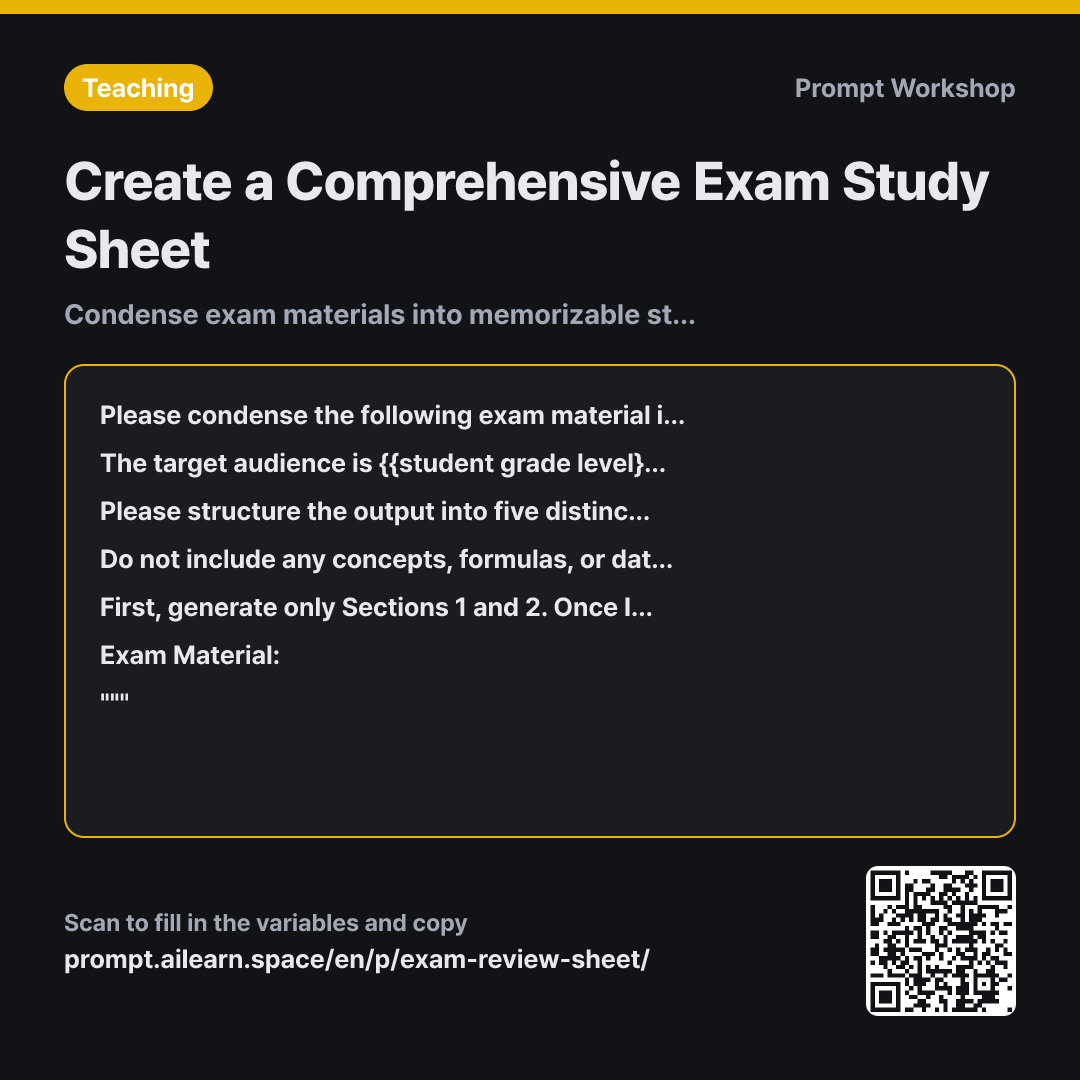
When asking AI to create an exam study sheet, it typically outputs a shortened summary following the textbook's sequential order. While shorter, it remains just a continuous text to read. A study sheet's primary purpose is not just to reduce word count, but to reorganize information into test-ready formats; simply asking for a summary fails to trigger this restructuring.
This is why "Do not merely summarize in the original chronological textbook order" is explicitly placed at the beginning of the Task paragraph. Defining negative constraints is essential to break the AI out of standard structural patterns. The five sections in the Format mirror the exact cognitive steps students take when preparing for a test: memorizing terms, clarifying confusing concepts, mastering procedures, recognizing traps, and testing their recall. The comparison tables and common mistakes are what distinguish this from a generic summary.
Under Constraints, two key rules are enforced. First, preventing hallucinated or supplementary content. AI often adds extraneous background formulas or dates, which only burden students if they are outside the test scope. Second, limiting definition length to ensure they are short enough for students to memorize word-for-word.
The fifth paragraph asks the AI to deliver only the first two sections initially. Generating everything at once makes it difficult to adjust pacing or reduce bloat, whereas reviewing the initial sections allows you to quickly assess if it will fit on two pages before proceeding. The triple quotes """ isolate the source material from instructions, preventing student margin notes (e.g., "not on test") from being misinterpreted as prompt directives.
Unfamiliar terms? See Aha AI: output-format, hallucination
Compared with a bad example
This is my exam material, please make a study sheet.
(paste textbook content)
The AI returns a line-by-line shortened version of the original text. Because it remains in paragraph format rather than structured units, students cannot easily memorize key terms or compare confusing concepts side by side. Without length constraints, it may span three or more pages, forcing the teacher to manually edit. Unwanted outside formulas may also slip in unnoticed.
Variations
Interactive Self-Assessment Worksheet
Please create a self-assessment worksheet for {{student grade level}} students based on the exam material below. Instead of providing completed summaries, format it so students actively fill in blanks to study. Leave the definition columns empty in the concept table, and keep only the header names in the comparison tables. Include an answer key at the very end, followed by a 3-line guide on how students should check their answers after completing the sheet.
""" {{unit content}} """
Active recall through filling out worksheets yields better long-term retention than passive reading. Useful for classroom review sessions.
Essential 1-Page Sheet for Struggling Students
From the exam material below, extract only the absolute core essentials that a {{student grade level}} student must know, condensed into a single page. Limit it to no more than 6 core concepts, each explained with a one-sentence definition and a single example. Include only the single most basic format for calculation problems. At the bottom, provide a separate bulleted list of topics that were omitted.
""" {{unit content}} """
A 2-page sheet can overwhelm struggling students. Providing the list of omitted topics allows teachers to add them back later if needed.
Model notes
If using textbook photos or PDFs, upload the file first before submitting the prompt. For handwritten notes, uploading 3–4 clear images at a time provides the most reliable results.
Related prompts
Last updated 2026-09-02 · Found a mistake? Let us know