Why it is written this way
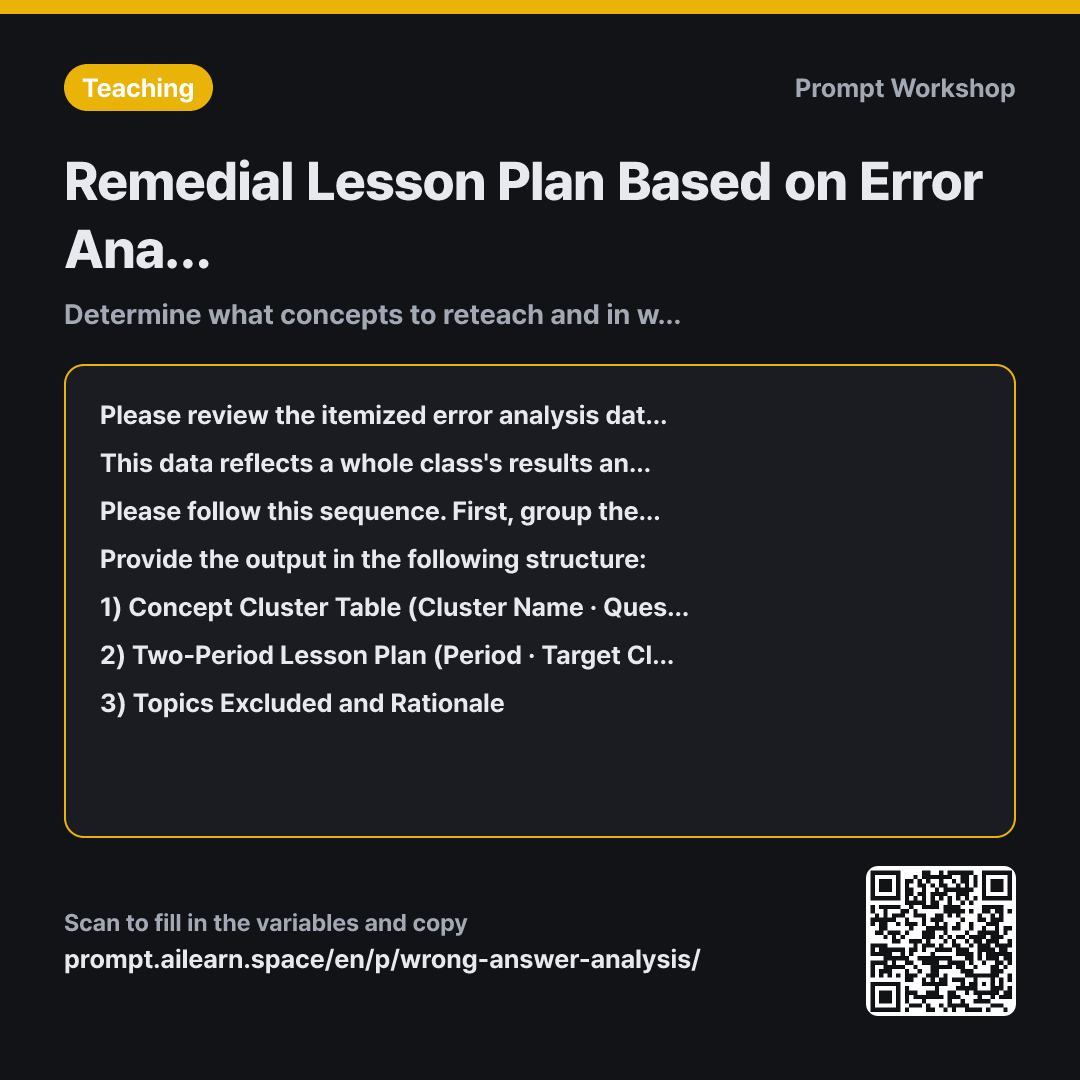
When planning remedial classes, the most common approach is simply to work through questions starting with the highest error rate. However, even if you tackle an 84% error rate mixture problem first, students will get stuck in the exact same place if their underlying distributive property and expression simplification skills are shaky. This prompt identifies the prerequisite conceptual hierarchy rather than raw ranking.
The third paragraph breaks this task down into explicit steps: cluster → assess foundational status → sequence → prune. When asked all at once without structured steps, AI typically stops after step one and returns a list sorted by error rate. Numbering the steps ensures the intermediate reasoning is visible, allowing the teacher to review the logic behind the instructional sequence.
The task in the first paragraph is framed not as "analyze this," but as "determine what to reteach and in what sequence over two periods." Requesting analysis yields summary tables and commentary, while requesting actionable decisions forces clear trade-offs and prioritization. The hardest part of class error analysis is deciding what to leave out.
In the format guidelines, the column evaluating prerequisite status provides the rationale for the teaching order. With this column populated, a teacher can quickly adjust the plan at a glance.
The final constraints prevent two major pitfalls: jumping to definitive conclusions about misconceptions based purely on data points, and hallucinating questions. Labeling inferences as "[Hypothesis]" makes it immediately obvious what needs direct classroom verification. Enclosing the source data in """ prevents text inside the data table from being misinterpreted as instructions.
Unfamiliar terms? See Aha AI: prompt, output-format
Compared with a bad example
Make a remedial lesson plan based on these error rates.
(Paste item analysis table)
The output will just be a list of questions ordered by error rate accompanied by generic statements like "Review this concept." It will not indicate what to cut when time is limited, and without prerequisite sequencing, it will suggest reteaching the most difficult application problems first. Students will remain stuck because foundational gaps were never addressed.
Variations
When Creating an Individualized Study Prescription
The {{academic subject}} error data below represents the test results of a single student. Please create a self-study prescription for this student.
Group the missed questions by concept, and select only the top two clusters the student should address first. For each cluster, provide: one line on what concept to review · one line on practice problem types · one line self-check question. Write in clear, concise language suited for a student, and do not mention scores or percentiles. If something cannot be determined from the data alone, leave it out rather than guessing.
Incorrect Answer Material: """ {{incorrect answer material}} """
Used for an individual student rather than a whole class. Constrained to two core clusters to keep it actionable and directly readable by the student.
When Reviewing Test Questions for Future Revisions
The following is the item-by-item error data from a recent {{academic subject}} exam. Please evaluate the exam items themselves before designing the next test.
Identify questions with exceptionally high or low error rates, and distinguish whether the outcome was likely due to concept difficulty or item construction/prompt phrasing. Provide a one-line rationale for each item, and label any uncertain items as "Inconclusive." Conclude with a 5-item checklist to use when writing question prompts for the next exam.
Incorrect Answer Material: """ {{incorrect answer material}} """
Focuses on item design and assessment validity rather than student remediation. Instructs the model to flag ambiguous data points as inconclusive.
Model notes
If you have an item analysis export or spreadsheet, attach the file first and paste the data. Removing student names and retaining only question numbers, concepts, and error rates is sufficient.
Related prompts
Last updated 2026-09-02 · Found a mistake? Let us know