Why it is written this way
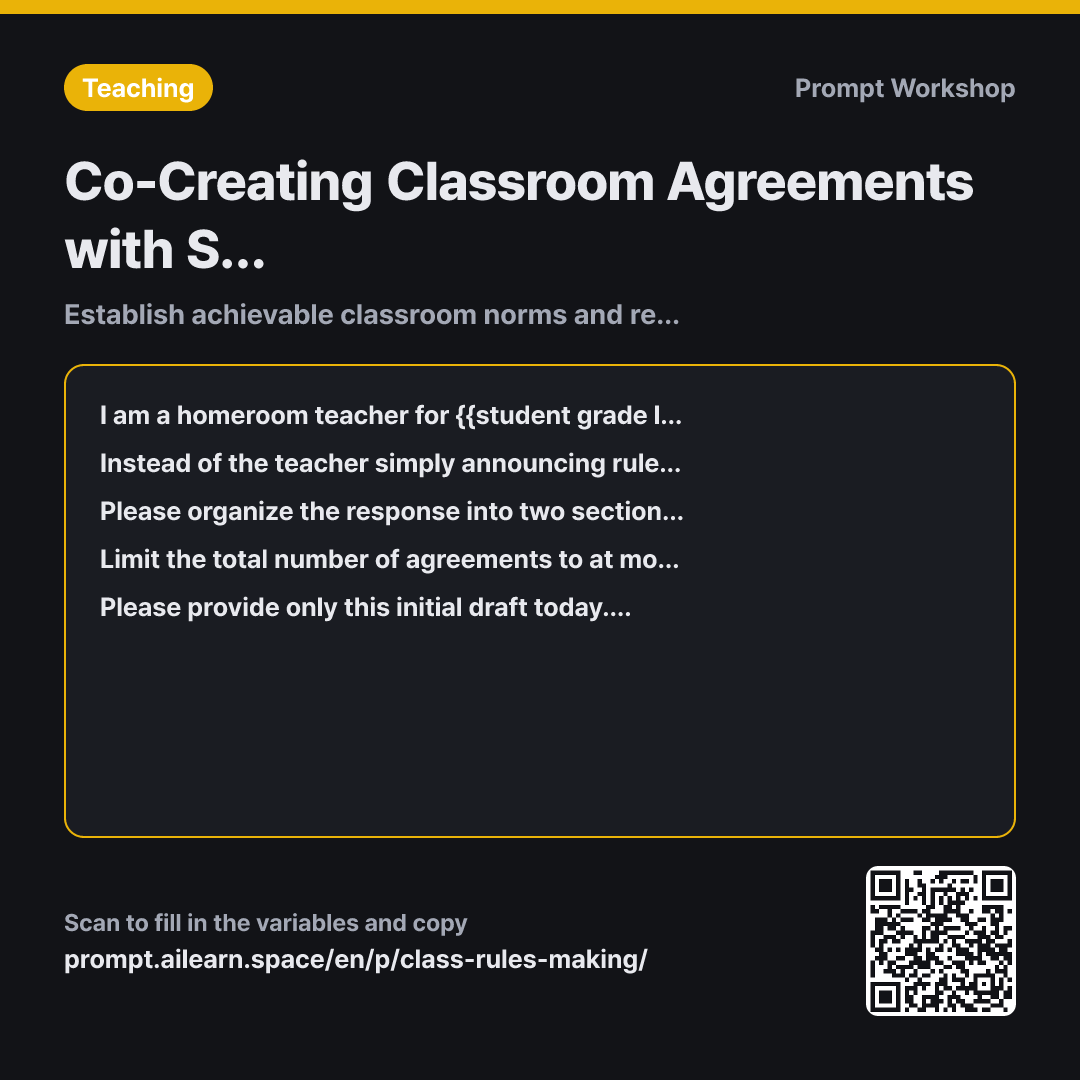
Classroom rules usually fail not in the first week, but two months into the semester. When rules consist of prohibition lists like "No talking, No running," students view them not as behaviors to practice, but as boundaries to avoid getting caught. This prompt prohibits negative phrasing entirely and instead captures desired positive behaviors in student-friendly language.
This is why the context paragraph asks for 2–3 sentences describing the specific class atmosphere. Generic rules that can be posted in any room end up being followed in none. Adding a concrete detail like "transitions take a long time" ensures the draft targets real classroom situations. Specifying a key focus point guarantees that at least one agreement directly addresses what the teacher wants to prioritize this year.
The core strength of the prompt lies in requesting an activity plan alongside the rules in the task. Receiving just a list of rules turns into another teacher monologue on the whiteboard. When the guiding questions for students are included in the lesson plan, the resulting norms genuinely feel student-created. The third column in the format, "Restorative Action When Broken," sets up agreed-upon repairs from day one. Without this, teachers are forced to improvise consequences on the spot every time an issue occurs.
The final paragraph instructs the AI not to finalize everything in a single turn. During the actual activity, students will express ideas in their own natural phrases. Feeding their exact words back into the prompt ensures the posters on the wall truly reflect student ownership. Trying to produce a finished product right away turns the exercise into students simply signing the teacher's pre-made rules. The initial draft is best used as a facilitating guide for the teacher.
Unfamiliar terms? See Aha AI: prompt, output-format
Compared with a bad example
Create 10 classroom rules for 4th grade.
This produces ten generic sentences seen on standard school bulletin boards. Half of them will be negative prohibitions like "Don't run in the hallway," without addressing the actual dynamics of your specific classroom. Having ten rules is also problematic; when there are too many rules, students remember none. Because students have no voice in the process, the list is ignored within days, and how to handle broken rules remains completely unresolved.
Variations
When Agreements Break Down Mid-Year
Here is our current {{student grade level}} dynamic: {{classroom environment atmosphere}}. The classroom agreements established at the beginning of the term are not being followed consistently, and I want to revisit them with the students.
Instead of creating new rules, please provide 5 inquiry-based questions to ask students why the agreements are struggling, along with a 20-minute class meeting agenda to adjust the agreements based on their feedback. Frame the questions around situational causes rather than assigning blame.
Shifted from adding more rules to diagnosing root causes through discussion. The more rules there are, the fewer get followed.
Communicating Classroom Agreements to Parents
Please write a concise letter (under 150 words) introducing our {{student grade level}} co-created classroom agreements to parents. Our main focus this year is "{{key focus point}}".
Before listing the agreements, start with two sentences explaining that the students formulated these norms themselves. Include a single request asking how families can reinforce this shared language at home, and add one line describing our restorative approach when an agreement is broken.
Classroom agreements gain real power when reinforced with consistent language between school and home; this incorporates the collaborative process and home partnership.
Related prompts
Last updated 2026-09-02 · Found a mistake? Let us know