Why it is written this way
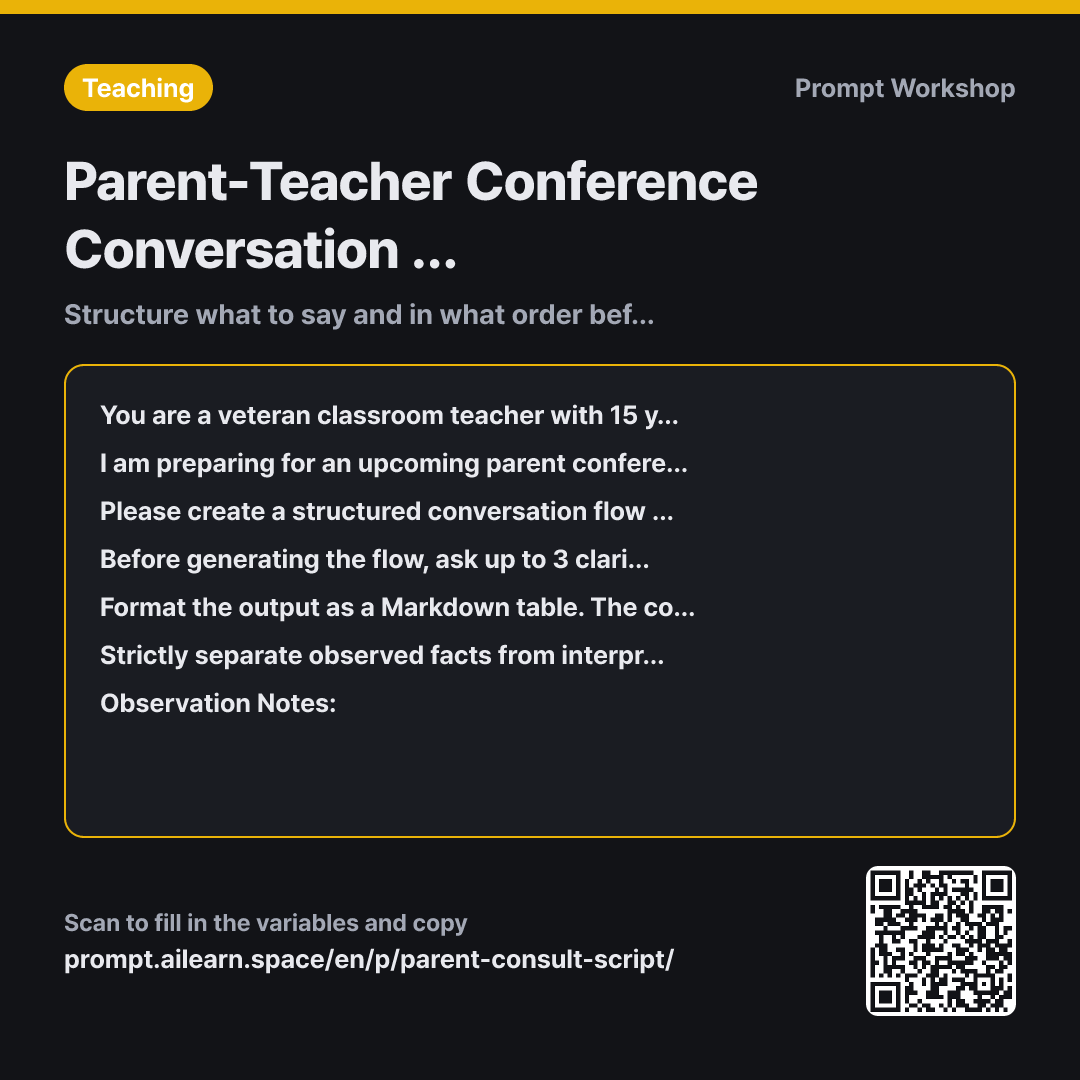
A 20-minute conference passes much faster than you think. If you plan solely in your head, you risk spending too much time on generic praise early on, leaving no time for the core issue. This prompt establishes the order of conversation before deciding on specific wording.
Setting the role as a "veteran classroom teacher with 15 years of experience" is not for vanity—it calibrates tone. Adding practical experience shifts the response away from theoretical communication advice toward phrases you would actually say aloud. The subsequent clarification prompt prevents generic output; prompting AI to ask about prior talks, siblings, or existing parent awareness tailors the response specifically to this child.
Specifying the table format and column names ensures the output can be referenced in real time. Having "Teacher Talking Points" right next to "One Key Question to Ask the Parent" keeps the discussion on track even if the conversation wanders. Mandating the specific phases also guarantees that dedicated listening time for the parent is not accidentally omitted.
The two constraints are critical. Without explicit boundaries, AI models naturally adopt clinical language like "appears to show signs of attention deficit." A teacher's role is strictly to share observable facts and school-based support. Banning assumptions about home background serves the same purpose: the moment a meeting shifts to assigning home blame, parents become defensive. Wrapping the observation notes in """ prevents student data from being misinterpreted as instructions.
You do not need to read the script verbatim. Print it on a single sheet of paper and glance at the phase names and questions during the meeting.
Unfamiliar terms? See Aha AI: role-prompting, hallucination
Compared with a bad example
I have a parent conference for a kid who doesn't do homework. What should I say? Give me a script.
Asking this way yields generic comforting phrases usable in any classroom. Without a timeline, managing 20 minutes remains unresolved, and room for parent input is neglected. Lacking specific context, the model will output cliché advice like "Please pay more attention at home," which often derails difficult conferences.
Variations
When wrapping up within a 10-minute phone call
I need to conduct a 10-minute phone conference with the parent of a {{student grade level}} student regarding "{{consultation reason}}". Please create a 5-line conversation sequence for this call.
Provide the exact script line by line in this order: Opening (reason for calling), One sentence sharing objective facts, One question for the parent, One action step the school will take, and Closing. Avoid definitive or judgmental language since body language and facial expressions are absent over the phone.
Since checking a table during a phone call is difficult, this variant asks for a concise, line-by-line spoken script instead.
When the parent requests the conference first
The parent of a {{student grade level}} student has requested a meeting regarding "{{consultation reason}}". Based on the notes below, create a table outlining 5 likely questions the parent will ask, along with a response framework for each.
In each response, separate verified facts, items not yet verified, and action steps the school will take by next week. Do not speculate on unverified points; instead, use phrases like "I will look into this and follow up with you."
Observation Notes: """ {{current student situation}} """
For parent-initiated meetings, anticipating incoming questions is far more effective than preparing a one-way agenda.
Model notes
Replace actual student names with "the student" in your notes, and review all AI-generated phrasing before using it with parents.
Related prompts
Last updated 2026-09-02 · Found a mistake? Let us know