Why it is written this way
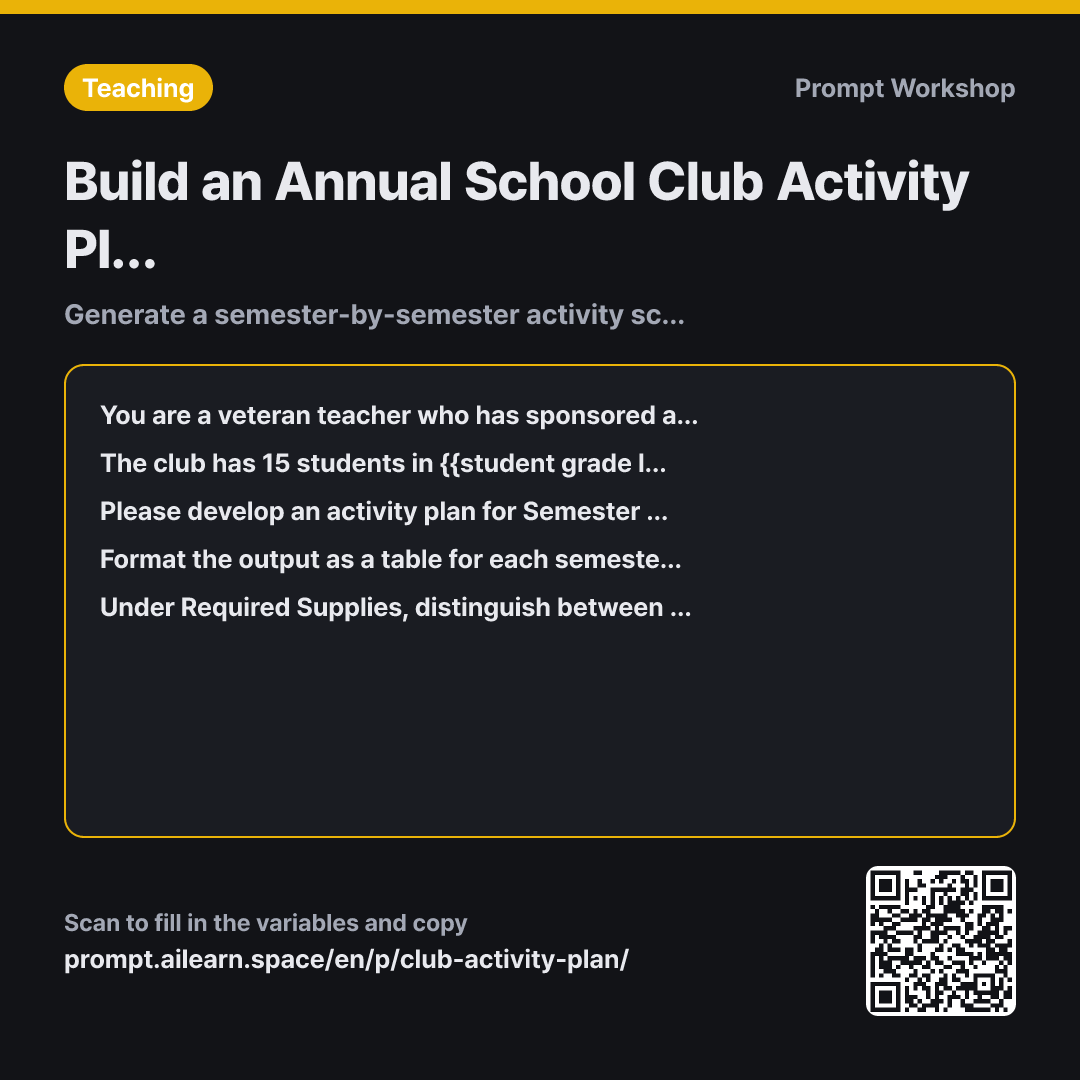
School club plans rarely fail when they are written; they fail in the middle of the semester. Teachers often draft a list of twelve exciting activities only to realize there is no budget for the supplies, or that an experiment cannot be finished in a single two-period block. This prompt forces the AI to consider activities, supplies, session counts, and budget simultaneously in a single table.
In the Role, specifying that you "care more about whether a plan actually works in practice" fundamentally shifts the nature of the generated ideas. Without this clause, AI tends to suggest photogenic but impractical activities; with it, the AI leans toward activities with simple prep and repeatable engagement. Mentioning years of advisory experience pushes the response from a generic overview toward practical operational wisdom.
Paragraph 2 delivers the Context, doing the heaviest lifting. Setting constraints—15 students, twice a month, two periods per session, and a limited budget—defines the realistic scope of each activity. Specifying the grade level prevents the AI from picking tasks that are too advanced for younger students in a mixed-grade setting.
The six table columns in the Format instructions anticipate operational bottlenecks. Seeing session length and estimated costs in the same row immediately highlights unrealistic activities. Asking for an end-of-semester deliverable provides a clear goal, naturally structuring the preceding sequence of sessions.
Finally, the Constraints prevent the AI from fabricating pricing ("Needs Verification") or relying heavily on passive lectures. Banning proprietary software and brand names ensures the plan can be submitted for official school approval without referencing nonexistent or unapproved tools.
Unfamiliar terms? See Aha AI: role-prompting, output-format
Compared with a bad example
Make an annual plan for a middle school science experiment club.
This prompt yields a generic list of twelve activity titles with no timeline, supply list, or cost breakdown. While it might look passable for an administrative submission, you will hit a wall when ordering supplies. Without student counts and time limits, the AI will suggest long-term projects or experiments requiring expensive equipment that 15 students cannot realistically share.
Variations
Detailed Plan for a Single Session
Please choose one session (2-period block) from the {{club field}} club plan and create a detailed operational plan for 15 students in {{student grade level}}.
Provide a step-by-step agenda broken down into 10-minute intervals in a table format. Include group formation instructions, precise supply quantities (for 15 students), tasks for fast finishers, and safety notes. For the supply quantities, clearly distinguish between group-shared items and individual items.
Use this variant when your annual plan is finalized and you need an actionable session plan. Breaking down supply quantities by group makes placing orders seamless.
Club Recruitment Flyer / Announcement
Write a club recruitment announcement targeting {{student grade level}} students for the {{club field}} club (under 400 words).
Structure the text in this order: a one-sentence summary of what the club does, 3 exciting projects or activities students will complete this semester, the meeting schedule, and how to apply. Avoid language implying only advanced students can join, and be transparent about any personal supplies required.
Recruitment copy requires a different, more engaging tone than an administrative syllabus, so this variant highlights concrete student takeaways upfront.
Related prompts
Last updated 2026-09-02 · Found a mistake? Let us know