Why it is written this way
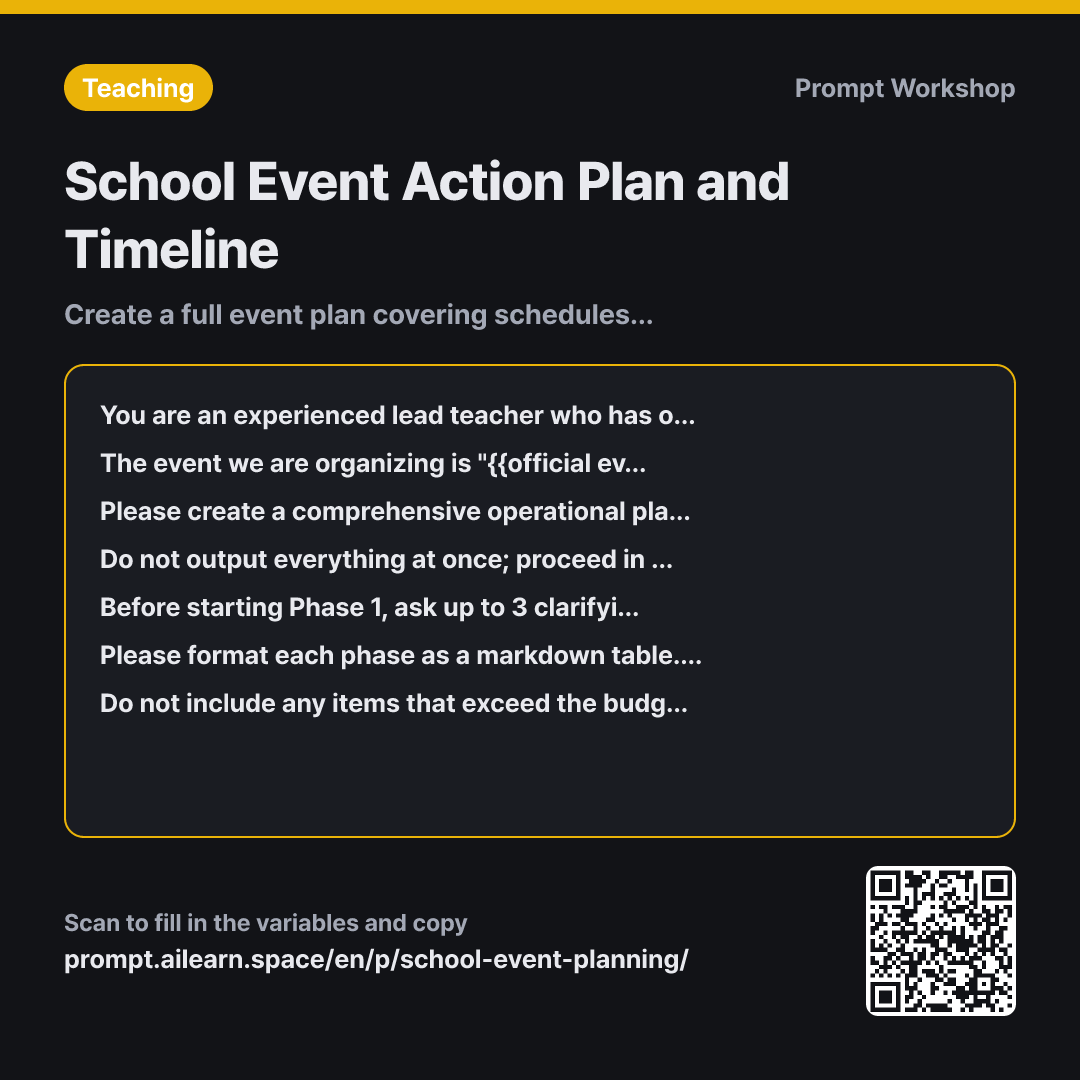
When you ask AI to plan a school event all at once, you usually just get a one-page schedule. The schedule is actually the easiest part to write; the real challenges that consume staff time are deciding who does what from when, and what to do if it rains. This prompt breaks the workload into three sequential phases.
The fourth paragraph is the core mechanism for this. By requesting the overview, roles, and contingencies separately with pauses in between, it prevents the AI from rushing. If requested in a single turn, the responses grow shorter toward the end, and Phase 3 gets reduced to just two or three lines. Breaking it up allows the organizer to adjust Phase 1's timeline first, ensuring that Phase 2's role assignments align perfectly with the updated flow.
Setting the role as "someone who instinctively thinks about what might go wrong on-site" directly elevates the quality of Phase 3. Without this, contingency planning often defaults to a generic line like "move indoors if it rains." With it, the AI specifies operational details down to who signals the move. The clarifying questions in the fifth paragraph help capture school-specific variables (such as A/V capabilities, staggered dismissal times, or parent attendance) that teachers often omit because they seem obvious.
Pre-defining the columns in the format section ensures that high-risk omissions are prevented. Without "Time Window" in Phase 2, you end up with assigned roles but no clear shift schedules. Without "Decision Maker" in Phase 3, staff hesitate during an emergency. The "Trigger/Signal" column serves the same purpose: unless the threshold for declaring a crisis is predefined, response times will lag.
Explicitly mandating weather, injuries, and schedule delays in the final paragraph addresses the three most frequent real-world issues in school event management. Instructing the AI not to exceed the budget or hallucinate prices saves time by eliminating unfeasible ideas right from the start.
Unfamiliar terms? See Aha AI: role-prompting, context-window
Compared with a bad example
Create an event plan for an elementary school fall talent show. In the gym for 2 hours.
This results in a single, generic schedule table. While the sequence (opening remarks, student performances, awards, closing) might be correct, it lacks setup materials and transition buffers, which in reality causes the event to run 20 minutes behind. Staff role assignments and safety contingency plans are completely absent, forcing the organizer to draft them manually from scratch.
Variations
When a day-before final checklist is needed
"{{official event name}}" is scheduled for tomorrow. The venue is {{location place venue}}, and the participants are {{target grade}}. Please generate a comprehensive final checklist for the day before and the morning of the event.
Format the response as a table with columns: "Checklist Time (Day Before / Event Morning) · Item · Verification Method · Person in Charge", organized into four sections: Equipment, Movement Flow/Traffic, Safety, and Emergency Contacts. Write each item as an observable, actionable task, and include a checkbox column on the far left.
Useful as the final step after the operational plan is finalized. Requiring the 'Verification Method' prevents staff from simply checking boxes without actually verifying the items.
When student MC scripts are needed
Please write an emcee script for two student hosts for "{{official event name}}". The audience is {{target grade}} and the location is {{location place venue}}.
Write the script matching the program order, alternating between Host A and Host B, ensuring no single turn exceeds three sentences. Include two separate filler scripts to use in case of technical delays or unexpected dead air. Keep the vocabulary accessible, natural, and age-appropriate for students.
Tailored for student emcees by restricting sentence length and vocabulary, while proactively generating filler scripts for unexpected delays on stage.
Model notes
These three phases must be kept within a single conversation thread so that the program schedule established in the first phase is accurately reflected in the subsequent role assignment phase.
Related prompts
Last updated 2026-09-02 · Found a mistake? Let us know