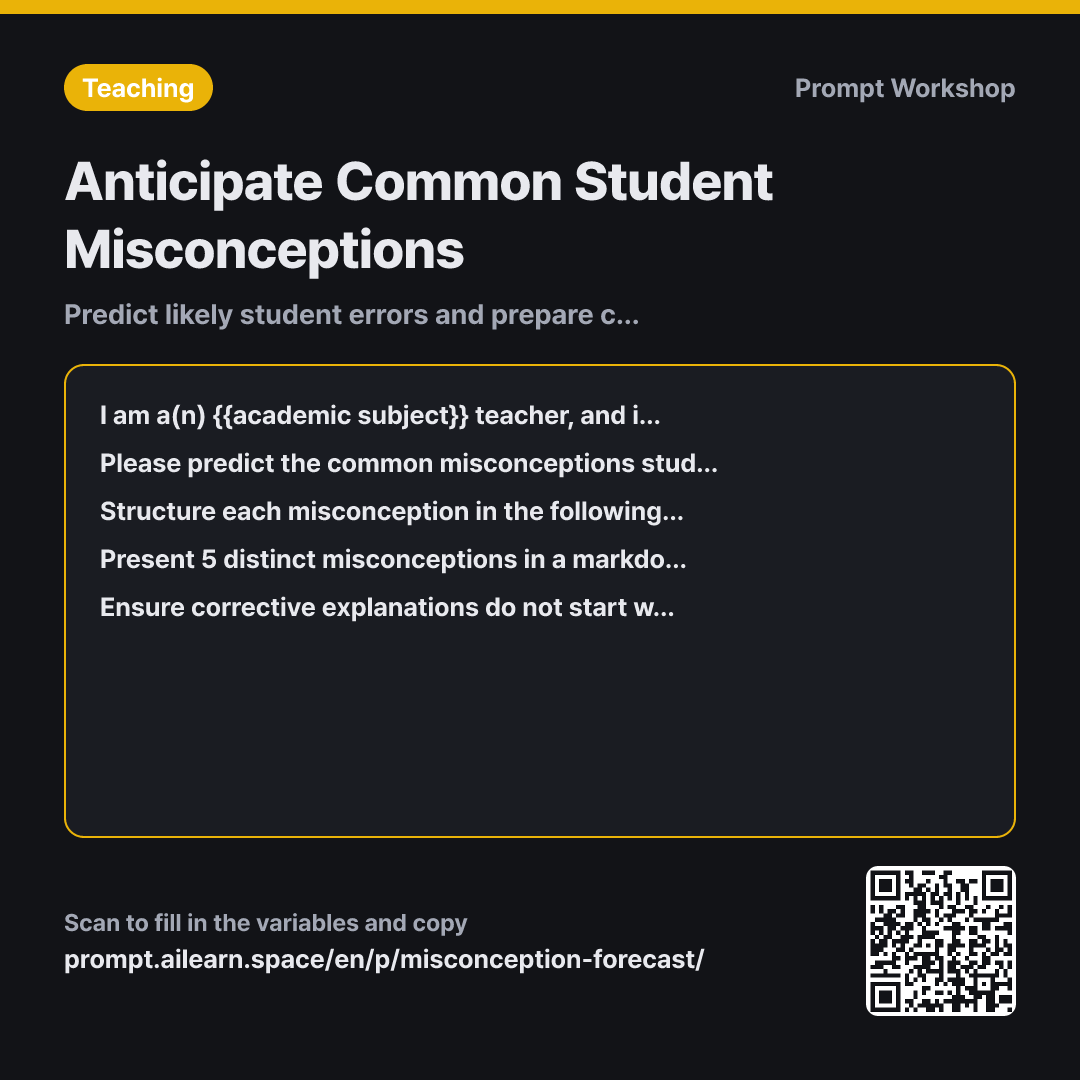
Why it is written this way
Preparing a lesson by only focusing on correct answers leaves you unprepared when a student offers an unexpected response. Anticipating student misconceptions is not just about having another answer ready; it is about preparing the right diagnostic questions when those errors surface. This prompt delivers both the common misunderstandings and ready-to-use pedagogical responses.
In the context paragraph, specifying "encountering this concept for the first time" and "successfully followed prerequisite lessons" narrows down the category of misconceptions. Students learning a fraction unit for the first time struggle with different hurdles compared to students reviewing it. Without these constraints, the AI defaults to a generic list of mistakes applicable across all grade levels.
Framing the task as "predict" rather than "explain" is deliberate. Asking to explain returns a theoretical summary of the concept, whereas asking to predict returns a practical classroom scenario. The third paragraph structures the prediction into discrete phases: student quote → underlying reasoning → diagnostic question → corrective explanation. This sequence prevents the AI from skipping the student's thought process and jumping directly to the correct answer.
The third column in the format is the most valuable part of this table. Misconceptions remain invisible until students articulate them, so having a targeted diagnostic question allows teachers to surface them mid-lesson. Selecting the primary misconception below the table provides focus; attempting to fix five misconceptions in a single class period often results in none being resolved.
The final paragraph requires validating the student's partial logic to generate language directly usable in the classroom. Starting an intervention with "You are wrong" stifles further inquiry. Finally, instructing the AI not to cite research prevents it from inventing fabricated studies or percentages.
Unfamiliar terms? See Aha AI: hallucination, chain-of-thought
Compared with a bad example
Tell me common mistakes students make when dividing fractions.
This prompt produces a superficial checklist of mechanical errors, such as "forgetting to invert the denominator." Computational mistakes are often mere slips rather than deep conceptual misconceptions, meaning re-explaining rarely prevents repeated errors. Without the student's underlying reasoning, the teacher's intervention defaults to a generic "let's try that again," leaving no method to diagnose the root confusion during class.
Variations
Diagnosing Causes from Student Assessment Results
Based on a recent quiz on "{{main central topic}}" in {{academic subject}}, multiple students made the exact same error on a specific problem. Please identify 3 distinct conceptual misunderstandings that could lead to this result.
For each possibility, provide one follow-up diagnostic question to test whether that specific misunderstanding is present. Design the diagnostic questions so that each misunderstanding produces a distinctly different answer.
Use this variant for post-lesson diagnosis. Generating multiple potential root causes alongside targeted test questions allows you to quickly verify student thinking at the start of the next session.
Designing a Discovery Activity to Resolve Misconceptions
Select one prominent misconception students frequently encounter during {{academic subject}} lessons on "{{main central topic}}", and design a 15-minute activity that allows students to discover and resolve this misconception on their own.
Structure the activity around student prediction and verification rather than direct teacher instruction. Divide it into three stages: Prediction → Verification → Discussion on Discrepancies. For each stage, include the teacher's guiding prompts and required materials.
Misconceptions are difficult to correct through explanation alone; this variant reframes the lesson into an active discovery exercise where students directly observe why their initial predictions failed.
Related prompts
Last updated 2026-09-02 · Found a mistake? Let us know